Owner’s manual
 Error Codes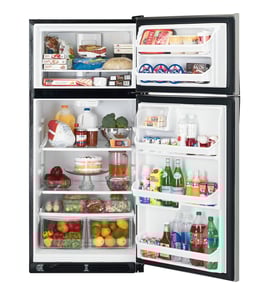



What is a fridge with freezer on top called?
A fridge with the freezer on top is called a top-freezer refrigerator (also commonly called a top-mount refrigerator). Your Kenmore model 79568033214 is this style: the freezer compartment is above the fresh-food compartment, with separate side-swing doors.
Common names you’ll see
- Top-freezer refrigerator
- Top-mount refrigerator
- Freezer-on-top refrigerator
- Traditional two-door refrigerator
How to identify it quickly
Use these simple checks to confirm you have a top-freezer design:
- The freezer door is the upper door
- The refrigerator (fresh-food) door is the lower door
- Both doors typically swing open from the side (not a pull-out drawer)
- The evaporator cooling system is designed to cool the freezer first, then send cold air down to the refrigerator section
Top-freezer vs. other common refrigerator styles
| Style | Freezer location | Typical door layout | Common benefit |
|---|---|---|---|
| Top-freezer (top-mount) | Top | Two swing doors | Simple, efficient design |
| Bottom-freezer | Bottom | Upper swing door + lower drawer | Easier access to fresh food |
| Side-by-side | Left side | Two tall swing doors | Narrow door swing clearance |
| French door | Bottom | Two upper swing doors + lower drawer | Wide fresh-food access |
Why it matters
Knowing the refrigerator style helps us match the right parts and troubleshooting steps for your Kenmore 79568033214, especially for airflow, defrost issues, and door-related problems. For model-specific features and compartment layout details, use the 79568033214 owner's manual.
Last updated: January 2026
Which is better, top mount or bottom mount refrigerator?
For most households, neither style is universally “better”; it depends on how you use your refrigerator. A top-mount like Kenmore 79568033214 typically costs less and is efficient, while a bottom-mount puts fresh food at eye level for easier daily access. For model-specific features and care tips, use the 79568033214 owner's manual.
Quick comparison: top-mount vs bottom-mount
| Feature | Top-mount (freezer on top) | Bottom-mount (freezer on bottom) |
|---|---|---|
| Fresh food access | Lower shelves require more bending | Most-used items are at eye level |
| Freezer access | Easy to reach | Often requires bending or pull-out drawer |
| Typical price | Usually lower | Usually higher |
| Organization | Simple layout | Often more drawers/baskets |
| Best for | Budget, smaller kitchens, basic storage | Heavy fresh-food use, better ergonomics |
When a top-mount is the better choice
A top-mount refrigerator is usually the best fit when you want simple, reliable storage and you use the freezer often.
- You want a lower upfront cost.
- You use frozen foods frequently and want the freezer at chest/eye level.
- You prefer a straightforward layout with fewer drawers and mechanisms.
- You have limited kitchen space and want a classic footprint.
- You want fewer “extras” to maintain.
When a bottom-mount is the better choice
A bottom-mount refrigerator is usually the best fit when you access fresh food many times per day.
- You cook often and want produce, dairy, and leftovers at eye level.
- You want more fresh-food organization (bins, drawers, adjustable shelving).
- You don’t mind bending to access the freezer drawer.
- You want a layout that reduces stooping for everyday items.
Why it matters
Choosing the right layout reduces door-open time and improves day-to-day convenience. That can help temperature stability, food freshness, and even wear on door components like the door switch and gaskets over time.
Last updated: January 2026
Does anyone make a 33 inch wide refrigerator?
Yes. Several major brands make 33-inch wide refrigerators, and they are a practical “in-between” size when a 30-inch model is too small but a 36-inch model will not fit. For fit and airflow, confirm your exact opening requirements in the 79568033214 owner's manual.
What “33-inch wide” usually means (and what to measure)
Manufacturers often list a nominal width (like 33 inches), but the actual cabinet width can vary slightly, and doors and handles can add more.
Measure these before you shop:
- Cabinet opening width (wall to wall at the front)
- Depth available (including door swing and handle clearance)
- Height to cabinets or soffit
- Ventilation space needed around the refrigerator
- Door swing path (will doors hit a wall, island, or pantry door?)
Common 33-inch refrigerator styles you will see
33-inch models show up most often in these configurations:
- French door
- Side-by-side
- Bottom-freezer
- Some top-freezer models (less common)
| Style | Typical fit benefit | Typical tradeoff |
|---|---|---|
| French door | Wide shelves, good fresh-food access | Needs door-swing clearance |
| Side-by-side | Narrow door swing, easy freezer access | Narrower shelf width |
| Bottom-freezer | Fresh food at eye level | Freezer drawer needs pull-out space |
| Top-freezer | Simple layout, often lower cost | Fewer premium features |
Why it matters for your Kenmore 79568033214 space
Even if you are replacing a Kenmore 79568033214 top-mount refrigerator, the “same width” does not guarantee the same fit. Small differences in hinge design, handle depth, and required airflow can change whether the doors open fully and whether the unit runs efficiently.
For odor control and a clean start after moving or replacing a refrigerator, we also recommend reviewing how to get rid of refrigerator smells.
Last updated: January 2026
How to tell cubic feet of Kenmore refrigerator by model number?
For Kenmore model 79568033214, the most reliable way to get the refrigerator’s cubic feet is to look up the capacity in the specifications section of the 79568033214 owner's manual. If you cannot access the spec page quickly, you can estimate capacity by measuring the usable interior space and converting cubic inches to cubic feet.
Best ways to find cubic feet (in order)
- Check the specifications section in the 79568033214 owner's manual (capacity is typically listed as “cu. ft.”).
- Look for a rating label inside the fresh food compartment (often on a side wall, ceiling, or behind a crisper drawer); it sometimes lists capacity.
- Use the model number to confirm you are searching the correct product family: Kenmore 795 models are commonly built by LG, so specs are usually consistent once the full model is matched.
- Estimate capacity by measuring the interior (helpful if labels are missing).
How to estimate cubic feet by measuring
- Empty the compartment enough to measure the usable interior.
- Measure width x height x depth in inches for:
- Fresh food section
- Freezer section
- Multiply to get cubic inches, then divide by 1,728.
Quick conversion table
| What you have | What to do | Result |
|---|---|---|
| Cubic inches | Divide by 1,728 | Cubic feet |
| Inches (W x H x D) | Multiply W x H x D | Cubic inches |
Example: 28 in x 30 in x 18 in = 15,120 cubic inches; 15,120 ÷ 1,728 = 8.75 cu. ft. (for that section).
Why the model number alone is not a dependable “capacity code”
Some Kenmore model families have patterns where certain digits loosely correlate to size, but it is not consistent across all series. For 79568033214, the manual/spec listing is the accurate source, and measuring gives a solid real-world estimate.
Related help that often comes up with capacity questions
- If you are checking capacity because cooling seems weak, confirm airflow and fan operation; see how to fix your evaporator cooling fan.
- If you are checking capacity because of water or ice issues, filter and supply problems are common; see how to replace the water filter in a Kenmore refrigerator.
Last updated: January 2026