Installation guide
 Owner’s manual
 Error Codes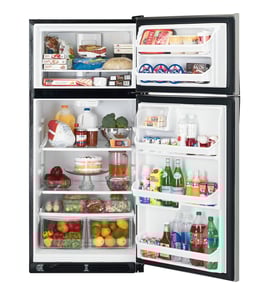



What are the disadvantages of a top mount fridge?
Top-mount refrigerators like the Frigidaire FFHI1831QE1 are reliable and efficient, but the main disadvantages are convenience and organization: fresh-food items sit lower (more bending), freezer access is higher, and many top-mount designs offer fewer built-in storage and dispenser features than premium layouts.
Common disadvantages (what most owners notice)
- More bending for daily use: the refrigerator section is below the freezer, so produce, drinks, and leftovers often require bending.
- Less “grab-and-go” organization: many top-mount models have fewer specialty zones and dividers than higher-end bottom-freezer or French door designs.
- Fewer dispenser options: top-mount units are less likely to include external water and ice dispensing.
- Freezer ergonomics: heavier frozen items can be awkward to lift down from the upper compartment.
- Door swing and clearance needs: you still need proper side, top, and rear clearances for airflow and service access.
How FFHI1831QE1 setup can reduce the downsides
We recommend using the storage features correctly so the most-used items are easiest to reach.
- Keep everyday items on the middle refrigerator shelves, not the crisper level
- Use crispers for produce only, and wrap high-odor items
- Avoid overpacking; airflow matters for even temperatures
- Level the cabinet so doors close and seal consistently
- If your model has an ice maker but no water hookup, keep the ice maker turned off
| Concern | What to do | Result |
|---|---|---|
| Bending for fresh food | Store daily items at eye or chest level | Faster access, less strain |
| Limited organization | Group foods by shelf and use bins/drawers consistently | Less searching, less waste |
| No dispenser convenience | Use a pitcher and ice bin strategy | Similar convenience without a dispenser |
Why it matters
Most “top-mount fridge problems” people feel day-to-day are really usability issues, not cooling performance. A good layout, correct leveling, and proper clearances help the FFHI1831QE1 run efficiently and keep temperatures stable.
Helpful references
- For leveling, clearances, and first-time setup steps, follow the FFHI1831QE1 installation guide.
- For storage tips (crispers, drawers) and operating guidance, use the FFHI1831QE1 owner’s manual.
Last updated: January 2026
Are top mount or bottom mount fridges better?
Top-mount and bottom-mount refrigerators are both good choices; the better option depends on how you use your Frigidaire FFHI1831QE1 and what matters most (ergonomics, freezer access, and energy use). In general, top-mount designs often use less energy, while bottom-mount designs put fresh food at eye level.
Quick comparison
- Choose top-mount if you want a simpler layout, easy freezer access, and typically lower energy use.
- Choose bottom-mount if you want less bending for everyday fresh-food items.
- Either style performs best when it has proper airflow clearances and a good door seal.
| Feature | Top-mount (like FFHI1831QE1) | Bottom-mount |
|---|---|---|
| Fresh-food access | Lower, more bending | Higher, less bending |
| Freezer access | Higher, easier reach | Lower drawer, more bending |
| Typical energy use | Often lower | Often slightly higher |
| Complexity | Often simpler | Often more complex |
What matters most for real-world performance
Installation and airflow
Even the “best” style struggles if it is installed too tight or in a hot spot. For top-mount refrigerators, we follow the clearance guidance in the installation guide.
- Leave space for airflow (sides/top and rear clearances)
- Avoid direct sunlight and nearby heat sources
- Use a grounded outlet (no extension cord)
- Keep the refrigerator level for proper door closing
Door sealing and temperature stability
A strong door seal helps any refrigerator style hold temperature and run less.
- Check that doors close fully on all sides
- Keep gaskets clean and flexible
- Avoid overloading door bins so the door sits flat
- If you see gaps, address alignment and gasket condition
Why it matters
The “better” refrigerator is the one that fits your daily habits and runs efficiently in your kitchen. For many homes, a top-mount like the FFHI1831QE1 is a practical, efficient choice, especially when installed with the right clearances and maintained with good door sealing.
Last updated: January 2026
What is the upper part of a fridge called?
On the Frigidaire FFHI1831QE1 top-mount refrigerator, the upper section is the freezer compartment (often called the freezer). It’s the coldest area of the appliance and is designed to keep foods frozen; many units also support an automatic ice maker.
Common names you’ll hear
- Freezer compartment
- Freezer section
- Upper freezer
- Freezer cabinet (less common)
- Freezer door (the door that seals the freezer opening)
What the upper freezer does (and what’s usually inside)
The freezer compartment is built to maintain freezing temperatures and circulate cold air. Depending on how your FFHI1831QE1 is equipped, it may also support ice production.
- Stores frozen foods long-term
- Helps maintain overall cooling balance through airflow
- May include an automatic ice maker connection and shutoff switch
- Relies on good door sealing and proper leveling for consistent temperatures
Quick reference: upper vs. lower sections
| Section | Common name | Primary purpose |
|---|---|---|
| Upper | Freezer compartment | Freezes and stores frozen food |
| Lower | Fresh food compartment | Keeps refrigerated foods cold (not frozen) |
Why it matters
Knowing the correct name helps when you’re ordering parts, following setup steps, or troubleshooting issues like frost buildup, warm temperatures, or doors not sealing.
If you’re setting up or adjusting the refrigerator, follow the leveling and door-alignment guidance in the FFHI1831QE1 installation guide; proper tilt helps doors close and seal correctly.
Last updated: January 2026
What is the most common problem with a Frigidaire refrigerator?
Cooling problems are the most common issue we see with Frigidaire refrigerators, including the FFHI1831QE1. Typical symptoms are warm fresh-food temps, soft ice, or long run times; the most frequent causes are restricted airflow (dirty coils or blocked vents), a weak evaporator fan, or a door that is not sealing tightly. See the FFHI1831QE1 owner's manual for model-specific operating checks and “common occurrences” troubleshooting.
Quick checks that fix many “not cold enough” complaints
- Confirm the temperature control is not set to “0” or “OFF” and allow 24 hours after any adjustment.
- Make sure the refrigerator is plugged in firmly; check the breaker or a 15-amp time-delay fuse.
- Do not overpack; keep air vents inside the cabinet clear so cold air can circulate.
- Clean dust from the condenser area (unplug first); dirty coils commonly cause poor cooling.
- Check door closing and gasket contact all the way around the door.
Common causes and what they usually look like
| Symptom | Most likely area | What to check first |
|---|---|---|
| Fresh food warm, freezer OK | Airflow from freezer to fridge | Blocked vents, frost buildup, fan noise |
| Both sections warm | Power, controls, sealed system | Control setting, condenser airflow, compressor running |
| Frost on back wall of freezer | Defrost system | Heavy frost, reduced airflow, warming fridge |
| Moisture or sweating near door | Door seal | Gasket gaps, door alignment, frequent openings |
Parts that often relate to these problems (when diagnosis points there)
- If you hear squealing, grinding, or no fan airflow from the freezer area, the evaporator fan system is a common suspect; the motor for this model is refrigerator motor 242077705.
- If you have heavy frost and airflow loss, a defrost failure is common; the heater used in the defrost circuit is refrigerator defrost heater 242044008.
Why it matters
A refrigerator that cannot move heat efficiently runs longer, wastes energy, and struggles to hold safe food temperatures. Catching airflow and sealing issues early also helps prevent frost buildup and temperature swings.
Last updated: January 2026