Owner’s manual
 Error Codes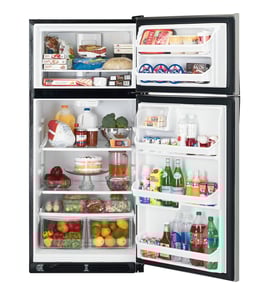
How to figure out GE fridge model?
To figure out your GE refrigerator model, we look for the model and serial number label on the cabinet (usually inside the fresh food section). For your GE GTS22KBPDRBB top-mount refrigerator, the exact label locations and examples are shown in the GTS22KBPDRBB owner's manual.
Check these common spots first (use a flashlight and look along the cabinet walls):
- Inside the refrigerator compartment on a side wall near the front
- On the ceiling area near the light shield/control housing
- Around the crisper drawer area (side wall or frame)
- On the cabinet frame behind the door gasket line (open the door wide and look along the edge)
- Less commonly, on the back exterior near the lower service area
Record the information exactly as printed so parts match correctly.
- Model number (example format: GTS22KBPDRBB)
- Serial number (letters and numbers)
- Any revision or suffix characters if shown
| Item | What it tells us | Used for |
|---|---|---|
| Model number | The exact design and parts list for your refrigerator | Ordering correct replacement parts (thermostat, fan motor, gasket) |
| Serial number | Production run and date coding | Service history, warranty paperwork, and compatibility checks |
GE often uses similar-looking cabinets across multiple top-mount models, but internal parts can differ. Using the exact GTS22KBPDRBB model number helps us match the right components, such as the refrigerator temperature control thermostat WR09X10104 or refrigerator temperature sensor WR55X10025, the first time.
Last updated: February 2026
Is a top mount or bottom mount fridge better?
A top-mount refrigerator like the GE GTS22KBPDRBB is better when you use the freezer often and want the lowest upfront cost; a bottom-mount is better when you use fresh food most and want the refrigerator section at eye level. The “better” choice depends on your daily habits and kitchen layout.
| Feature | Top-mount (freezer on top) | Bottom-mount (freezer on bottom) |
|---|---|---|
| Best for | Frequent freezer use | Frequent fresh-food use |
| Ergonomics | More bending for fridge items | Less bending for fridge items |
| Freezer access | Easy reach, simple shelves | Often a pull-out drawer |
| Typical cost | Usually lower | Usually higher |
| Organization | Straightforward, fewer drawers | More bins and drawer-style storage |
- If you open the freezer many times a day, a top-mount layout is usually more convenient.
- If you cook with fresh ingredients daily, a bottom-mount keeps the refrigerator shelves and bins closer to eye level.
- If you store bulky frozen items (pizza boxes, large bags), check whether a drawer-style freezer fits your storage style.
- If you have limited kitchen clearance, consider door swing and how often you need to fully open each door.
- If you want simpler maintenance and fewer moving storage parts, top-mount designs are often simpler.
Layout affects comfort and food preservation habits. When the refrigerator section is easier to access, you tend to keep doors open for less time, which helps temperatures recover faster and can reduce moisture issues and food temperature swings.
If you are comparing based on real-world usability, use the shelf and bin adjustment guidance in the owner's manual to set up the refrigerator and freezer compartments for how you actually store food. Adjustable shelving can make a top-mount feel significantly more “custom” without changing the fridge style.
Last updated: February 2026
What are the disadvantages of a top mount fridge?
Top-mount refrigerators like the GE GTS22KBPDRBB put the freezer on top and the fresh-food section below, so the main disadvantage is convenience: you bend more to reach everyday items. They also typically offer fewer premium organization and dispenser features than many bottom-freezer designs.
- More bending for fresh food: the refrigerator compartment sits lower, so produce, deli items, and drinks are less eye-level.
- Less “grab-and-go” organization: many top-mount layouts have simpler bins and fewer specialty drawers.
- Fewer built-in dispenser options: top-mount models often skip through-the-door ice and water.
- Freezer access can be tight: a top shelf can make it harder to see items buried in the back.
- More temperature swings with frequent door openings: opening doors often can increase run time (normal for modern refrigerators).
Top-mount refrigerators are popular because they are straightforward and efficient for many kitchens.
| Feature | Top-mount refrigerator | Bottom-freezer refrigerator |
|---|---|---|
| Fresh-food access | Lower, more bending | Higher, less bending |
| Freezer access | Eye-level | Lower drawer style |
| Typical features | Simpler | More premium options |
| Service complexity | Often simpler | Often more complex |
- Keep daily-use items on the upper refrigerator shelves to reduce bending.
- Avoid blocking air vents with food; it can cause freezing near the controls.
- Set shelves and bins to match how you shop; the shelves are adjustable.
- Allow proper airflow around the cabinet (clearances matter for performance).
- If doors do not self-close well, level the unit by adjusting the rollers.
Most “disadvantages” come down to ergonomics and features, not basic cooling. When a top-mount is installed with proper clearances and organized well, it maintains stable temperatures and runs normally even if it cycles longer during hot weather or frequent openings.
For model-specific layout and adjustment steps (shelves, rollers, clearances), use the GTS22KBPDRBB owner's manual.
Last updated: February 2026
Is GE Cafe considered high end?
Yes. GE Café is widely considered a high-end (premium) line within the GE brand; it’s positioned above standard GE models and focuses on upgraded design, finishes, and feature sets compared with typical top-mount refrigerators like the GE GTS22KBPDRBB.
GE organizes products into different tiers; Café sits in the premium tier and is typically compared with other upscale lines.
- GE (standard): core features and value-focused designs
- GE Café (premium): elevated styling, more feature options, and higher-end finishes
- GE Monogram (luxury): built-in and luxury-focused designs (often the top tier)
When customers call a line “high end,” they usually mean a combination of these factors:
- More design-forward styling (handles, finishes, coordinated suites)
- More convenience features (controls, lighting, storage options)
- Higher price point than standard lines
- More configuration choices across the product lineup
For your GE GTS22KBPDRBB top-mount refrigerator, the “Café” label does not change what parts you need; parts must match the exact model number and configuration. We recommend using the model-specific diagrams and procedures in the owner's manual when troubleshooting or replacing components.
| Item | What it tells you | What to use for parts |
|---|---|---|
| “GE Café” | Product line and feature tier | Not enough by itself |
| GTS22KBPDRBB | Exact refrigerator identity | Always use this |
| Part ID (example) | Exact replacement component | Match by ID/model |
If you’re diagnosing a cooling or temperature complaint on this model, a common related component is the refrigerator temperature sensor WR55X10025.
Last updated: February 2026
What is the most common problem with GE profile refrigerators?
The most common issue we see with GE top-mount refrigerators like model GTS22KBPDRBB is not cooling properly (fresh food warm, freezer warming, or temperatures swinging). This usually traces back to airflow problems, a failing fan, or a temperature-sensing/control issue; use the GTS22KBPDRBB owner's manual to confirm normal settings and checks.
- Refrigerator warm, freezer OK: restricted airflow, evaporator fan issue, or control/thermostat problem
- Freezer warm and refrigerator warm: condenser airflow problem, sealed-system/compressor start issue, or dirty condenser area
- Temps fluctuate: sensor or thermostat drifting out of range
- Unusual buzzing or rattling: condenser fan or evaporator fan blade contacting ice/debris
- Water under drawers or on floor: defrost drain restriction (common on many top-mount designs)
- Verify temperature controls are set correctly and vents are not blocked (avoid packing food tight against air returns).
- Listen for fans: you should typically hear a fan running when the compressor is running.
- Clean dust from the condenser area and confirm the condenser fan runs.
- Check door seals for gaps and make sure doors close fully.
- If temperatures are inconsistent, test the sensor and control components.
| Problem clue | Likely part to inspect | Example part on this page |
|---|---|---|
| Temps swing, unit runs too long or not long enough | Temperature sensing | Refrigerator temperature sensor WR55X10025 |
| Compressor clicks, struggles to start | Start components | Refrigerator compressor start relay WR07X10055 |
| Warm cabinet, noisy rear, poor heat removal | Condenser airflow | Refrigerator condenser fan WR60X10220 |
| Fan noise inside freezer, weak airflow | Fan blade or mounting | Refrigerator evaporator fan blade WR60X10205 |
A refrigerator that is not cooling correctly can lead to food spoilage and can also overwork the compressor. Catching airflow, fan, or sensor issues early often prevents bigger repairs.
Last updated: February 2026