Installation guide
 Owner’s manual
 Error Codes


How can I tell how many cubic feet my Kenmore refrigerator is?
For your Kenmore 10656642500 side-by-side refrigerator, the most reliable way to confirm cubic feet is to check the model’s specifications in the owner's manual. If you need a quick estimate, measure the usable interior space and convert cubic inches to cubic feet.
Fast ways to find cubic feet
- Check the specs: Look for capacity listed in the owner's manual.
- Find the rating plate: Many refrigerators list capacity on the rating plate inside the fresh food section (often on a side wall or near the crisper area).
- Measure and calculate: Measure the usable interior height, width, and depth (in inches), then convert.
- Use compartment totals: If you measure refrigerator and freezer sections separately, add them together.
- Measure around fixed parts: Measure open space, not the outside cabinet size.
How to calculate cubic feet (measurement method)
- Empty enough items to measure safely.
- Measure interior height, width, and depth in inches.
- Multiply:
H x W x D = cubic inches. - Divide by 1,728 to convert to cubic feet.
Quick conversion table
| What you have | What to do | Result |
|---|---|---|
| Interior inches (H x W x D) | Multiply | Cubic inches |
| Cubic inches | Divide by 1,728 | Cubic feet |
Tips so your estimate is accurate
- Measure usable space (don’t include door bins, thick insulation walls, or areas blocked by the ice maker housing).
- If shelves are adjustable, measure the full interior cavity, then subtract obvious non-usable areas (like large duct towers).
- Round to the nearest tenth; most refrigerator capacities are listed that way.
Why it matters
Cubic feet helps you compare storage capacity, choose the right replacement shelves and bins, and set realistic expectations for airflow and food loading (overpacking can reduce cooling performance).
Last updated: February 2026
What's the average lifespan of a Kenmore refrigerator?
Kenmore refrigerators typically last 12 to 15 years. For a Kenmore 10656642500 side-by-side refrigerator, regular maintenance (cleaning condenser coils, keeping door gaskets sealing, and maintaining airflow) is what most often determines whether you land closer to 12 years or closer to 15+.
Typical lifespan and what affects it
Most refrigerators wear out from heat stress, poor airflow, and door-seal issues more than from “age” alone.
Common factors that shorten lifespan:
- Dirty condenser coils causing the compressor to run hotter and longer
- Worn or leaking door gaskets letting warm, moist air in
- Overpacked compartments blocking vents and airflow
- Frequent door openings and warm food loads
- Ice maker and water system leaks that create corrosion or ice buildup
Maintenance checklist (best return for the effort)
We recommend these habits for Kenmore side-by-side models like 10656642500:
- Vacuum and brush condenser coils regularly (more often with pets)
- Keep the doors level so they close fully and don’t “bounce” open
- Clean sticky gaskets with mild soap and water; dry completely
- Leave space around interior vents so cold air can circulate
- Replace water filters on schedule to protect the water system
Repair vs. replace: a practical guide
Use age plus symptoms to decide where to put your money.
| If your refrigerator is... | And you’re seeing... | Usually makes sense to... |
|---|---|---|
| Under 10 years | Minor issues (leaks at fittings, ice maker not filling) | Repair |
| 10 to 15 years | Repeated cooling problems or heavy frost | Diagnose carefully, then decide |
| Over 15 years | Sealed-system or compressor symptoms | Consider replacement unless repair is clearly cost-effective |
Why it matters
A refrigerator can run “okay” while slowly losing efficiency. Keeping coils clean and gaskets sealing reduces compressor runtime, helps temperatures stay stable, and often adds years of service life.
For model-specific care and cleaning steps, follow the maintenance guidance in the owner's manual.
Last updated: February 2026
What does er if mean on a Kenmore refrigerator?
On Kenmore model 10656642500, the ER IF code points to a problem with the ice maker fan (ice compartment/evaporator fan airflow). When that fan is blocked by frost, jammed, or not running, the refrigerator can’t move cold air correctly to the ice area, so the control reports ER IF. See the troubleshooting and airflow guidance in the owner's manual.
What you’ll usually notice
- Ice production slows down or stops
- Ice clumps in the bin or cubes look wet
- Warmth around the ice chute or dispenser area
- Unusual fan noise from the freezer (or no fan sound at all)
- Freezer temperature may drift warmer than normal
Quick checks we recommend (before replacing parts)
- Power reset: Unplug the refrigerator (or switch off the breaker) for 2 minutes, then restore power.
- Check for blocked vents: Make sure packages are not blocking freezer air vents; blocked airflow prevents proper cooling and can trigger cooling-related problems.
- Look for frost buildup: If you see heavy frost on the back freezer panel or around the ice area, the fan can’t move air.
- Confirm doors seal and close: A door left ajar or a poor seal can cause moisture, frost, and fan interference.
- Let temperatures stabilize: After changes, give the unit time to recover; normal cooling changes do not happen instantly.
Parts that commonly relate to ER IF on this model
If the fan is not running because of a defrost issue or airflow restriction, these parts are often involved:
| Symptom | Most likely area | Example part on this model page |
|---|---|---|
| Heavy frost, fan hitting ice | Defrost system | Refrigerator defrost bi-metal WPW10225581 |
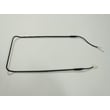
| Frost returns quickly after manual defrost | Defrost heater circuit | Refrigerator heater WP2323198 |
| Ice maker not filling and no ice | Water supply to ice maker | Refrigerator inlet valve W10408179 |
Why it matters
The ice fan is part of the refrigerator’s airflow system. When airflow is blocked (food blocking vents) or frost builds up, temperatures become unstable and ice production suffers. The manual specifically warns that blocked vents prevent airflow and proper temperature control.
Last updated: February 2026
Why is the ice maker not working on my Kenmore side by side refrigerator?
If the ice maker on your Kenmore 10656642500 side-by-side refrigerator isn’t making ice, the most common causes are the ice maker being switched off (wire shutoff arm up), the freezer not being cold enough yet, or the water supply being turned off or restricted. Confirm the basic settings first using the owner's manual.
Quick checks (most fixes start here)
- Make sure the wire shutoff arm is down (ON). If it is up, the ice maker is off.
- If the refrigerator was just installed or reconnected, allow 24 hours for ice production to begin and up to 3 days to fill the ice container.
- Confirm the water line shutoff valve to the refrigerator is fully open.
- Check for an ice cube jam in the ice maker ejector area; clear any stuck cubes.
- Verify the freezer temperature is cold enough; if ice is slow, adjust the freezer control slightly colder.
What to do if water dispenses but the ice maker won’t fill
Water at the dispenser does not always mean the ice maker is getting proper flow. A weak fill can point to a valve issue, a restriction, or an internal ice maker problem.
- Inspect the fill area for ice blockage (a frozen fill tube can stop filling).
- If the ice mold is dry and the water supply is on, the water inlet valve can be the failure point.
- If the mold fills but cubes do not harvest, the ice maker assembly can be worn.
Parts that commonly solve “no ice” on this model
| Symptom | What it often points to | Part on this page |
|---|---|---|
| No water entering ice maker | Water inlet valve not opening fully | Refrigerator inlet valve W10408179 |
| Repeated no-ice condition with good water supply | Ice maker mechanism not cycling | Ice maker assembly - refrigerator ice maker by whirlpool 4317943 |
| Frost buildup and warm freezer affecting ice | Defrost issue causing airflow problems | Refrigerator defrost bi-metal WPW10225581 |
Why it matters
An ice maker depends on three things working together: freezer temperature, water supply, and ice maker on/off control. Fixing the simple items first prevents unnecessary part replacement and gets ice production back faster.
Last updated: February 2026
What are the most common problems with Kenmore refrigerators?
The most common issues we see on Kenmore refrigerators like model 10656642500 are cooling problems, ice maker or dispenser trouble, water leaks, excess frost, and unusual noises. Many of these start with airflow restrictions, dirty condenser coils, or doors that are not sealing and closing correctly (all covered in the owner's manual).
Common problems and what usually causes them
- Not cooling or temperature too warm: blocked air vents, frequent door openings, controls set incorrectly, or a cooling system problem
- Ice maker not making ice or not enough ice: freezer not cold enough, ice maker turned off, or water supply issue
- Water dispenser issues: newly installed unit, water not used recently (first glass is warmer), or supply/valve problems
- Water leaks or puddles: humidity, defrost water evaporation timing, or a water line connection issue
- Noisy operation or runs too much: normal operating sounds, dirty condenser coils, or doors not fully closed
Quick checks we recommend first (fast, no parts)
- Confirm doors close firmly and nothing is preventing closure.
- Make sure air vents are not blocked in either compartment.
- If the unit has digital controls, turn it OFF then ON to reset.
- Clean the condenser coils (dirty coils make the compressor run longer).
- For ice maker complaints, allow 24 hours after hookup for ice production to begin and up to 3 days to fill the bin.
Parts that commonly solve these symptoms on 10656642500
If your troubleshooting points to a failed component, these are common repair paths for this model:
| Symptom | Likely system | Example part for this model |
|---|---|---|
| No ice or weak ice production | Ice maker assembly | Ice maker assembly - refrigerator ice maker by whirlpool 4317943 |
| No water to dispenser or ice maker | Water supply valve | Refrigerator inlet valve W10408179 |
| Heavy frost, warm temps, poor airflow | Defrost system | Refrigerator defrost bi-metal WPW10225581 and refrigerator heater WP2323198 |
Why it matters
Cooling, ice, and leak complaints often share the same root causes: restricted airflow, poor heat transfer from dirty coils, or doors that do not seal. Fixing those basics first prevents unnecessary part replacement and helps the refrigerator maintain stable temperatures.
Last updated: February 2026