Owner’s manual
 Error Codes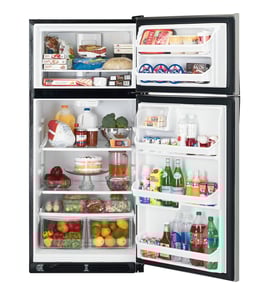




Is top mounted refrigerator better than bottom mounted?
A top-mount refrigerator like the Whirlpool WRT519SZDT01 is better when you want strong energy efficiency, a lower purchase cost, and simple, reliable storage. A bottom-mount is better when you want fresh-food items at eye level and easier access to the refrigerator section.
Quick comparison (top-mount vs bottom-mount)
| Feature | Top-mount (freezer on top) | Bottom-mount (freezer on bottom) |
|---|---|---|
| Fresh-food access | You bend more | More eye-level access |
| Freezer access | Easier, higher | Easier for pull-out drawers |
| Energy use (typical) | Often lower | Often slightly higher |
| Cost and complexity | Usually lower and simpler | Usually higher and more complex |
| Best for | Budget, efficiency, fewer features | Convenience, organization |
When a top-mount is the better choice
- You want a straightforward Whirlpool refrigerator with fewer moving parts.
- You open the freezer often (frozen meals, ice trays, bulk items).
- You prefer a lighter door and simpler layout.
- You want good performance in normal indoor temperatures (your manual notes indoor use and a preferred room range for best efficiency).
- You want easier placement flexibility; the manual lists clearance guidance for ventilation and door swing.
When a bottom-mount is the better choice
- You use the refrigerator section far more than the freezer.
- You want wide, pull-out freezer drawers for organization.
- You store lots of fresh produce and want less bending.
Why it matters
“Better” depends on how you use the refrigerator day to day. Layout affects comfort (bending vs eye-level access), energy use, and even how long doors stay open while you search for items, which impacts temperature stability.
Tip for getting the best performance from your current top-mount
Use the clearances and door adjustment guidance in the WRT519SZDT01 owner's manual so airflow stays strong and the doors seal correctly; both help the refrigerator cool efficiently.
Last updated: February 2026
What is the lifetime of a Whirlpool refrigerator?
A Whirlpool refrigerator typically lasts 13 years with normal household use and basic maintenance. For your Whirlpool WRT519SZDT01 top-mount refrigerator, keeping airflow clear, temperatures set correctly, and door seals tight helps you reach that expected service life; see the owner's manual for model-specific care and operating guidance.
Typical lifetime and what affects it
Most Whirlpool refrigerators fall into a similar lifespan range, but real-world life depends heavily on usage and conditions.
- Door openings and warm kitchens increase run time
- Dirty condenser area (where applicable) makes the sealed system work harder
- Weak door gaskets cause temperature swings and moisture issues
- Power issues (outages, tripped breakers) stress electrical components
- Overloading shelves can block vents and reduce cooling performance
Maintenance that helps you get the full lifespan
These steps reduce wear on the compressor, fans, and defrost system.
- Keep interior air vents unblocked so cold air can circulate
- Confirm the controls are set to recommended temperatures (not always “coldest”)
- Clean spills promptly to prevent odors and corrosion
- Check door closing and alignment; the door should seal without forcing it
- If you have an ice maker or water line, fix slow fills and leaks quickly
Quick reference: what “normal” looks like
| Item | Typical target | Why it matters |
|---|---|---|
| Expected service life | 13 years | Helps plan repair vs. replace decisions |
| Cool-down after install | 24 hours | Prevents false “not cooling” symptoms |
| Temperature strategy | Stable, not coldest | Reduces run time and icing risk |
Why it matters
Knowing the typical lifetime helps you decide when a repair is worth it. For example, if cooling is inconsistent, issues like a failing evaporator fan motor can shorten compressor life; replacing a worn component such as the refrigerator evaporator fan motor WP2315539 can restore airflow and reduce strain on the sealed system.
Last updated: February 2026
What is the most common problem with a Whirlpool refrigerator?
The most common Whirlpool refrigerator problem is a cooling issue: the fresh food section gets warm, the freezer temperature drifts, or temperatures swing. On the Whirlpool WRT519SZDT01, we start with basic operation checks and airflow, then test common cooling components listed in the WRT519SZDT01 owner's manual.
Most common symptoms we see (and what they usually point to)
- Refrigerator not running at all: power supply, control settings, start components
- Freezer cold but refrigerator warm: restricted airflow, evaporator fan issue, frost buildup
- Frost or ice buildup on the back wall: defrost system problem
- Water under the refrigerator: defrost drain restriction or water line/valve issue
- Clicking, humming, or intermittent running: start device or compressor-related issue
Quick checks before replacing parts
- Confirm power and controls: Make sure the unit is plugged into a grounded 3-prong outlet and the controls are ON (the manual troubleshooting section walks through this).
- Allow proper cool-down time: After a new install or power outage, allow 24 hours for full cooling.
- Check airflow: Do not block vents with food packages; poor airflow can mimic a “not cooling” failure.
- Listen for the evaporator fan: In many top-mount designs, a failed fan causes a warm refrigerator compartment.
Parts that commonly cause “not cooling” complaints on this model
If the basic checks look good, these are frequent culprits for Whirlpool top-mount cooling problems:
| Symptom | Likely area | Example part on this model |
|---|---|---|
| Fridge warm, freezer not consistent | Evaporator airflow | Refrigerator evaporator fan motor WP2315539 |
| Temps inaccurate or cycling oddly | Temperature sensing | Refrigerator thermistor (model-specific options vary) |
| Clicking, won’t start, short cycling | Start components | Refrigerator start device WPW10448874 |
| No cooling at all, sealed system concerns | Compressor | Refrigerator compressor W10233960 |
Why it matters
Cooling problems can spoil food quickly and also force the compressor to run longer than normal. Catching airflow, defrost, or sensing issues early often prevents bigger, more expensive failures.
For additional troubleshooting patterns (including display or diagnostic codes when applicable), we use the Whirlpool refrigerator error codes.
Last updated: February 2026