Owner’s manual

Can I add sawstop to any table saw?
No. You can’t add the SawStop brake system to just any table saw, including the Craftsman 113298150 10-inch table saw, because that safety technology is built into SawStop saws as an integrated design (mechanical, electrical, and structural) rather than a bolt-on accessory.
What you can do instead (safer options)
If you want to reduce kickback and blade-contact risk on a conventional table saw, we recommend focusing on proven guarding, alignment, and work practices.
- Use the blade guard and splitter/riving-knife style hardware your saw was designed for
- Keep the fence parallel to the blade and miter slots to reduce binding
- Use push sticks/push blocks and keep hands out of the blade path
- Use featherboards or hold-downs to control the workpiece
- Use the correct blade for the cut (rip vs. crosscut) and keep it sharp
- Stand slightly to the side of the cut line to reduce kickback exposure
Quick comparison: integrated brake vs. traditional safety features
| Safety approach | What it does | What it does not do |
|---|---|---|
| SawStop-style brake (integrated) | Detects contact and stops the blade rapidly | Does not prevent kickback or poor setup |
| Guard + splitter/riving knife | Helps keep hands away and reduces kerf closing | Does not stop the blade on contact |
| Alignment + technique | Reduces binding, burning, and kickback | Does not replace guarding |
Why it matters
On older 10-inch table saw designs like the Craftsman 113298150, the guard system, arbor area, and switch wiring are engineered as a set. Trying to retrofit a brake-style system typically creates new hazards (clearance issues, unreliable triggering, or compromised guarding) and costs more than it’s worth.
Where to check your saw’s original safety setup
Use the 113298150 owner's manual to confirm the correct guarding components, adjustment points, and safe operating instructions for your exact Craftsman table saw.
Last updated: February 2026
Can you use an 8 inch blade on a 10 inch table saw?
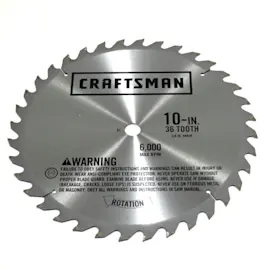
Yes, you can use an 8-inch blade on the Craftsman 113298150 10-inch table saw as long as the blade has the correct arbor (shaft) size and is rated for the saw’s RPM. An 8-inch dado set is common on 10-inch saws because it’s used for non-through cuts.
What must match for safe use
- Arbor hole size: The blade or dado set must fit the saw’s arbor exactly (commonly 5/8 inch on many 10-inch table saws).
- Blade type: Use an 8-inch blade for the cut you’re making (rip, crosscut, plywood, or dado).
- Speed rating: The blade must be rated at or above the saw’s no-load RPM.
- Kerf and splitter/riving knife fit: If your saw uses a splitter or guard, the blade kerf must be compatible.
- Guarding: Standard blade guards often won’t work with dado cuts; follow the manual’s guidance.
What changes when you drop from 10-inch to 8-inch
Using a smaller diameter blade mainly reduces maximum cut depth.
| Blade diameter | Typical max cut depth at 90° | Best use case |
|---|---|---|
| 10-inch | ~3-1/8 inches | General through-cuts |
| 8-inch | ~2 inches | Shallower cuts, many dado setups |
Dado notes (common reason to use 8-inch)
An 8-inch stacked dado set is widely used on 10-inch table saws because it provides plenty of depth for grooves and rabbets while keeping the cutter mass reasonable.
- Typical dado width range: 1/4 inch to 13/16 inch (varies by set)
- Use a dado throat plate/insert when required
- Re-check fence alignment and test-cut on scrap before cutting your workpiece
Why it matters
Blade diameter affects cut depth, guarding, and how the saw handles the load. Matching arbor size and RPM rating prevents wobble, poor cuts, and unsafe operation. For model-specific setup and safety steps, follow the Craftsman 113298150 owner's manual.
Last updated: February 2026
Are Craftsman table saws any good?
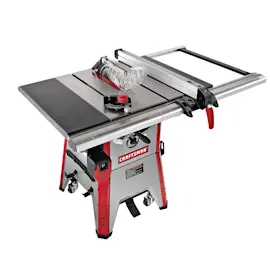
Yes. Craftsman table saws like model 113298150 are a solid choice for DIY and home-shop use when they are properly set up and maintained; they deliver reliable basic ripping and crosscutting, and they are easy to keep running with routine alignment and safety checks. For best results, follow the setup and safety procedures in the 113298150 owner's manual.
What “good” means for a 10-inch Craftsman table saw
A table saw is “good” when it cuts straight, holds settings, and runs safely. For most owners, that comes down to alignment, fence performance, blade condition, and motor health.
Strengths you can expect
- Good capability for common home projects (plywood, framing lumber, trim stock)
- Straight cuts when the fence and blade are aligned
- Serviceable design with standard wear items (blade, belts, switch components)
Common limitations to watch for
- Fence drift or difficulty locking square
- Vibration from belt/pulley wear or an out-of-true blade
- Reduced accuracy if the tabletop, miter gauge, or trunnion alignment is off
Quick setup checks that improve cut quality
These steps make more difference than brand name.
- Verify the blade is parallel to the miter slot
- Square the fence to the miter slot and confirm it locks consistently
- Confirm the blade is 90 degrees to the table and the bevel stop is accurate
- Use a sharp, appropriate 10-inch blade for the material
- Check for wobble, vibration, or burning that suggests alignment or drive issues
Troubleshooting: “good saw” vs “needs service”
| Symptom | Most likely cause | What to do first |
|---|---|---|
| Cuts wander or pinch | Fence not parallel, blade misalignment | Re-align fence and blade to miter slot |
| Excess vibration | Blade issue, belt/pulley wear, loose hardware | Inspect blade, check belt tension and fasteners |
| Motor struggles or stalls | Dull blade, feed rate too fast, electrical issue | Change blade, slow feed, inspect power/switch |
| Burning on rip cuts | Dull blade, fence toe-in | Replace/clean blade, re-check fence alignment |
Why it matters
A table saw that is slightly out of alignment can feel “bad” even if the saw is fundamentally sound. Proper setup improves accuracy, reduces kickback risk, and helps the motor run cooler and last longer.
Last updated: February 2026
How to get rid of an old table saw?
If your Craftsman 113298150 10-inch table saw still runs, the best way to get rid of it is to sell or donate it. If it’s unsafe or non-working, remove accessories (blade, fence, miter gauge) and recycle the metal and electrical components through local recycling or a scrap-metal facility; use the 113298150 owner's manual for safe disassembly and handling steps.
Best options (from easiest to most responsible)
- Sell it (local pickup): working saws, even older ones, often move quickly.
- Donate it: only if it’s complete and safe to operate (guarding and switch work correctly).
- Give it away: list it as “for parts” if it doesn’t run.
- Scrap/recycle: most of the saw is steel and aluminum; a scrap yard can take it.
- Municipal bulky-item or e-waste drop-off: good for motors, switches, and wiring.
What to do with the blade and small metal parts
Table saw blades are sharp and should not go loose into a bin.
- Remove the blade and wrap the teeth (cardboard and tape works well).
- Keep the blade with other scrap metal for drop-off, or store it safely if you plan to reuse it.
- Bag small hardware (nuts, washers, screws) so it doesn’t spill during transport.
Quick decision table
| Condition of saw | Recommended path | Notes |
|---|---|---|
| Runs, cuts accurately | Sell or donate | Include fence and miter gauge if you have them |
| Runs but unsafe (missing guard, bad switch) | Give away “for parts” or recycle | Disclose issues clearly |
| Won’t run, motor hums/trips | Recycle/scrap | Motor and wiring are recyclable in many areas |
| Rusted, incomplete | Scrap yard | Remove non-metal items first |
Why it matters
A table saw combines a heavy motor, wiring, and a lot of recyclable metal. Disposing of it responsibly reduces landfill waste and helps prevent injuries from exposed blades or unstable, incomplete tools.
Last updated: February 2026