Owner’s manual
 Error Codes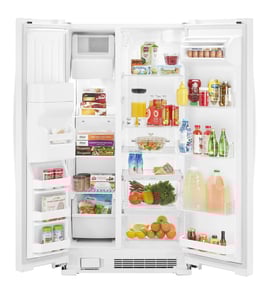



What's better, a side-by-side or a French door refrigerator?
For a kitchen like the one a Whirlpool WSF26C3EXW01 is designed for, a side-by-side is usually better when you want easy, eye-level access to both fresh and frozen foods and tighter door-swing clearance; a French door is usually better when you prioritize wide shelves for platters and large items.
Quick comparison
| Feature | Side-by-side (like WSF26C3EXW01) | French door |
|---|---|---|
| Fresh-food shelf width | Narrower | Wider |
| Freezer access | Eye-level, vertical | Lower drawer |
| Door swing clearance | Often easier in tight aisles | Often needs more front clearance |
| Organization style | Tall, narrow zones | Wide, open zones |
How to choose for your home
- Choose side-by-side if you store lots of frozen foods, use the ice/water dispenser often, or have a narrow kitchen walkway.
- Choose French door if you regularly store wide items (pizza boxes, party trays) and want the refrigerator section at eye level.
- If you meal prep, think about container shapes: tall bins fit well in side-by-sides; wide trays fit better in French doors.
- If you have mobility concerns, consider whether bending for a bottom freezer drawer is comfortable.
- If you entertain, French door layouts often make it easier to see and access large fresh-food items.
Model-specific notes for Whirlpool WSF26C3EXW01
This model’s user instructions cover features common to dispenser-style side-by-sides (controls, water/ice dispensing, filtration, and door/leveling guidance). For operating and layout details that affect day-to-day convenience, use the WSF26C3EXW01 user manual.
Why it matters
The “better” style is the one that matches your kitchen clearance and the way you actually store food. Picking the right layout reduces cold-air loss from long door-open times, improves organization, and helps the refrigerator maintain steadier temperatures.
Last updated: January 2026
What is the life expectancy of a Whirlpool side-by-side refrigerator?
A Whirlpool side-by-side refrigerator like model WSF26C3EXW01 typically lasts about 12 years with normal household use. Regular cleaning, good door sealing, and keeping the cooling system from overworking are the biggest factors in reaching that lifespan; see the WSF26C3EXW01 user manual.
What affects lifespan the most
- Keeping condenser coils clean so the compressor runs cooler
- Maintaining tight door seals to prevent warm air leaks and frost
- Allowing proper ventilation around the cabinet (especially behind the unit)
- Using correct temperature settings (factory recommended is 37°F fresh food, 0°F freezer)
- Replacing wear items (filters, gaskets) when performance drops
Maintenance schedule we recommend
| Task | Typical frequency | Why it helps |
|---|---|---|
| Clean condenser coils | Every 6 to 12 months | Reduces run time and heat stress on the compressor |
| Check/clean door gaskets | Every 3 to 6 months | Prevents air leaks, frost, and long run times |
| Verify temperatures | Monthly | Avoids overcooling or warm temps that strain the system |
| Replace air filter (if equipped) | About every 6 months | Helps control odors and keeps airflow fresher |
Model-compatible parts that may help performance
If you are addressing odors, sealing issues, or dispenser problems on WSF26C3EXW01, these parts are listed as compatible for this model:
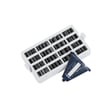
- Refrigerator air filter W10311524 (odor-reducing carbon air filter)
- Refrigerator door gasket WPW10249912 (fresh food door seal)
- Refrigerator water inlet valve WPW10341320 (controls water flow to the dispenser and ice maker)
Why it matters
When airflow is restricted or doors do not seal tightly, the refrigerator can still cool but it usually runs longer and hotter. That extra run time is what most often shortens the service life of major components like the compressor, fans, and electronic control boards.
Last updated: January 2026
What is the biggest problem in a Whirlpool refrigerator?
On the Whirlpool WSF26C3EXW01 side-by-side refrigerator, the biggest problem category we see is cooling performance (refrigerator too warm, freezer not cold enough, or uneven temperatures). The WSF26C3EXW01 user manual confirms the factory recommended set points are 37°F for the refrigerator and 0°F for the freezer, and it outlines troubleshooting steps for temperature complaints.
What “cooling problems” usually look like
- Fresh food section warm while the freezer seems normal
- Freezer not cold enough, soft ice cream, or slow ice production
- Unit runs longer than normal
- Frost buildup that blocks airflow
- Food freezing in the refrigerator section (airflow control issue)
Checks we recommend first (before replacing parts)
- Verify settings: factory recommended is 37°F fridge and 0°F freezer; acceptable ranges are 33°F to 45°F (fridge) and -5°F to 5°F (freezer).
- Make sure interior air vents are not blocked by food packages.
- Clean condenser coils and confirm airflow space around the cabinet.
- Check door closing and gasket sealing; warm air leaks can mimic a cooling failure.
- After any adjustment, allow 24 hours for temperatures to stabilize.
When a part is often involved
If the basics check out, these model-compatible parts commonly relate to cooling complaints:
| Symptom | What to suspect | Example compatible part |
|---|---|---|
| Fridge warm, freezer OK | Damper not opening or stuck | Refrigerator electronic damper W11087463 |
| Weak airflow, warm temps | Evaporator fan not running | Evaporator motor 4389144 |
| Temps erratic or unresponsive | Control not regulating correctly | Refrigerator electronic control board W11088499 |
Why it matters
Cooling issues can spoil food quickly and can also force the compressor and fans to run longer than normal, increasing wear and energy use.
Last updated: January 2026