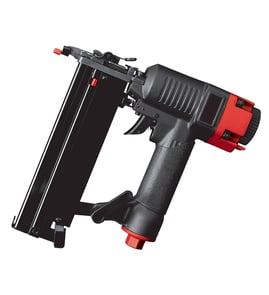

What goes wrong with a Paslode nail gun?
On a Paslode 3250 finish nailer, the most common problems are air leaks, weak or inconsistent driving, and failure to fire. These issues usually trace back to worn seals/O-rings, a sticking firing valve, a dirty nose/driver channel, or a weak return spring.
Common failures we see (and what they look like)
- Worn O-rings or seals: hissing air leak, tool cycles but lacks power
- Sticking firing valve: trigger clicks but no shot, or intermittent firing
- Dirty nose/driver channel: nails jam, driver does not return smoothly
- Weak/broken return spring: driver stays down, double-fires, or won’t reset
- Worn driver blade: frequent jams, nails not set consistently
- Air supply issues (hose, coupler, regulator): low power, slow cycling
Quick checks before you tear into it
- Disconnect air and remove fasteners.
- Confirm air pressure is in the normal operating range for finish nailers (most run best around 70 to 120 PSI).
- Add 2 to 3 drops of pneumatic tool oil into the air inlet (unless your setup uses an in-line oiler).
- Clear the nose; check for bent nails and debris in the magazine.
- Inspect the trigger and safety tip for free movement.
Troubleshooting guide (symptom to likely cause)
| Symptom | Most likely cause | What to do next |
|---|---|---|
| Won’t fire at all | Sticking firing valve, trigger/safety not actuating | Clean/lubricate; inspect trigger linkage |
| Fires but won’t sink nails | Low PSI, air leak, worn seals | Verify PSI; listen for leaks; plan seal service |
| Jams often | Dirty nose, worn driver, wrong fasteners | Clean nose; inspect driver; confirm nail type |
| Double-fires | Return spring issue, valve sticking | Inspect return action; clean valve area |
Why it matters
A finish nailer that leaks air or has a sticking valve can damage internal components and create inconsistent fastening. Catching worn seals, springs, and driver wear early helps keep your Paslode 3250 driving cleanly and reduces jams.
Parts and repair help
We list model-specific replacement parts by diagram when available; if you do not see the exact part you need for Paslode model 3250, search by the full model on Sears PartsDirect. For general repair readiness, we also recommend reviewing must have tools for appliance repair to make sure you have the basics (drivers, picks, and a good light) before starting.
Last updated: February 2026
What is a 16 gauge nailer good for?
A 16-gauge finish nailer like the Paslode 3250 is best for medium-duty trim and woodworking where you want strong holding power with a relatively small nail hole. We use it for jobs like baseboards, door and window casing, and light cabinetry.
Best uses for a 16-gauge finish nailer
A 16-gauge nailer is a go-to tool when you need more bite than an 18-gauge brad nailer, but you still want a clean finish.
- Installing baseboards and crown molding (especially thicker profiles)
- Hanging door and window casing
- Fastening chair rail and other wall trim
- Assembling and installing cabinets (face frames, nailers, and light trim)
- Attaching stair trim and risers (when the material is not overly hard)
- General finish carpentry where you plan to fill and paint or stain
When to choose 16-gauge vs other nailers
Use this quick comparison to pick the right tool for the material and the look you want.
| Nailer type | Typical strength | Typical hole size | Common jobs |
|---|---|---|---|
| 18-gauge brad nailer | Light | Smallest | Delicate trim, thin molding |
| 16-gauge finish nailer | Medium-high | Small-medium | Baseboards, casing, thicker trim |
| 15-gauge finish nailer | High | Larger | Heavy trim, doors, tougher fastening |
Setup tips for cleaner results
These habits help reduce splitting and improve holding power on trim work.
- Match nail length to the job; aim for the nail to penetrate the framing by about 1 inch.
- Angle nails slightly (toe-nail) on narrow trim to improve grip.
- Set depth so the head is just below the surface; fill with wood putty before paint.
- Pre-drill near ends of hardwood trim to reduce splitting.
- Keep the nose clean and check the driver area if you see inconsistent depth.
Why it matters
Using the right gauge prevents loose trim, excessive nail holes, and split wood. A 16-gauge finish nailer hits the sweet spot for many interior trim projects by balancing holding power and appearance.
For replacement parts and diagrams for your Paslode 3250 finish nailer, start with the model parts list and search by model number on Sears PartsDirect.
Last updated: February 2026
Which is better, a 15 or 16 gauge finish nailer?
A 15-gauge finish nailer is better when you need maximum holding power for thicker trim and heavier assemblies; a 16-gauge finish nailer is better when you want a smaller nail hole and cleaner-looking finish work. Your Paslode model 3250/65-F16 is a 16-gauge style tool.
Quick comparison: 15 gauge vs 16 gauge
| Feature | 15-gauge finish nailer | 16-gauge finish nailer (like Paslode 3250/65-F16) |
|---|---|---|
| Nail thickness | Thicker | Slightly thinner |
| Holding power | Higher | High, but less than 15 ga |
| Hole size | Larger, more filling | Smaller, easier to hide |
| Best for | Door jambs, baseboard, stair parts | Casing, shoe molding, light baseboard, panels |
| Risk of splitting | More likely in thin stock | Less likely in thin stock (still possible near edges) |
Choose 15 gauge when you need strength
Use a 15-gauge finish nailer when the joint needs to resist movement, weight, or repeated stress.
- Hanging doors and fastening door jambs
- Thick baseboard and large crown molding
- Stair trim and other high-stress areas
- Nailing into framing or thicker hardwoods
Choose 16 gauge when you want a cleaner finish
A 16-gauge finish nailer is the better all-around choice for many interior trim jobs because the holes are smaller and touch-up is faster.
- Window and door casing
- Shoe molding and quarter round
- Light to medium baseboard
- Decorative panels and trim returns
Setup tips that matter either way
Gauge helps, but results depend on setup and technique.
- Match nail length to the material stack-up (many finish jobs use about 1-1/4 to 2-1/2 inches)
- Set depth-of-drive so the head sits just below the surface
- Use the lowest air pressure that still sets nails consistently
- Pre-drill near ends in hardwood to reduce splitting
Why it matters
The “better” gauge is the one that balances holding power with appearance for your trim. A thicker 15-gauge nail grips harder but leaves a larger hole; a 16-gauge nail typically disappears more easily after filler and paint.
To look up diagrams or order replacement parts for your Paslode 3250/65-F16, search by model number on Sears PartsDirect.
Last updated: February 2026