Owner’s manual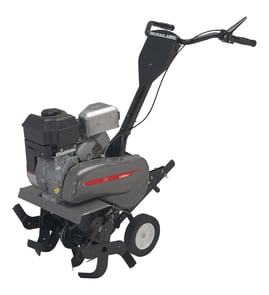



Where is the model number on a tiller?
On the Craftsman tiller model 917292301, the model number is printed on the product ID label (a sticker or metal tag) attached to the tiller frame. On many front-tine tillers, that label is commonly found near the tine shield/guard area or on the engine area near the fuel tank; confirm the exact location using the 917292301 owner's manual.
Common places to check on a front-tine tiller
Look for a rectangular label with the model number and sometimes a serial number. Check these spots first:
- On the tine shield (tine guard) near the front of the machine
- On the main frame rails behind the tines
- Near the belt guard and pulley area
- On or near the engine mounting plate
- Near the fuel tank area (engine side)
What the label usually looks like
Most tiller ID labels include a few key fields. Use this quick guide when you find a tag:
| Label field | What it means | Example for this tiller |
|---|---|---|
| Model number | Identifies the exact tiller version | 917292301 |
| Serial number | Unique ID for your specific unit | Varies |
| Engine model/type | Identifies the engine for engine parts | Briggs & Stratton 137202 (type 1124-E1) |
Why it matters
We use the model number to match the correct Craftsman parts diagrams and ensure you get the right items for your tiller, such as the belt guard and pulley hardware, tines, and transmission drive components.
Tips if the label is hard to read
- Wipe dirt and oil off the tag with a rag and mild cleaner
- Use a flashlight at an angle to make faded printing easier to see
- Take a close-up photo and zoom in to read worn characters
- If the tag is missing, use the engine identification numbers to help narrow down engine-related parts
Last updated: January 2026
Is front tine or rear tine tiller better?
For most homeowners, a front-tine tiller like the Craftsman 917292301 is better for smaller gardens, lighter soil, and routine bed maintenance because it’s easier to maneuver. A rear-tine tiller is better for breaking new ground, tougher soil, and larger areas because it typically tills deeper and tracks straighter.
Quick comparison (what to choose)
| If you need to… | Front-tine tiller (like 917292301) | Rear-tine tiller |
|---|---|---|
| Maintain existing beds | Best fit | Works, but often more than you need |
| Work in tight spaces | Easier to turn and control | Less agile |
| Break sod or hard, unworked ground | Can struggle and may lurch forward if tines catch | Best fit |
| Cover large areas faster | Slower, more operator effort | Faster, more stable |
How we recommend deciding
- Choose front-tine if you’re cultivating, mixing compost, and refreshing soil in established plots.
- Choose rear-tine if you’re doing first-time tilling, cutting into compacted soil, or expanding into new ground.
- If your soil is hard, expect more “grab” with a front-tine; use a slower pace and avoid trying to till too deep too fast.
- If you want the smoothest, straightest passes with less effort, rear-tine usually wins.
- If storage space and budget matter most, front-tine is often the practical choice.
Why it matters (control and safety)
With a front-tine tiller, the tines can catch in hard ground and propel the machine forward. When that happens, we follow the safe practice described in the 917292301 owner's manual: let go of the handlebars and do not restrain the machine. Also avoid overloading the tiller by trying to till too deep at too fast a rate.
Tips to get better results with a front-tine tiller
- Start at a slower throttle setting until you’re comfortable with handling.
- Make shallow passes first, then deepen gradually.
- Adjust the wheels and depth stake by trial and error for your soil conditions.
- Let the engine warm up before engaging the tines.
- Wear gloves when handling tines; they’re sharp.
For step-by-step tine service, we use the guide how to replace the tines on a front tine tiller.
Last updated: January 2026
What are the blades on a tiller called?
On the Craftsman tiller model 917292301, the “blades” are called tines. Tines are the rotating digging tools that bite into the soil to cultivate, mix, and loosen it; they can be arranged for different tilling widths.
What tines do (and why the name matters)
When you’re shopping for parts or following service steps, “tines” is the term used in diagrams and instructions. On this model, the manual also describes inner and outer tines and how their position changes the tilling path.
- Tines cultivate and move soil as they rotate
- Inner and outer tines work together to set the tilling width
- Tines are sharp; wear gloves when handling them
- If tines catch in hard ground, the tiller can lurch forward; release the handlebars
- Use only manufacturer-approved attachments and accessories
For the exact tine arrangement and safety notes for your unit, use the 917292301 owner's manual.
Common tine types you may hear about
Different tine shapes are used for different soil conditions and tasks.
| Tine type | Best for | What it looks/acts like |
|---|---|---|
| Bolo | General garden tilling | Curved “scoop” that churns soil well |
| Pick and chisel | Hard, compacted soil | More aggressive points for breaking ground |
| Slasher | Weedy areas, residue | Cuts and clears more than it pulverizes |
Why it matters
Using the right term helps you get the correct replacement parts (tines, tine hardware, tine assemblies) and follow the correct setup steps for tilling width and safe operation.
Last updated: January 2026
Who builds Craftsman tillers?
For Craftsman model 917292301, the 917 model prefix is commonly used on Craftsman outdoor power equipment that was built for Sears by AYP (American Yard Products), a manufacturer associated with Husqvarna. For model-specific identification details, we recommend checking the 917292301 owner's manual.
How to identify who built your Craftsman tiller
We use the model number and the product labeling to narrow down the original manufacturer.
- Use the full model number (example: 917292301, not just “917”) when searching parts.
- Check the product tag for additional codes (often near the engine or frame).
- Compare the tiller’s control layout and tine drive design to common AYP-built platforms.
- Use the parts list in the manual to confirm assemblies like the tine control and transmission.
- If you are replacing wear items, match by model number first (not by appearance).
What “built for Craftsman” means
Craftsman is the brand on the machine, but many Craftsman tillers were produced by partner manufacturers. For the 917 prefix models, AYP is the most common builder referenced in parts and service ecosystems.
| What you have | What it tells us | What to do next |
|---|---|---|
| Model starts with 917 | Typically an AYP-built Craftsman unit | Use the model number to select parts |
| Need a control or tine part | Builder matters for fit | Match to the illustrated parts list |
| Unsure about a fastener size | Hardware varies by assembly | Verify in the manual diagrams |
Why it matters
Knowing the builder helps you get the right parts the first time, especially for drivetrain and tine-control components where small design differences affect fit and belt alignment.
Parts that are often model-specific
If you are troubleshooting tine engagement or replacing linkage hardware, these model-matched parts are common starting points:
- Control lever 584447601 (tine engagement control)
- Inner tine assembly 584971502 (tine set/assembly)
- Idler pulley 532161806 (belt tension component)
Last updated: January 2026