Owner’s manual
 Error Codes


Is a top or bottom mount fridge better?
A bottom-mount refrigerator like Kenmore model 59675234402 is better when you want fresh-food items at eye level and more freezer organization; a top-mount is better when you want the simplest layout and typically the lowest operating cost. The “better” choice depends on how you shop and cook.
Quick comparison: top-mount vs bottom-mount
| Feature | Top-mount (freezer on top) | Bottom-mount (freezer on bottom) |
|---|---|---|
| Everyday access | Freezer is easiest to reach | Refrigerator section is easiest to reach |
| Freezer storage | Often a single cavity with a shelf | Often drawers/baskets for sorting |
| Organization | Simple, fewer compartments | More zones and pull-outs are common |
| Typical energy use | Often slightly lower | Often slightly higher |
| Best for | Budget, simplicity | Convenience, organization |
How to decide for your kitchen
- If you use fresh foods daily, bottom-mount keeps milk, produce, and leftovers at a comfortable height.
- If you use the freezer most, a top-mount puts frozen foods at eye level.
- If you like sorting frozen foods, bottom-mount drawers reduce “digging” and help prevent forgotten items.
- If you want the simplest design with fewer moving bins, top-mount layouts are usually more basic.
- If you are tight on space, measure your opening and door swing before choosing any style.
Why it matters
Bottom-mount designs are built around how most households use a refrigerator: fresh food gets accessed more often than frozen food. That convenience can reduce door-open time and improve day-to-day usability, even if a top-mount can be a little more efficient.
Model-specific tip for 59675234402
For clearances, placement, and handling guidance (including temperature limits for the install location and safe moving practices), follow the 59675234402 use and care guide.
Last updated: January 2026
Why is my Kenmore refrigerator leaking underneath?
Water under a Kenmore 59675234402 bottom-mount refrigerator usually comes from a defrost drain problem (clogged or frozen) or a water-supply connection leak for the ice maker. Start by checking inside for a blocked drain, then inspect the rear water line and the drain pan underneath.
Quick checks that solve most “leaking underneath” complaints
- Look for ice or standing water on the freezer floor; that points to a frozen/clogged defrost drain.
- Check the drain pan underneath for overflow, cracks, or being out of position.
- Inspect the water supply line and fittings behind the refrigerator for slow drips.
- Confirm the water line is copper tubing (plastic lines are more likely to leak).
- Make sure the refrigerator is level and doors close fully; warm air intrusion increases defrost water.
Step-by-step: clear a clogged or frozen defrost drain
- Unplug the refrigerator.
- Remove the freezer drawer/bins as needed to access the rear interior panel area.
- Melt any visible ice with warm water (not boiling) and towels.
- Flush the drain hole with warm water; use a flexible pipe cleaner to remove sludge.
- Verify water flows to the drain pan underneath.
For model-specific access points and panel removal details, follow the 59675234402 owner's manual.
Step-by-step: check the ice maker water connection (rear of unit)
- Pull the refrigerator out carefully and look for wetness at the shutoff valve, tubing, and inlet connection.
- Tighten compression nuts by hand first, then snug with a wrench; do not over-tighten.
- Confirm household water pressure is in the typical operating range of 35 to 100 psi.
- Recheck for leaks after moving the refrigerator back into place.
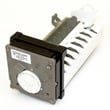
If you find the leak is coming from the ice maker area (molded fill cup, ice maker housing, or repeated overfilling), the correct replacement for this model is the refrigerator ice maker D7824706Q.
What to check based on where the water shows up
| Where you see water | Most likely cause | What to do first |
|---|---|---|
| Under freezer, inside cabinet | Defrost drain clogged/frozen | Clear and flush the drain |
| Under front center | Drain pan overflow or misalignment | Inspect pan and drain flow |
| Under back near wall | Water line or fitting leak | Inspect tubing, fittings, pressure |
Why it matters
Leaks underneath can damage flooring and also indicate a water connection issue that gets worse over time. Fixing the drain path or tightening the water supply connection restores normal defrost drainage and prevents repeat puddles.
Last updated: January 2026
How do I find the model number on my 59675234402?
For Kenmore refrigerator model 59675234402, the model and serial number sticker is located inside the fresh food (refrigerator) section on the left wall. Open the refrigerator door and look along the left interior wall for the rating label; it lists both numbers.
Where to look (quick checklist)
- Open the refrigerator (top) door, not the freezer drawer
- Check the left interior wall of the fresh food compartment
- Look for a sticker or plate labeled “Model” and “Serial”
- Use a flashlight; the label can be easy to miss
- Write the numbers down exactly as shown
What the label typically includes
| Item on label | What it’s used for |
|---|---|
| Model number | Matching parts and diagrams to your exact refrigerator |
| Serial number | Identifying production details for service and records |
| Electrical ratings | Confirming power requirements and specifications |
Why it matters
Using the exact model number (and sometimes the serial number) helps us match the correct Kenmore parts for your bottom-mount refrigerator, such as a control board, door gasket, or ice maker, and prevents ordering a similar-looking part that will not fit.
Tip for ordering parts
When you search or order, enter the full model number exactly as printed on the label (including all digits). For model-specific location details and care information, use the 59675234402 owner's manual.
Last updated: March 2026