Installation guide
 Owner’s manual
 Error Codes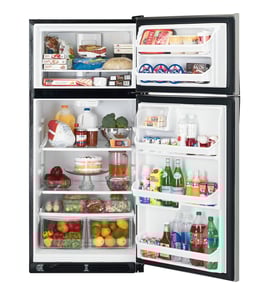


What is the difference between top mount and bottom mount refrigerators?
A top-mount refrigerator like the Frigidaire LFHT2117NF5 has the freezer on top and the fresh-food section below; a bottom-mount flips that layout. The biggest day-to-day difference is ergonomics: bottom-mount designs put fresh food at eye level, while top-mount designs make frozen items easier to reach.
Quick comparison
| Feature | Top mount (freezer on top) | Bottom mount (freezer on bottom) |
|---|---|---|
| Most-used items access | Fresh food lower | Fresh food higher |
| Freezer access | Easier, less bending | More bending or pull-out drawer |
| Typical cost and complexity | Often simpler, often lower cost | Often more features, often higher cost |
| Common maintenance needs | Similar for both: airflow, seals, leveling | Similar for both: airflow, seals, leveling |
What changes in real use
- Fresh-food convenience: Bottom-mount models usually reduce bending for everyday items like milk, produce, and leftovers.
- Freezer convenience: Top-mount models make it easier to see and reach frozen foods without crouching.
- Storage style: Bottom-mount freezers are often drawer-based; top-mount freezers are typically shelf-and-bin based.
- Energy and performance: Both styles can be efficient; real-world performance depends more on door seal condition, airflow, and temperature settings than freezer location.
Setup details that matter on either style
For the LFHT2117NF5, proper installation and leveling help doors close and seal correctly. We recommend:
- Leave installation clearance of 3/8 inch at the sides and top, and 1 inch at the back.
- Level the cabinet so it is level side-to-side and tilted about 1/4 inch (6 mm) front-to-back so doors close freely.
- Do not block the toe grille; airflow there supports normal cooling.
Use the steps and specs in the LFHT2117NF5 installation guide for the exact leveling method and clearance notes.
Why it matters
Choosing top-mount vs bottom-mount is mostly about how you use your refrigerator every day. A layout that matches your habits reduces door-open time, helps temperatures stay stable, and can cut down on issues like warm spots and excess frost.
Last updated: January 2026
What is the upper part of a fridge called?
On the Frigidaire LFHT2117NF5 top-mount refrigerator, the upper section is the freezer compartment. It’s the coldest area of the appliance and is designed to keep foods frozen; on some setups it also supports an ice maker when the water supply is connected.
What the freezer compartment includes
In a top-mount refrigerator like the LFHT2117NF5, the upper freezer area commonly includes:
- A freezer door and door gasket that seal cold air in
- Shelves or bins for frozen food storage
- Airflow passages that help circulate cold air
- Temperature controls (or a control setting that affects both sections)
- Optional ice maker components (if equipped and connected)
Freezer vs. refrigerator section (quick comparison)
| Section | Common name | Main purpose | Typical temperature target |
|---|---|---|---|
| Upper section | Freezer compartment | Long-term frozen storage | 0°F |
| Lower section | Fresh food compartment | Everyday refrigerated storage | 37°F |
Why it matters
Knowing the correct name helps when you’re ordering parts (like a door gasket or shelf) and when you’re troubleshooting cooling issues. For example, poor freezer airflow or a door that doesn’t seal can affect temperatures in both the freezer and the fresh food section.
Helpful tips for normal operation
- Set temperatures and then wait 24 hours before making additional adjustments.
- Keep the refrigerator level so doors close freely and seal correctly.
- Maintain installation clearances for airflow (typically 3/8 inch at sides/top and 1 inch at the back).
- If you do not connect a household water supply, keep the ice maker turned OFF (if equipped).
For model-specific operating details and control guidance, use the LFHT2117NF5 owner’s manual.
Last updated: January 2026
What is the most common problem with a Frigidaire refrigerator?
Cooling problems are the most common issue we see on Frigidaire refrigerators like model LFHT2117NF5. Most “not cold enough” complaints trace back to restricted airflow (dirty condenser coils, blocked vents), a weak fan, or warm air leaking in through a door gasket; start with basic checks in the LFHT2117NF5 owner's manual.
Quick checks we recommend first
- Confirm the refrigerator is plugged in firmly and the outlet has power.
- Verify the temperature controls are not set to “0/Off” and allow 24 hours for temperatures to stabilize after changes.
- Make sure air vents inside the fresh food and freezer sections are not blocked by food packages.
- Clean dust from the condenser area (dust buildup commonly causes poor cooling and long run times).
- Check door closing and sealing; look for gaps, torn gasket areas, or doors that do not self-close.
- Listen for fans: an evaporator fan (freezer area) and condenser fan (near compressor) should run during cooling.
Most common symptoms and what they usually point to
| Symptom | Most likely cause | What to do next |
|---|---|---|
| Fresh food warm, freezer cold | Airflow problem between sections | Clear vents, check for frost buildup, verify evaporator fan operation |
| Both sections warm | Power/control setting, dirty condenser, sealed system or compressor start issue | Check controls and power first; then clean condenser area |
| Frost buildup on freezer back wall | Defrost system issue | Inspect for heavy frost; defrosting restores cooling temporarily |
| Lights work but cooling is off | Unit “off” by controls or in defrost | Recheck control settings; wait 20 minutes and recheck |
When the issue is ice maker or water related
If your LFHT2117NF5 has an ice maker, the most common “no ice” causes are water supply problems (shutoff valve closed, kinked line, leaks at fittings) or air in the line after installation. The installation instructions also cover turning the ice maker on (wire signal arm down or switch set to “I”); use the LFHT2117NF5 installation guide.
Why it matters
Cooling and airflow issues can make food unsafe and force the compressor to run longer than normal, increasing wear and energy use. Catching simple causes early (blocked vents, dirty condenser area, poor door seal) prevents bigger failures.
Last updated: January 2026
What does CF mean on a Frigidaire refrigerator?
On a Frigidaire LFHT2117NF5 refrigerator, CF typically points to a communication or control problem (the main control and the user interface are not “talking” correctly). In many cases, the cause is a loose connection, damaged wiring, or a failing control board.
What to do first (safe, quick checks)
- Power reset: Unplug the refrigerator for 5 minutes, then plug it back in.
- Confirm the unit has steady power: Use a dedicated, grounded outlet (no extension cord or adapter).
- Check for accidental “cooling off”: If your model has electronic controls, pressing and holding the On/Off button for about 5 seconds can disable cooling (lights can still work). Use the LFHT2117NF5 owner’s manual to confirm your control style and the correct settings.
- Listen for normal operation: After restart, you should typically hear the compressor and fans cycle on and off.
- Watch temperatures for 24 hours: After any reset or setting change, allow time for temperatures to stabilize.
Common causes of a CF code
| Likely cause | What you may notice | Typical fix |
|---|---|---|
| Loose or oxidized connector | Code appears intermittently | Reseat connectors (power off) |
| Pinched or broken wire harness | Code returns quickly after reset | Repair/replace harness |
| Failing control board or user interface | Code persists, cooling may be erratic | Replace the failed control component |
Why it matters
A communication fault can prevent the refrigerator from controlling the compressor, evaporator fan, and defrost system correctly. That can lead to warm temperatures, food spoilage, or excessive frost buildup.
When to stop and schedule service
- The refrigerator is warming and the code returns after a reset
- You smell burning, see arcing, or the breaker trips
- The compressor is unusually hot or the unit repeatedly clicks on and off
For wiring or control-board diagnosis, we recommend using the LFHT2117NF5 installation guide for safe access steps and having a qualified technician handle live-voltage testing.
Last updated: January 2026