Installation guide
 Owner’s manual
 Error Codes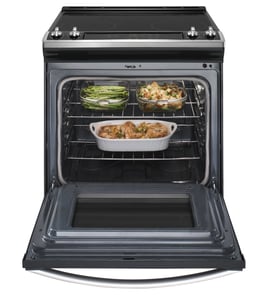



What is the life expectancy of a Whirlpool electric range?
A Whirlpool electric range like model WFC130M0AB0 typically lasts 13 to 15 years with normal household use. Consistent cleaning, avoiding repeated high-heat self-clean cycles, and fixing heating or wiring issues early help you reach (and often exceed) that range.
- Heat stress: frequent broiling, long bakes, and repeated high-temperature cycles wear components faster.
- Electrical health: loose or overheated connections can shorten the life of controls and heating circuits.
- Door and seal condition: heat loss makes the oven work harder and can cause uneven baking.
- Spills and corrosion: baked-on spills can damage elements and sensors over time.
- Leveling and stability: a range that rocks or is out of level can strain the door hinges and drawer.
- Keep the oven cavity and cooktop clean to prevent smoke and overheating.
- Verify the range is level and stable after moving it.
- Periodically inspect the power connection area for heat discoloration (power off first).
- Replace failed heating parts promptly, such as a weak bake element.
- Follow the safety and installation requirements in the WFC130M0AB0 installation guide.
| Symptom | Common cause | Example part for WFC130M0AB0 |
|---|---|---|
| Oven temperature swings | Sensor drifting out of spec | Range oven temperature sensor WPW10181986 |
| Oven not baking evenly or not heating | Bake element failing | Range bake element |
| Intermittent power or burning smell at cord area | Loose/overheated connection | Range terminal block |
A range that is heating correctly and wired securely runs cooler internally, cycles more accurately, and puts less stress on the electronic control board, elements, and wiring. That directly translates into a longer service life and fewer costly repairs.
Last updated: January 2026
How to fix oven temperature sensor Whirlpool?
On the Whirlpool WFC130M0AB0 electric range, fixing an oven temperature sensor problem usually means testing the sensor circuit and replacing the sensor if it reads out of range or the oven won’t regulate heat. Use the wiring and access steps in the WFC130M0AB0 owner’s manual to confirm the correct procedure.
- Turn off power at the breaker before touching any wiring.
- If the oven is overheating or underheating, run a simple temperature check with an oven thermometer.
- Inspect the sensor harness connection for looseness, heat damage, or corrosion.
- If the control shows an error after power-up, reset power for 1 minute and recheck operation.
- If the range is not operating at all, confirm the home breaker is on and the outlet is wired correctly (miswiring can trigger an F9 or F9,E0 condition).
Most Whirlpool range oven temperature sensors measure about 1,080 ohms at room temperature (around 70°F). If the reading is far off, the sensor is the likely cause.
- Disconnect power.
- Access the sensor inside the oven cavity (typically mounted to the rear wall).
- Remove mounting screws and gently pull the sensor forward to reach the connector.
- Disconnect the plug and measure resistance across the sensor terminals.
If the sensor tests bad or the connector is damaged, replace it with the correct part for this model: range oven temperature sensor WPW10181986.
| Symptom | Most common cause | What to do |
|---|---|---|
| Oven temp swings widely | Sensor drifting out of spec | Test ohms; replace sensor if out of range |
| Oven won’t heat correctly | Loose/burned connector | Repair connection; replace sensor if needed |
| Error returns after reset | Sensor circuit or control issue | Test sensor and harness; then evaluate control |
The oven temperature sensor is the feedback device the control board uses to regulate bake and broil heat. When it fails or the wiring connection is poor, the oven can overcook, undercook, or trigger fault behavior.
Last updated: January 2026
Does the Whirlpool electric range have a reset button?
The Whirlpool WFC130M0AB0 electric range does not use a dedicated physical “reset button.” Most reset situations are handled by canceling a cycle at the control panel or resetting power at the home breaker, then confirming the range powers back on and operates normally per the WFC130M0AB0 installation guide.
- Press Cancel/Off to stop an active bake or broil cycle.
- If the control is unresponsive, turn OFF the range circuit breaker for 1 minute, then turn it back ON.
- After power is restored, set the clock (if needed) and test surface elements and oven heat.
- If the display shows F9 or F9, E0, have a qualified electrician check for a miswired outlet.
- If the range stays cold after several minutes of operation, stop using it and schedule service.
Many “needs a reset” symptoms are actually power supply or wiring issues.
| Symptom | Most common cause | What we recommend |
|---|---|---|
| Display is blank | No power to range | Check breaker, outlet, and cord connection |
| Breaker trips | Short, damaged wiring, failed component | Inspect wiring, terminal block, and connections |
| Oven heats poorly | Failed sensor or element | Test components and replace if failed |
| F9 / F9, E0 code | Miswired electrical supply | Electrician verifies supply wiring |
If power is correct but heating or control behavior is still abnormal, these model-matched parts are common suspects:
- Range terminal block WPW10245259 (burned or loose power connections)
- Range oven temperature sensor WPW10181986 (incorrect temperature readings)
- Range bake element WPW10308477 (no bake heat)
A breaker reset can restore a locked-up control, but repeated resets usually point to an electrical supply problem, a loose terminal block connection, or a failing heating component. Fixing the root cause prevents nuisance shutdowns and unsafe overheating at the power connection.
Last updated: January 2026