Error Codes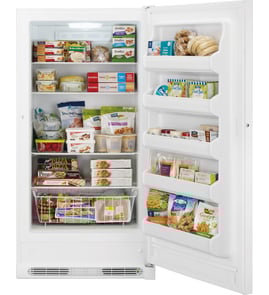



Where to find model number on upright freezer?
On a Kenmore upright freezer like model 2538292310, the model number is printed on a rating label that’s usually inside the cabinet. Common spots include the upper side wall, the ceiling area, or behind the lower kick plate.
- Inside the freezer on a side wall (often near the front opening)
- On the ceiling area inside the cabinet
- Behind or just above the kick plate (toe grille) at the bottom front
- On the back of the cabinet near the power cord
- Along the door frame edge (open the door and look around the perimeter)
- Open the door and scan the inside walls and ceiling with a flashlight.
- Check the door frame perimeter for a white or silver sticker.
- If you see a kick plate, remove it (usually it pulls off or uses a couple screws) and look for the label.
- If you still do not see it, look on the back panel near the lower area.
| You may see | What it means | Why you need it |
|---|---|---|
| Model number (example: 2538292310) | Identifies the exact freezer design | Ensures diagrams and parts match |
| Serial number | Production identifier | Helps with age and service history |
| Electrical info (volts/amps) | Power requirements | Useful for troubleshooting |
Kenmore model numbers can look similar across different upright freezers, but parts like door hardware, wiring, and defrost components can vary. Using the exact model number helps us match the correct replacement parts and avoid returns.
If you’re ordering parts after you find the model number, match the part by description and diagram; for example, a refrigeration-system part like the drier 5303305677 must match the correct system design.
Last updated: January 2026
What is the average life expectancy of an upright freezer?
Most upright freezers, including the Kenmore 2538292310 upright freezer, typically last 15 to 20 years with normal use and basic maintenance (clean airflow, stable temperatures, and good door sealing).
- Room conditions: Hot garages and tight enclosures make the compressor work harder.
- Door seal health: A leaking gasket causes longer run times and frost buildup.
- Condenser airflow: Dust and blocked vents raise operating temperatures.
- Defrost and drainage: Ice buildup and drain issues can lead to fan and airflow problems.
- Power quality: Frequent outages or surges can stress electrical components.
- Keep the freezer level so the door closes consistently.
- Set temperature near 0°F for food safety and stable cycling.
- Leave a little space around the cabinet for air circulation.
- Keep the door closed as much as possible; avoid overpacking against vents.
- If you see water or heavy ice, inspect the drain tube and consider replacing the hose 5304512272.
| What you notice | Common cause | What to do first |
|---|---|---|
| Runs constantly | Warm room, dirty airflow path, door not sealing | Improve airflow, check door closure |
| Heavy frost | Door leak or frequent openings | Check seal and loading habits |
| Water pooling | Drain restriction | Clear/replace drain tube |
| Not cold enough | Airflow restriction or sealed-system issue | Check vents and frost pattern |
A freezer that runs longer than it should uses more electricity and wears out the sealed system faster. Simple airflow and door-seal habits are the biggest drivers of long service life.
Last updated: January 2026
How do I know how many cubic feet my upright freezer is?
To find the cubic feet of your Kenmore upright freezer model 2538292310, measure the inside width, depth, and height in inches, multiply them together, then divide by 1,728. That converts cubic inches to cubic feet and gives you the freezer’s approximate capacity.
- Unplug the freezer for safety before measuring around shelves and wiring.
- Measure the interior liner space, not the outside cabinet.
- Measure in inches (W x D x H).
- If shelves or bins are removable, take them out to measure the full liner space.
- Round to the nearest 1/8 inch for a more consistent result.
Use this formula:
- Cubic feet = (W x D x H) ÷ 1,728
| What you measure | Unit | What to do |
|---|---|---|
| Interior width (W) | inches | Multiply |
| Interior depth (D) | inches | Multiply |
| Interior height (H) | inches | Multiply |
| Total | cubic inches | Divide by 1,728 |
Example: If the interior measures 24 in x 20 in x 50 in:
- 24 x 20 x 50 = 24,000 cubic inches
- 24,000 ÷ 1,728 = 13.9 cu ft (approx.)
Knowing cubic feet helps us match the right freezer parts and storage accessories, and it also helps you compare capacity across upright freezer models when planning food storage.
If you are measuring because of a cooling or frost issue, check the drain area and related components such as the hose 5304512272 (freezer drain tube), since a blocked drain can create ice buildup that reduces usable space.
Last updated: January 2026