Error Codes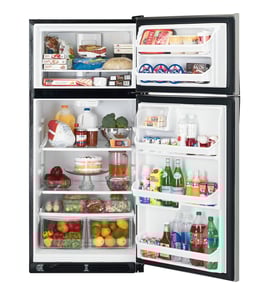

What is a fridge with freezer on top called?
A fridge with the freezer on top is called a top-freezer refrigerator, also commonly called a top-mount refrigerator. Your Kenmore model 1069738312 is this classic style, with the freezer compartment above the fresh-food compartment.
Common names you will see
- Top-freezer refrigerator
- Top-mount refrigerator
- Freezer-on-top refrigerator
- Two-door, side-swing (one door for freezer, one for refrigerator)
How to confirm you have a top-freezer design
- The freezer compartment is physically above the refrigerator section
- There are typically two separate doors (upper freezer door, lower refrigerator door)
- Temperature controls are usually inside the fresh-food section (varies by design)
- The ice maker (if equipped) is usually mounted in the freezer
| Feature | Top-freezer (top-mount) | Bottom-freezer |
|---|---|---|
| Freezer location | Top | Bottom |
| Typical door layout | Two side-swing doors | One refrigerator door plus freezer drawer/door |
| Common ice maker location | Freezer | Freezer |
Why it matters
Knowing the style helps you pick the right repair instructions and parts categories (for example, ice maker components, door hinge hardware, and defrost system parts are organized differently across refrigerator styles). If you are adding or troubleshooting ice production on this model, the refrigerator ice maker kit 1129316 is a common top-freezer upgrade part.
Last updated: February 2026
What are the disadvantages of a top mount fridge?
Top-mount refrigerators like Kenmore 1069738312 are usually reliable and affordable, but the main tradeoffs are convenience and storage layout: fresh-food items sit lower (more bending), freezer access is higher, and organization features are often simpler than on bottom-freezer designs.
Common disadvantages (what you will notice day to day)
- More bending for fresh food: the refrigerator section is below eye level, so you reach down more often.
- Less “grab-and-go” organization: many top-mount layouts have fewer wide deli drawers, door bins, or full-extension pantry storage.
- Harder access for kids or shorter users: the freezer shelf area can be high.
- Fewer built-in dispenser options: many top-mount models do not include an external water or ice dispenser.
- Ice maker is often an add-on: if your unit did not ship with one, you may need a kit.
What to check before you decide it is the wrong style
Use this quick comparison to match the design to your household.
| If you mostly use... | Top-mount fridge experience | Best fit when... |
|---|---|---|
| Fresh food (daily) | More bending and crouching | You do not mind lower shelves or you store daily items in door bins |
| Frozen food (often) | Freezer is at eye level | You want easier freezer access |
| Large platters, wide bins | Layout can feel tighter | You prioritize simple storage over specialty drawers |
Options that reduce the downsides
- Add an ice maker if your model is ice-maker ready: refrigerator ice maker kit 1129316
- If ice or water performance is inconsistent, check the water supply components: refrigerator inlet valve WP2315576
- For dispenser-related layouts and trim access on Kenmore units that have them, use: how to disassemble a Kenmore refrigerator dispenser
Why it matters
Most “disadvantages” of a top-mount refrigerator are ergonomic and storage-related, not cooling performance. If bending for fresh food or limited organization is a daily frustration, a different configuration may feel like a bigger upgrade than changing brands or features.
Last updated: February 2026
Why is my Kenmore 1069738312 Elite refrigerator not cooling enough?
If your Kenmore 1069738312 top-mount refrigerator is running but not cooling enough, the most common causes are restricted airflow (dirty condenser coils), a failed evaporator fan, or a defrost problem that leaves frost blocking the evaporator. Start with cleaning and airflow checks before replacing parts.
Quick checks we recommend first
- Make sure the temperature controls were not accidentally turned warmer.
- Confirm the condenser fan (by the compressor) runs when the compressor runs.
- Clean condenser coils and the area around the compressor.
- Check freezer vents for blocked airflow (overpacked shelves can cause warm temps).
- Listen for the evaporator fan in the freezer; it should run with the door switch held closed.
- Look for heavy frost on the freezer back wall (points to a defrost issue).
What the symptoms usually mean
| Symptom | Most likely area | What to do next |
|---|---|---|
| Fridge warm, freezer also warming | Sealed system or compressor start issue | Check for compressor trying to start (clicking), then test start components |
| Freezer cold, fridge warm | Airflow problem | Check evaporator fan and air passages |
| Frost/ice sheet on freezer back wall | Defrost system problem | Inspect defrost timer and defrost components |
| No water to ice maker and temps drifting | Water/ice issue plus cooling strain | Verify airflow first; then check water supply and valve |
Parts that commonly relate to low cooling on this model
If your checks point to a specific failure, these parts on our list are common suspects:
- Defrost timer WP2183400 (defrost cycle not advancing can cause frost buildup)
- Run capacitor WPW10662129 (can contribute to compressor start problems)
- Condenser motor 833697 (poor heat removal can reduce cooling)
- Refrigerator thermostat WP627985 (temperature control issues)
Why it matters
Low cooling is usually an airflow or heat-transfer problem; when coils are dirty or frost blocks the evaporator, the refrigerator cannot move heat out of the cabinet efficiently. Fixing the root cause helps protect food and reduces compressor run time.
Last updated: February 2026
What does DH mean on Kenmore 1069738312 Elite refrigerator?
On a Kenmore 1069738312 refrigerator, DH on the display typically points to a defrost heating problem (often shown as dH or Er dH). The refrigerator may stop responding to buttons until the condition clears or power is reset, and cooling performance can be affected.
What you’ll usually notice
- Freezer temperature starts rising or swings warm
- Frost buildup on the evaporator cover or back wall
- Fan noise changes (fan hitting frost) or airflow feels weak
- Refrigerator section warms even though the compressor runs
- Display shows DH/dH and controls may seem locked out
Quick checks we recommend first
- Power reset: Unplug the refrigerator (or switch off the breaker) for 5 minutes, then restore power.
- Look for heavy frost in the freezer: heavy frost strongly supports a defrost-system issue.
- Confirm doors seal and close: warm air leaks can overload the defrost system.
- Listen for the evaporator fan: weak airflow can mimic a defrost failure.
Parts commonly involved (and why)
If DH keeps returning, the issue is usually in the defrost circuit (timer/control, heater, thermostat, wiring). For this model page, these parts are often relevant to defrost-related symptoms:
| Symptom | Most likely area | Example part on this page |
|---|---|---|
| Repeating DH/dH, heavy frost | Defrost control/timer | Defrost timer WP2183400 |
| Defrost seems intermittent | Defrost thermostat/sensor circuit | Bimetl-del WP4387503 |
| Random shutoffs or odd compressor behavior | Start components (less common for DH) | Run capacitor WPW10662129 |
Why it matters
A true defrost heat problem lets frost build up on the evaporator coil; that blocks airflow, warms the fresh-food section, and can eventually lead to poor ice production and longer compressor run times.
Helpful DIY guidance
For Kenmore 106-series refrigerators, we use the troubleshooting flow in our error-code resource to narrow down whether the problem is the defrost timer/control, defrost thermostat, heater circuit, or wiring.
Last updated: February 2026