Owner’s manual
 Error Codes


Are bottom mount fridges better?
Bottom-mount refrigerators like the Whirlpool WRF555SDFZ02 are often “better” for many kitchens because the fresh-food section sits at eye and waist level, so the items you use most are easier to reach. The tradeoff is that freezer access requires bending to use the lower drawer; see the WRF555SDFZ02 user manual for layout and use details.
What “better” usually means in day-to-day use
Bottom-mount designs tend to work well when you access the refrigerator compartment more than the freezer.
- Easier access to fresh foods (produce, dairy, leftovers) at a comfortable height
- Wide shelves and door bins can make organizing groceries simpler
- Freezer drawer can hold bulky items, but you will bend more often
- Better visibility of refrigerated items, which can reduce forgotten food
- Often a good fit for frequent cooking and meal prep
Quick comparison: bottom-mount vs top-freezer
| Feature | Bottom-mount (like WRF555SDFZ02) | Top-freezer |
|---|---|---|
| Fresh-food access | Best (eye-level) | Lower (more bending) |
| Freezer access | Lower drawer | Eye-level |
| Organization style | Shelves up top, bins below | Traditional stacked |
| Best for | Fresh-food heavy households | Freezer heavy households |
How to decide for your home
Use these checkpoints to match the configuration to your habits.
- If you open the refrigerator door far more than the freezer, bottom-mount is usually the better ergonomic choice
- If you store lots of frozen foods or use the freezer daily, a top-freezer can feel more convenient
- If you have mobility concerns, prioritize the compartment you access most
- If you use ice and water often, confirm your preferred dispenser setup and maintenance routine
Why it matters
Choosing the right configuration affects comfort, organization, and how efficiently you use the space. With a bottom-mount like the Whirlpool WRF555SDFZ02, the design is optimized around frequent fresh-food access, which is how many households use a refrigerator most.
Last updated: January 2026
Do you remove cardboard from the bottom of a Whirlpool refrigerator?
For Whirlpool model WRF555SDFZ02, we do not recommend removing the cardboard-like cover on the bottom/rear area. That panel is typically a protective air-flow and safety cover for the machine compartment (condenser area, wiring, and tubing) and is meant to stay in place per the WRF555SDFZ02 refrigerator user manual.
What you should do instead
If you are trying to clean or check airflow, use the access points Whirlpool intends (base grille and open areas behind it) rather than removing fixed covers.
- Unplug the refrigerator before cleaning near the condenser area.
- Remove the base grille (toe grille) for access to the condenser area.
- Vacuum dust using a soft brush attachment.
- Reinstall the base grille securely when finished.
- Plug the refrigerator back in.
When it is OK to remove something
Some packaging materials are meant to be removed, but they are usually inside the refrigerator or obvious shipping pieces.
| Item you see | Remove it? | Typical location |
|---|---|---|
| Tape, foam blocks, shelf spacers | Yes | Inside compartments, around doors/shelves |
| Cardboard-like bottom/rear cover | No | Under/back near condenser/machine compartment |
| Base grille (toe grille) | Yes, for cleaning | Front bottom of cabinet |
Why it matters
That bottom cover helps protect components and supports proper airflow. Removing it can increase dust buildup on the condenser, raise operating temperatures, and lead to longer run times.
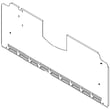
If your goal is better cooling performance, condenser cleaning is usually the right first step; the refrigerator grille WPW10534155 is the common access point for that area on this model.
Last updated: January 2026
What is the biggest problem in a Whirlpool refrigerator?
For Whirlpool bottom-mount refrigerators like model WRF555SDFZ02, the biggest problem we see most often is cooling performance (fresh food too warm, freezer not holding 0°F, or long run times). Many cooling complaints come from airflow restrictions, dirty condenser areas, or a temperature-sensing/control issue; use the troubleshooting steps in the WRF555SDFZ02 refrigerator user manual.
What “cooling problems” commonly look like
- Refrigerator section warmer than the set point
- Freezer temperature creeping up, ice production slows
- Compressor and fans seem to run more than normal
- Uneven temperatures (warm spots) in the fresh food section
- Doors not closing fully or gaskets not sealing consistently
Quick checks we recommend first (no parts)
- Verify set points: factory recommended is 38°F (refrigerator) and 0°F (freezer).
- Give it time: wait 24 hours after any temperature change.
- Check vents: keep packages from blocking air vents.
- Clean the condenser area: dust and pet hair can reduce heat removal.
- Confirm doors seal: look for gaps, torn gasket areas, or a door that does not self-close.
When it points to a part on WRF555SDFZ02
If the basics check out, these model-compatible parts are common suspects depending on symptoms:
| Symptom you notice | What it often indicates | Example compatible part |
|---|---|---|
| Temperatures seem inaccurate or swing | Temperature sensing issue | Refrigerator thermistor W10316760 |
| Freezer cold but refrigerator warm | Airflow/damper not opening correctly | Refrigerator damper control assembly WPW10196393 |
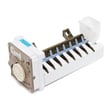
| Ice maker not producing or inconsistent | Ice maker system issue | Refrigerator ice maker assembly WPW10300024 |
Why it matters
Cooling problems can spoil food quickly and force the compressor and fans to run longer than normal. Fixing airflow and temperature-sensing issues early often prevents more expensive repairs later.
Last updated: January 2026