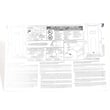
Installation guide
 Owner’s manual
 Error Codes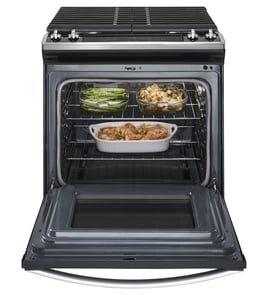



What model is my Kenmore gas range?
For Kenmore gas range model 79075751100, the model number is printed on the serial plate inside the storage or warmer drawer compartment. Pull the drawer out and look on the right side of the oven front frame for the model and serial label (serial plate).
- Open the storage or warmer drawer at the bottom of the range
- Look on the right side of the range frame (oven front frame)
- Find the serial plate label and read the model number
- Record the model and serial number for future parts lookup and service
- The label shows both model and serial numbers
- The model number is typically the most prominent identifier
- The label is attached to the metal frame, not the drawer itself
- The number should match the format used in the 79075751100 owner’s manual
If you do not see it in the drawer area, these are other common places ranges may use.
| Location | How to check | How common |
|---|---|---|
| Storage/warmer drawer compartment (right side of frame) | Pull drawer out, look at right frame | Most common for this Kenmore style |
| Oven door jamb / front frame | Open oven door, inspect frame edges | Common on many ranges |
| Back panel near vent area | Look behind range with power/gas off | Sometimes used |
We use the exact model number to match the correct Kenmore range parts list, including items like the oven igniter, oven temperature sensor, burner caps, and control overlay. One digit off can lead to ordering a part that does not fit.
Last updated: February 2026
How do I know if my igniter is bad on my gas stove?
On the Kenmore 79075751100 gas range, a bad igniter shows up as a burner that clicks or the oven that takes too long to light, lights with a delayed “whoosh,” or never lights at all. A healthy surface burner should ignite within about 4 seconds after air is purged; the oven typically ignites within 30 to 60 seconds in normal operation (see the 79075751100 installation guide).
- Surface burner: you hear sparking but the burner does not light, or it lights only after repeated tries.
- Oven bake/broil: the igniter glows but the burner does not light within about a minute.
- Weak ignition: delayed ignition followed by a sudden flare or “whoosh.”
- No ignition activity: no spark at the surface electrode, or no glow from the oven igniter.
- Visible damage: cracked igniter, heavy white oxidation, or a burned spot.
- Confirm the knob is turned to LITE only long enough to ignite; do not leave it there.
- For surface burners, verify the burner head and cap are seated correctly and dry.
- Try a different burner: on this range, all surface igniters spark, but only the selected burner should light.
- If the oven is slow to light, watch for the igniter glow; it should glow like a light bulb before the gas valve opens.
A weak oven igniter can glow but still fail to draw enough current to open the gas valve. Many techs confirm failure by checking igniter current draw and replacing the igniter when it is below typical spec.
| What you observe | Most likely cause | What usually fixes it |
|---|---|---|
| Spark present, no flame | Dirty/misaligned burner head/cap, clogged ports | Clean and reseat parts |
| No spark on one burner | Bad electrode/wire or switch | Inspect wiring, replace failed part |
| Oven igniter glows, no flame | Weak oven igniter | Replace igniter (often frigidaire range oven burner igniter 5303935066) |
Delayed ignition can allow gas to build briefly before lighting, which causes flare-ups and uneven heating. Getting ignition back to normal timing improves safety and cooking performance.
Last updated: February 2026
How long should a Kenmore gas stove last?
A Kenmore gas range like model 79075751100 typically lasts 15 years with normal household use. Regular cleaning to prevent grease buildup and keeping burners and ignition parts in good condition helps you reach that lifespan.
Most gas ranges land in a similar range, but real-world life depends on heat exposure, cleaning habits, and how often the oven and surface burners run.
- Cooking frequency (daily use shortens life versus occasional use)
- Grease control (grease buildup can cause overheating and ignition issues)
- Ignition wear (spark electrodes and oven igniters are common wear items)
- Gas quality and pressure stability (steady flame reduces stress on components)
- Cleaning method (avoid harsh sprays that leave flammable residue)
For model-specific care and cleaning guidance, follow the 79075751100 owner's manual.
We recommend these habits for Kenmore gas stoves:
- Clean cooktop spills promptly; keep the area under burners free of grease
- Remove and wash burner caps and heads; dry fully before reinstalling
- Confirm each surface burner lights quickly and the flame is steady
- Keep the oven cavity reasonably clean to avoid smoke and excess heat retention
- Use cleaners exactly as directed; avoid heavy aerosol residue near heat
| Component | Typical issue over time | What you notice |
|---|---|---|
| Surface burner parts | Clogged ports, misalignment | Uneven flame, delayed ignition |
| Oven ignition system | Igniter weakens | Oven won’t heat or heats slowly |
| Temperature sensing | Sensor drift | Baking too hot or too cool |
If the oven struggles to ignite or heat, the frigidaire range oven burner igniter 5303935066 is a common repair part for this model family.
A 15-year lifespan is realistic when the range stays free of grease that can ignite and when ignition and burner components are kept clean and properly seated. Your installation and burner setup steps also matter; the installation guide shows the correct order for installing burner heads, caps, and grates.
Last updated: February 2026
How to remove the top of a Kenmore gas range?
To remove the cooktop (top) on your Kenmore gas range model 79075751100, we start by lifting off the removable cooktop pieces (grates, burner caps, and burner heads), then remove any mounting screws that secure the burner bases or cooktop so the top can be lifted for service access. Use the steps in the 79075751100 installation guide for safe handling and reassembly checks.
- Turn all burner knobs to OFF and let the range cool completely.
- Shut off the gas supply at the shut-off valve.
- Unplug the range (or switch off the circuit) to prevent electric ignition from sparking.
- Protect the countertop and cooktop finish with a towel or cardboard.
- If you must pull the range out, pull only as far as needed to access connections.
- Remove the burner grates.
- Lift off the burner caps.
- Lift off the surface burner heads (note their orientation for reassembly).
- Look for screws that secure burner bases, burner tubes, or the cooktop to the frame; remove them.
- Lift the cooktop from the front edge and support it (some models use support rods; others hinge up).
| Install order | What goes back on |
|---|---|
| 1 | Surface burner pans (if equipped) |
| 2 | Surface burner heads |
| 3 | Burner caps |
| 4 | Burner grates |
- Confirm each burner head sits flat and the cap is centered.
- Restore power and test ignition: each burner should light quickly once gas is available.
- If the range was moved, verify it is stable and properly positioned; follow the anti-tip and leveling checks in the 79075751100 installation guide.
Removing the top correctly prevents misaligned burner heads (poor flame, delayed ignition) and avoids stressing the gas line or wiring harness. Proper reassembly also helps the igniters spark and light within normal timing.
Last updated: February 2026
What causes a Kenmore oven to stop working?
On the Kenmore 79075751100 gas range, the oven can stop working because the electronic control detects a fault and shuts the oven down, a power failure interrupts electric ignition operation, or a key component like the igniter or temperature sensor fails and prevents safe ignition and heating.
- Press OFF/CANCEL to stop beeping and clear the display if an error code is flashing.
- If there was a power outage, turn the oven control OFF; electric ignition ovens should not be operated during a power failure.
- Confirm the broiler drawer/door is fully closed; broiling requires the drawer/door closed.
- Make sure the oven vent area is not blocked (vent is below the backguard).
- If the oven will not ignite or takes a long time to light, suspect the igniter.
| Symptom | Likely cause | What you’ll notice |
|---|---|---|
| No heat, no ignition | Failed oven igniter | No glow, or weak glow and no burner flame |
| Heats but temps are off | Failed temperature sensor | Overbakes or underbakes, long preheat |
| Beeping, stops mid-cycle | Control fault (F1/F3/F9 on some versions) | Continuous beeping, flashing code |
| Works after outage then acts odd | Power interruption | Clock needs reset, functions may need reprogramming |
- Frigidaire range oven burner igniter 5303935066 (most common no-heat cause on gas ovens)
- Oven probe 316233903 (temperature sensor for inaccurate or unstable heating)
A gas oven that will not ignite is often failing a safety-related step (ignition or sensing). Addressing the igniter, sensor, or a control fault restores reliable heating and helps prevent repeated shutdowns.
For model-specific operating and safety steps (including power failure guidance), follow the 79075751100 owner's manual.
Last updated: February 2026
What are the parts of a gas oven?
A Kenmore gas range like model 79075751100 is built from a few core systems: the gas bake and broil burners (heat source), ignition and safety controls (to light and regulate flame), the oven cavity and door (to contain heat), and user controls and indicators. For your exact feature layout, use the 79075751100 owner's manual.
- Oven cavity and liner: the insulated cooking box that holds heat
- Oven door assembly: door, window, hinges, and gasket that help seal heat
- Bake burner: primary heat source for baking (bottom of oven)
- Broil burner: high-heat burner for broiling (top of oven)
- Ignition system: igniter and related wiring that lights the gas
- Gas valve and regulator: controls gas flow and pressure to the oven
- Temperature sensing and control: sensor/probe and electronic oven control
- Racks and rack supports: hold cookware at different heights
- Oven light system: bulb, lens/cover, and socket
These are examples of parts we see customers replace on the Kenmore 79075751100 when symptoms point to them:
| Symptom | Part that often relates | Example part for this model |
|---|---|---|
| Oven will not heat or takes too long to preheat | Oven ignition system | Frigidaire range oven burner igniter 5303935066 |
| Oven temperature seems inaccurate | Temperature sensor/probe | Oven probe 316233903 |
| Oven light does not work | Bulb or socket | Range oven light bulb 316538904 |
Knowing which system you are dealing with helps you troubleshoot faster. For example, a “no heat” complaint on a gas oven is often ignition related, while uneven baking is more often tied to temperature sensing, airflow, or rack placement.
- If you smell gas, turn off the range and shut off the gas supply before checking anything.
- For surface burners, your manual describes manual lighting during a power outage using a match and the burner head.
- Avoid lining the oven with foil; it can damage the oven interior and affect heat distribution.
- Use the manual’s feature diagram to identify what your model has (some features vary by model).
Last updated: February 2026