Owner’s manual
 Error Codes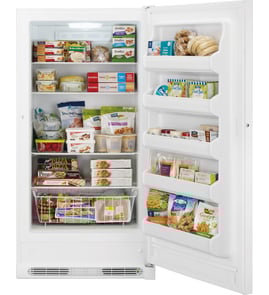


What temperature should my Kenmore Elite freezer be set at?
Set your Kenmore Elite upright freezer model 25328092806 to 0°F for safe long-term frozen food storage. If your freezer uses a dial or electronic buttons, make small adjustments and then wait several hours for the temperature to stabilize before changing it again (details in the 25328092806 owner's manual).
How to set the temperature control on this model
Your freezer may have one of these control styles:
- Electromechanical control (dial/knob): Turn the knob clockwise for colder, counterclockwise for warmer.
- Electronic control (UP/DOWN buttons): Press UP for colder and DOWN for warmer.
- After any change: Wait several hours before adjusting again so the cabinet temperature can stabilize.
Quick temperature guide
| Goal | Recommended setting | What you should see |
|---|---|---|
| Everyday frozen food storage | 0°F | Food stays solid, minimal frost buildup |
| Faster initial pull-down after loading warm groceries | Slightly colder temporarily | Temperature drops back toward 0°F after stabilizing |
| Reduce freezer burn risk | 0°F (steady) | Fewer temperature swings |
If the “HI TEMP” light or alarm comes on
This freezer’s temperature alarm is designed to warn you if the inside temperature rises above about 23°F.
- Press ALARM RESET to silence the buzzer.
- Check that the door is fully closing and sealing.
- Avoid overloading with unfrozen food all at once; distribute items so air can circulate.
- If the freezer was just plugged in, allow time to cool down; the alarm can sound during initial startup.
Why it matters
Keeping the freezer near 0°F helps prevent partial thawing and refreezing, which protects food quality and reduces ice buildup. A steady setting also helps the compressor and evaporator fan run in normal cycles instead of struggling to recover.
Last updated: January 2026
Is there a reset button on a Kenmore upright freezer?
Kenmore upright freezers like model 25328092806 typically do not have a dedicated “reset” button for the control. For control glitches after a power surge or outage, the reliable reset is a power reset: unplug the freezer for 1 minute, then plug it back in (the control runs a self-check and returns to normal). See the 25328092806 owner's manual.
How to reset the control (recommended)
- Unplug the freezer from the wall outlet.
- Wait 1 minute.
- Plug it back in and allow the control to complete its self-check.
Tips while you wait:
- Keep the door closed so cabinet temperature stays stable.
- If the display shows unusual characters, this reset is the first step.
- If an error code such as “E” appears, service is typically required.
What buttons you might see (and what they do)
Some upright frost-free models use an electronic temperature control with UP (colder) and DOWN (warmer) buttons. Those buttons adjust temperature; they are not the primary “reset” method.
| Control type | Where it’s located | What “reset” usually means |
|---|---|---|
| Electromechanical control (dial/knob) | Inside the freezer | Turn the knob to adjust; power reset if it acts erratically |
| Standard electronic control (UP/DOWN) | Outside the freezer | Power reset (unplug 1 minute) to clear glitches |
If you meant the alarm reset button
Many freezers have an ALARM RESET button that silences the buzzer when the HI TEMP alarm is active. That button resets the alarm sound, not the freezer’s electronics.
Check these common causes of a HI TEMP alarm:
- Door left ajar or gasket not sealing
- Warm food loaded all at once
- Power interruption
- Frost buildup restricting airflow
Why it matters
Using the correct reset method prevents unnecessary part replacement and helps you quickly recover from power surges, brown-outs, or brief outages that can confuse the control.
Last updated: January 2026
Why is my Kenmore Elite freezer not freezing?
If your Kenmore Elite upright freezer model 25328092806 is not freezing, the most common causes are an incorrect temperature control setting, poor door sealing from an unlevel cabinet, or a cooling-system/airflow problem such as heavy frost buildup or a failed fan. Start with the temperature control and door seal checks in the 25328092806 owner's manual.
Quick checks we recommend first
- Confirm the temperature control is not set to OFF; adjust it and allow several hours for temperatures to stabilize.
- If the freezer was just plugged in or restarted, allow a full 4-hour cool-down period before loading unfrozen food.
- Keep the door closed as much as possible; frequent openings quickly warm the cabinet.
- Make sure the freezer is level so the door closes and seals properly (an unlevel freezer can cause cooling and frost problems).
- Verify there is enough clearance for airflow around the cabinet; exterior walls can feel warm during normal operation.
What to check next (symptom-based)
| What you notice | Most likely area | What to do next |
|---|---|---|
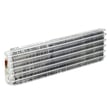
| Runs constantly but still warm | Door seal, airflow, frost restriction | Check gasket seal and look for heavy frost on the back wall/evaporator cover. |
| Little or no airflow inside | Evaporator fan system | Listen for the fan; inspect the fan blade and motor. |
| Heavy frost buildup, poor cooling | Defrost system | Suspect a defrost heater or related defrost components. |
| Completely dead, no sound | Power or control setting | Check outlet, breaker/fuse, and temperature control position. |
Parts that commonly fix “not freezing” on this model
If your troubleshooting points to a specific failure, these model-matched parts are commonly involved:
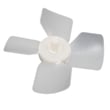
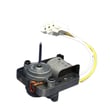
- Freezer evaporator fan motor 297309000 (moves cold air through the cabinet)
- Blade 5308000010 (damaged blades reduce airflow and cooling)
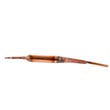
- Defrost heat 5304496284 (failed heater can allow frost to block airflow)
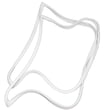
- Freezer door gasket 5304507199 (air leaks cause warm temps and frost)
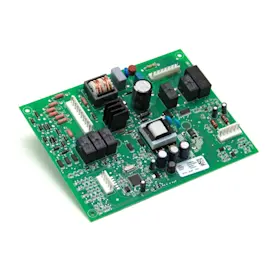
- Freezer electronic control assembly (white) 297366203 (can prevent proper cooling operation)
Why it matters
A freezer that is not freezing is often an airflow or sealing issue, not immediately a compressor problem. Correct leveling, a tight door gasket seal, and proper temperature control settings prevent warm temperatures, moisture intrusion, and frost buildup that can choke off cooling.
Last updated: January 2026