 Owner’s manual



What does HWA mean on LG washer?
On the LG WT1801HVA washer, the letters at the end of the model number (such as “HVA” or “H*A” shown in the specs) identify a feature and finish variation within the WT1801 series, not an error code. For exact decoding used for your unit, we recommend checking the WT1801HVA owner's manual.
What “HWA” usually indicates in LG model names
LG model suffix letters are commonly used to describe a combination of:
- Feature package (for example, a steam or special-cycle package)
- Color or finish (for example, graphite steel vs. white)
- Minor design revisions within the same platform
- Market or retailer variation
Because LG can reuse letters across different product lines and years, the most reliable interpretation is the one tied to the WT1801HVA documentation.
How to confirm what your suffix means (fast checks)
Use these quick checks to match the suffix to your exact washer:
- Compare the full model number on the lid frame label to the manual’s model listing
- Look for feature callouts in the manual (for example, control panel style, special cycles)
- Match the listed dimensions and electrical requirements to your unit
- Confirm finish/color by comparing the model suffix on the rating label
WT1801 series specs you can use as a cross-check
The WT1801 “H*A” specification listing in the manual includes these baseline specs:
| Spec item | WT1801 series reference value |
|---|---|
| Electrical | 120 VAC, 60 Hz |
| Max spin speed | 1,100 RPM |
| Dimensions (W x D x H) | 27 in x 28 3/8 in x 40 1/8 in |
Why it matters
Knowing the exact suffix helps us match the correct LG washer parts (like a lid assembly, control board, or suspension components) to your WT1801HVA so fit and connectors line up correctly.
Last updated: January 2026
What is the most common problem with LG washers?
Drain and spin issues are the most common problems we see with LG washers like model WT1801HVA. That typically shows up as the washer not draining fully, stopping before the spin finishes, or leaving clothes too wet because the load cannot balance and reach full spin speed.
Most common issues (and what they look like)
- Drain problems: water left in the tub, long drain times, or the cycle ends with wet clothes.
- Out-of-balance / spin problems: the washer keeps trying to rebalance, adds water, or will not spin up.
- Fill problems: slow fill or no fill when inlet screens are clogged or hoses are kinked.
- Oversudsing: too much detergent can cause leaks, poor rinsing, and performance issues.
- Control or motor-related errors: the washer may pause, display an error, or need a power reset.
Quick checks we recommend first
Start with these simple steps before replacing parts:
- Confirm the drain hose is not kinked or pinched; keep drain height at 96 inches (8 ft.) max.
- Redistribute the load; bulky items and tangling commonly prevent a full spin.
- Use only HE detergent and reduce the amount if you see excess suds.
- Make sure both hot and cold faucets are fully open.
- Check inlet hoses for kinks and clean any clogged inlet screens.
When a part is often involved
If the washer will not drain or drains weakly, the drain system is a common failure point.
| Symptom | Most likely area | Example part for WT1801HVA |
|---|---|---|
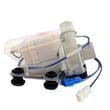
| Water stays in tub | Drain pump or drain path restriction | Washer drain pump assembly 5859EA1004P |
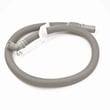
| Slow drain or siphoning issues | Drain hose routing or restriction | Washer drain hose AEM73732901 |
| Overfilling or odd water levels | Water level sensing system | LG washer water-level pressure switch 6501EA1001R |
Why it matters
Drain and balance problems can turn into repeat wet loads, longer cycle times, and extra wear on the drive system. Fixing hose routing, detergent use, and load size early prevents bigger repairs later.
For model-specific operating tips and troubleshooting steps, follow the guidance in the WT1801HVA owner's manual.
Last updated: January 2026
Is WT1801HVA a high efficiency washer?
Yes. The LG WT1801HVA is a high-efficiency (HE) top-load washer; it is designed to use only HE detergent and it uses a lower, optimized water level that typically will not fully cover the clothes during the wash.
How to tell (and what to use)
We recommend following the detergent guidance in the WT1801HVA owner's manual. Using non-HE detergent or too much detergent commonly causes oversudsing, poor rinsing, and residue buildup.
- Use detergent labeled with the HE symbol.
- For average loads, use less than 1/2 of the detergent maker’s recommended maximum.
- Use even less for soft water, light soil, or small loads.
- Never exceed the detergent manufacturer’s maximum amount.
- Avoid “extra” detergent to fix cleaning issues; it often makes performance worse.
What “HE” means for water level and performance
This LG washer is designed to wash efficiently with less water. It is normal for the water level to look low compared to older, conventional washers.
| What you notice | What it means on an HE washer | What to do |
|---|---|---|
| Clothes are not fully submerged | Normal, optimized fill for wash action | Load loosely; do not pack the tub |
| Lots of suds or suds left after rinse | Too much detergent or non-HE detergent | Reduce dose; switch to HE detergent |
| Musty odor or residue | Detergent buildup over time | Use correct dose; clean dispensers regularly |
Why it matters
Using the correct HE detergent amount helps the WT1801HVA rinse cleaner, spin better, and avoid detergent residue that can contribute to odors and buildup inside the washer.
Last updated: January 2026
What is the average lifespan of an LG washing machine?
LG washers like model WT1801HVA last 10 to 15 years with normal household use. Lifespan depends most on avoiding overloads, keeping the washer level, maintaining good draining, and protecting water lines from high pressure and freezing; see the WT1801HVA owner's manual for model-specific care guidance.
What most affects lifespan
- Overloading increases strain on the washplate, hub, and suspension.
- Out-of-balance loads create vibration that wears suspension and tub support.
- Water supply issues (very high pressure, kinked hoses, freezing conditions) stress fill components and lines.
- Drain problems force longer pump run time and can lead to repeated cycle issues.
- Routine cleaning reduces odor, residue, and performance issues that shorten service life.
Quick care checklist
- Keep loads evenly distributed; mix large and small items.
- Do not pack the tub tight; allow items to move freely.
- Use the correct detergent amount to prevent excess suds.
- Periodically inspect inlet hoses for cracks, bulges, or leaks.
- Confirm the washer is level to reduce vibration during spin.
Lifespan by usage pattern
| Usage pattern | Typical lifespan | Common wear areas |
|---|---|---|
| Light (1 to 3 loads/week) | 12 to 15 years | Hoses, lid components |
| Average (4 to 7 loads/week) | 10 to 15 years | Drain pump, suspension |
| Heavy (multiple loads/day) | 7 to 10 years | Suspension, drive components |
When replacing a part can extend life
If the washer is otherwise in good shape, replacing a worn component can restore performance and reduce stress on other parts.
- Excessive shaking or banging: washer suspension rod kit AJK72989702
- Slow drain or no-drain symptoms: washer drain pump assembly 5859EA1004P
Why it matters
A level washer that is not overloaded and drains correctly runs with less vibration and shorter cycle strain. That reduces wear on the motor system, tub support, and hoses, helping you reach the full 10 to 15 year lifespan.
Last updated: January 2026


