 Error Codes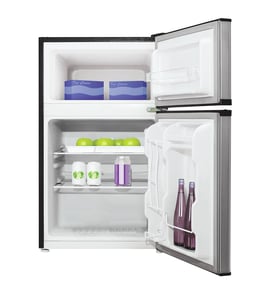


How do I find the cubic feet of my Kenmore freezer?
To find the cubic feet of the freezer section on your Kenmore 5642950199 compact refrigerator, measure the inside height, width, and depth of the usable freezer space (in inches), then multiply and divide by 1,728 to convert to cubic feet.
- Unplug the refrigerator or keep the door open briefly so you can measure safely and accurately.
- Measure the inside height (top to bottom of the usable space).
- Measure the inside width (left wall to right wall).
- Measure the inside depth (back wall to the front edge of the usable space, not the door).
- Multiply:
height x width x depthto get cubic inches. - Convert to cubic feet:
cubic inches ÷ 1,728.
Freezer capacity changes depending on what you count as “usable.” Use these guidelines:
| What you measure | Include it? | Why |
|---|---|---|
| Main open cavity | Yes | This is the true storage volume |
| Fixed shelves or evaporator cover | Measure around it | They reduce usable space |
| Door bins | No (for freezer section capacity) | They are not part of the main cavity |
| Ice maker (if equipped) | No | It displaces storage space |
If your freezer measures 12 in (H) x 16 in (W) x 14 in (D):
- Cubic inches: 12 x 16 x 14 = 2,688
- Cubic feet: 2,688 ÷ 1,728 = 1.56 cu ft
Knowing cubic feet helps when you are comparing compact refrigerator sizes, planning food storage, or checking whether airflow space is being blocked by items packed too tightly.
If you are troubleshooting cooling performance while you measure, we recommend starting with how to fix your evaporator cooling fan.
Last updated: February 2026
How do I reset my Kenmore refrigerator?
For the Kenmore compact refrigerator model 5642950199, the most reliable reset is a power reset: unplug the refrigerator (or switch the breaker off) for 5 to 10 minutes, then restore power. This clears many control glitches and gets cooling and the compressor cycle started normally.
- Power reset: Unplug for 5 to 10 minutes, then plug back in.
- Breaker reset: Turn the refrigerator circuit breaker off for 5 to 10 minutes, then back on.
- Control lock check: If buttons do not respond, look for a control lock and hold the lock key (often 3 seconds).
- Temperature reset: Set both compartments to a mid-range setting, then wait for stabilization.
- After reset: Give the unit time to restart; the compressor may delay a few minutes before running.
A reset clears the electronics, but cooling still takes time to recover.
| What you should see | Typical timing | What it means |
|---|---|---|
| Interior light and controls come back on | Immediately | Power restored |
| Compressor or fan starts (or you hear a click) | 0 to 10 minutes | Normal restart delay |
| Noticeable cooling improvement | 4 to 8 hours | System is pulling temps down |
| Full temperature recovery | Up to 24 hours | Normal for many refrigerators |
These checks solve the most common “needs a reset” complaints on compact refrigerators:
- Make sure the temperature control is not set to warm/off.
- Confirm the door closes and seals; warm air leaks can mimic a cooling failure.
- Clean dust from the condenser area (where accessible) and keep airflow space around the cabinet.
- Avoid overpacking; blocked vents reduce airflow.
- If you hear a fan noise change or no airflow, use our how to fix your evaporator cooling fan guide for troubleshooting steps.
A power reset is a safe first step because it clears minor control board glitches without replacing parts. If cooling does not improve after a full 24 hours, the issue is usually airflow, a fan, a thermostat/control, or a sealed-system problem.
Last updated: February 2026
What does er if mean on a Kenmore refrigerator?
On Kenmore compact refrigerator model 5642950199, ER IF is not a standard, model-specific display code. When customers see ER, IF, or ER IF on a compact unit, it almost always points to a control/display glitch or a cooling-airflow problem caused by frost buildup, a blocked vent, or a fan issue.
- Power reset: unplug the refrigerator for 5 minutes, then plug it back in.
- Confirm the doors close fully and the gasket seals all the way around.
- Make sure packages are not blocking interior vents or the back wall.
- Set the temperature control to a mid-range setting and wait 24 hours for stabilization.
- Check for heavy frost on the freezer wall; heavy frost indicates restricted airflow.
Compact refrigerators commonly develop frost that restricts airflow between the freezer and fresh-food section.
- Move food to a cooler.
- Unplug the unit.
- Leave doors open until frost fully melts; use towels to catch water.
- Restart and monitor temperatures for the next 24 hours.
| What you notice | What it typically indicates | What to do |
|---|---|---|
| Fridge warm, freezer very frosty | Airflow blocked by frost | Full manual defrost, then avoid overpacking |
| Both sections warming | Poor heat release or control issue | Clean condenser area, verify outlet power, reset |
| Code returns right after reset | Control/display or sensor circuit issue | Inspect wiring connections; service may be needed |
When airflow is restricted, the refrigerator section warms first even if the freezer still feels cold. Clearing frost and restoring airflow prevents temperature swings and food spoilage.
For general Kenmore refrigerator code patterns and troubleshooting steps (useful for comparing how Kenmore labels faults), use our Kenmore 111 model top freezer refrigerator error codes reference.
Last updated: February 2026
What kind of freon do I need for a refrigerator?
Most refrigerators do not use “Freon” anymore; the correct refrigerant depends on the sealed-system label on your Kenmore 5642950199. Many older units used R-12, many later units used R-134A, and many newer units use R-600A; you must match what the data plate specifies.
Check the refrigerator’s rating/data plate; it lists the refrigerant type and charge amount.
- Look for a label inside the fresh food compartment (side wall or ceiling), behind the kick plate, or on the back near the compressor
- Find the line that says “Refrigerant” (examples: R-134A, R-600A)
- Note the charge amount (often shown in ounces or grams)
- If the label is missing or unreadable, stop and have a technician identify the system before any service
- Never “top off” with a different refrigerant type
Here’s a quick reference for common household refrigerator refrigerants:
| Refrigerant | Where you’ll see it most often | Key takeaway |
|---|---|---|
| R-12 | Older refrigerators | Not used in modern service; requires specialized handling |
| R-134A | Many refrigerators from the 1990s through 2010s | Common legacy refrigerant in domestic units |
| R-600A (isobutane) | Many newer compact and full-size refrigerators | Flammable; sealed-system service requires proper procedures |
Using the wrong refrigerant (or the wrong charge amount) can damage the compressor, reduce cooling, and create a safety hazard. Refrigerant work is sealed-system service; it requires the correct equipment, recovery procedures, and leak repair before recharging.
If you are troubleshooting cooling issues that lead people to suspect “low freon,” we recommend checking airflow and fan operation first:
Last updated: February 2026





