Owner’s manual
 Error Codes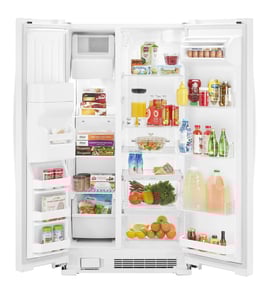

What model is my Kenmore Elite refrigerator?
Your Kenmore Elite refrigerator’s model number is printed on the appliance’s rating label; on model 10651182110, you will typically find that label inside the fresh food compartment or inside the freezer compartment. Use the exact model number from the label when ordering parts or checking specifications in the owner's manual.
Check these common locations first (use a flashlight and look along the cabinet walls):
- Inside the refrigerator section on a side wall near the top shelf area
- Inside the refrigerator section behind or beside the crisper drawers
- Inside the freezer section on a side wall
- Along the door frame area (cabinet edge that the door seals against)
- Behind the lower toe grille or kickplate area (less common, but worth checking)
The rating label usually includes several identifiers. Record them exactly as shown.
| Label item | What it’s used for | Example format |
|---|---|---|
| Model number | Ensures correct part fit and diagrams | 10651182110 |
| Serial number | Helps identify production run | Letters and numbers |
| Electrical ratings | Useful for service checks | Volts/amps |
Kenmore Elite refrigerators often have multiple similar-looking versions. Using the exact model number (and sometimes the serial number) prevents ordering the wrong items such as an ice maker, door bin, or control board.
- Match the model number exactly (no extra spaces or missing digits)
- Use the model number to select parts made for your unit
- If you are troubleshooting, check the Kenmore 106 model refrigerator error codes guide for display or diagnostic code help
Last updated: February 2026
Where is the model number on a Kenmore side by side refrigerator?
On a Kenmore side-by-side refrigerator like model 10651182110, the model number is printed on the appliance identification label, most often inside the fresh food (refrigerator) compartment along the side wall near the top, or around the door opening. Use the owner's manual to confirm the exact label location for your unit.
Look for a white or silver sticker or plate that lists MODEL and SERIAL.
- Inside the refrigerator section on the left or right side wall
- On the ceiling of the fresh food compartment (near the light housing)
- On the frame around the refrigerator door opening (door jamb)
- Behind the crisper drawers (on the side wall or rear wall)
- Inside the freezer section on a side wall (less common, but possible)
We recommend copying the model number exactly as shown (letters and numbers), because even one character changes the parts list.
| Item on label | Why it matters | Example format |
|---|---|---|
| Model number | Matches the correct parts diagrams and replacement parts | 10651182110 |
| Serial number | Helps identify production variation and compatible revisions | Letters plus numbers |
The model number is how we match your Kenmore Elite refrigerator to the correct parts, diagrams, and troubleshooting info. It is especially important when ordering fit-critical items like a door bin, ice maker, or control board.
Last updated: February 2026
What are the common problems with Kenmore Elite refrigerators?
Common problems on the Kenmore Elite 10651182110 side-by-side refrigerator are weak or uneven cooling, ice maker or water dispenser failures, water leaks, and excess frost. These issues usually trace back to airflow problems (fans or blocked vents), defrost system faults, water inlet valve trouble, or worn door seals; use the owner's manual to match symptoms to checks.
- Fridge warm, freezer OK (or vice versa): evaporator fan not moving air, iced-over evaporator, blocked air vents
- No ice or slow ice: water supply restriction, inlet valve not opening, ice maker module failure
- Water under the fridge or in the crisper area: clogged defrost drain, cracked water line, dispenser leak
- Frost buildup on freezer back wall: defrost bi-metal or defrost circuit issue, door not sealing
- Clicking or humming with poor cooling: start components or compressor system problem
- Confirm temperatures: set freezer near 0°F and fresh food near 37°F; allow 24 hours to stabilize.
- Check airflow: make sure vents are not blocked by food packages.
- Listen for the evaporator fan: it should run when the compressor is running and the freezer door switch is closed.
- Inspect door gaskets: look for gaps, tears, or areas that do not grip a dollar bill.
- Look for ice on the freezer rear panel: heavy frost often signals a defrost problem.
| Problem area | What fails | Example part for model 10651182110 |
|---|---|---|
| Airflow in freezer | Evaporator fan motor | Refrigerator evaporator fan motor WP2315549 |
| Defrost protection | Defrost bi-metal | Refrigerator defrost bi-metal WPW10225581 |
| Ice and water | Water inlet valve | Refrigerator water inlet valve WPW10341320 |
| Odors (not cooling) | Air filter | Refrigerator air filter W10311524 |
Cooling, ice production, and leak complaints are often connected. A weak evaporator fan or a defrost failure can reduce airflow, create frost, and raise temperatures, which then leads to poor ice making and water puddles from melting ice.
For model-specific display alerts and troubleshooting patterns, we also use the Kenmore 106 model refrigerator error codes guide.
Last updated: February 2026
How many cubic feet is my Kenmore refrigerator by model number?
For Kenmore Elite model 10651182110, the most reliable way to get the exact cubic-foot capacity is to use the model’s specification information in the owner's manual. If you do not see capacity listed there, the rating label inside the fresh food section typically lists the official capacity.
Check these spots in this order:
- Owner’s manual/specifications for model 10651182110 (often lists total and compartment capacity)
- Rating label inside the refrigerator compartment (commonly on a side wall near the crisper area)
- Tech sheet (if your unit has one) tucked behind the toe grille or rear access cover
- If you are measuring yourself: calculate interior volume (less accurate because shelves, ducts, and bins reduce usable space)
If you need a rough estimate before you locate the specs, you can measure the interior of each compartment and convert to cubic feet.
- Measure width x height x depth (in inches) of the usable interior space.
- Multiply to get cubic inches.
- Divide by 1,728 to convert to cubic feet.
| What you have | Convert to cubic feet |
|---|---|
| Cubic inches | divide by 1,728 |
| Cubic centimeters (cc) | divide by 28,316 |
Capacity affects how we choose compatible accessories and maintenance parts (for example, airflow and odor control needs). Keeping airflow clear and replacing the air filter on schedule helps the refrigerator cool evenly.
| Part | What it helps with |
|---|---|
| Refrigerator air filter W10311524 | Reduces food odors and helps keep air fresher inside the cabinet |
Last updated: February 2026
How to tell if a Kenmore refrigerator compressor is bad?
If your Kenmore Elite refrigerator model 10651182110 isn’t cooling and you hear repeated clicking or the unit runs nonstop with little or no temperature drop, the compressor or its start components are likely failing. We confirm by checking airflow, frost pattern, and compressor electrical behavior; see the owner's manual for model-specific checks and access points.
- Warm refrigerator and freezer even though the lights and fans run
- Clicking every few minutes (start attempt, then overload trips)
- Compressor very hot to the touch after trying to run (use caution)
- Humming then stopping shortly after it starts
- No compressor sound at all while the refrigerator is calling for cooling
Many “bad compressor” symptoms are caused by cheaper, more common issues. Before condemning the compressor, we check:
- Condenser coils and airflow (dirty coils or blocked grille can mimic a weak compressor)
- Evaporator fan operation; a failed fan can cause poor cooling even with a good compressor (see refrigerator evaporator fan motor WP2315549)
- Defrost system problems; heavy frost on the evaporator points to a defrost failure (see refrigerator defrost bi-metal WPW10225581)
- Control or sensor issues that prevent proper compressor run time
- Door gasket leaks that cause long run times and warm temps
| What we see | What it usually means | Next step |
|---|---|---|
| Fans run, compressor clicks on and off | Start device/overload or compressor locked | Electrical checks; inspect start circuit |
| Compressor runs continuously, still warm inside | Sealed system issue or weak compressor | Check frost pattern; check condenser heat |
| Compressor silent, no cooling demand response | Control, wiring, or start circuit | Verify power to compressor circuit |
- Locked-rotor behavior (clicking, overheating) often points to a compressor that cannot start under load.
- Poor heat transfer at the condenser (not getting warm) can indicate the sealed system is not pumping.
A compressor replacement is a sealed-system repair; diagnosing correctly prevents replacing an expensive part when the real issue is airflow, defrost, or a fan motor.
Last updated: February 2026