Owner’s manual
 Error Codes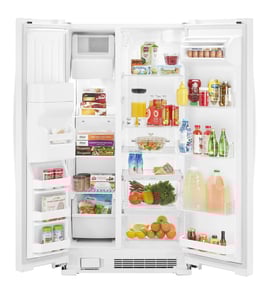
How wide is a 25.6 cubic foot refrigerator?
For a GE side-by-side refrigerator like model PSC25MSWCSS, the cabinet width is typically about 36 inches. For installation, plan for a little extra space on both sides plus room for doors to swing and for water and electrical connections; confirm your exact dimensions in the owner's manual.
Most 25 to 27 cu. ft. side-by-side refrigerators are built on a 36-inch-wide cabinet. The installation instructions for this style also call out small side clearances for airflow and easier hookup.
- Typical cabinet width: 36 in.
- Typical “fits in opening” width needed: 36 in. + side clearances
- If an entryway is less than 38 in. wide, doors often need to be removed to move the refrigerator through
- Leave space for the water line (if you have an ice maker or dispenser)
- Leave space behind for airflow and cords
| Measurement you’re planning for | Typical value for this size class | Notes |
|---|---|---|
| Cabinet width | 36 in. | Common for 25 to 27 cu. ft. side-by-side units |
| Side clearance | 1/8 in. each side | Helps with installation and air circulation |
| Top clearance | 1 in. | Helps with airflow and easier placement |
| Back clearance | 1/2 in. to 1 in. | Helps with airflow and connections |
| Minimum doorway (without door removal) | 38 in. | Narrower openings usually require door removal |
Use a tape measure and capture these numbers before you order parts or plan a move:
- Width: left cabinet side to right cabinet side (not the doors)
- Depth: back of cabinet to front edge of doors/handles (handles add a lot)
- Height: floor to top of hinge cover
- Door swing space: enough room to fully open doors and pull out bins
Getting the width right prevents delivery and installation problems, protects the water line from kinks, and ensures proper airflow so the compressor and condenser system can cool efficiently.
Last updated: February 2026
What is the average lifespan of a GE refrigerator?
Most GE refrigerators, including the GE PSC25MSWCSS side-by-side, typically last 12 years. With normal use and basic maintenance (cleaning coils, keeping door seals tight, and fixing defrost or fan issues early), it’s common to see 10 to 15 years of service.
- Average: about 12 years
- Common range: 10 to 15 years
- Shortened lifespan: heavy use, poor airflow around the cabinet, dirty condenser coil
- Extended lifespan: clean coils, stable temperatures, good door gasket seal
| Refrigerator type | Typical lifespan | Notes |
|---|---|---|
| Side-by-side (like PSC25MSWCSS) | 10 to 15 years | Ice maker and dispenser parts often need attention first |
| Top-freezer | 12 to 18 years | Usually simpler design |
| French door | 9 to 14 years | More electronics and door seals to maintain |
- Condenser coil packed with dust (compressor runs hotter and longer)
- Door gasket leaks (warm air causes longer run times and frost)
- Poor airflow around the refrigerator (especially behind and underneath)
- Ignoring early symptoms like clicking, warm spots, or heavy frost
- Running with a failing fan motor (temperature swings and icing)
If your PSC25MSWCSS starts warming up, frosting over, or making unusual fan noise, these are common repair areas that can restore normal operation and reduce strain on the compressor:
- Refrigerator temperature sensor WR55X10025
- Refrigerator defrost heater WR51X10055
- Refrigerator defrost bi-metal thermostat WR50X10069
- Refrigerator evaporator motor WR60X10307
A refrigerator’s “lifespan” is usually limited by how hard the sealed system and compressor have to work. Keeping airflow and temperatures stable reduces run time, prevents icing, and helps major components last longer. For model-specific operating features and settings, use the PSC25MSWCSS owner’s manual.
Last updated: February 2026
What is the most common problem with a GE refrigerator?
The most common GE refrigerator complaint is not cooling properly (fresh food too warm, freezer too warm, or temperatures that swing). On the GE PSC25MSWCSS, this is often tied to airflow issues, control settings, door left open, or a defrost-related problem; our PSC25MSWCSS owner's manual troubleshooting chart walks through the most likely causes.
- Refrigerator or freezer too warm: control setting too warm, frequent door openings, door not sealing, or airflow blocked by packages
- Runs a lot or seems to never shut off: normal after first plug-in (allow time to stabilize), hot weather, frequent door openings, or controls set too cold
- Ice maker not making ice or slow ice: water supply not connected, door left open, temperature not cold enough, or a clogged filter
- Water on the floor or in the freezer area: ice jam in the chute or a defrost/drain issue
- Strange noises or rattling: rollers need adjustment (slight vibration is normal)
- Interior light not working: burned-out bulb or no power at the outlet
- Confirm temperature controls are set correctly (avoid the coldest setting unless needed).
- Check for a door held open by food packages; warm air causes temperature problems and can trigger beeping.
- Give it time after power loss or first start; many units need up to 24 hours to fully stabilize.
- Look for airflow blockages (items pushed against vents in the refrigerator or freezer).
- If ice is hollow/small or ice production is slow, replace the water filter with the correct cartridge.
| Symptom | Common part to check | Example from this model’s parts |
|---|---|---|
| Temps too warm or inconsistent | Temperature sensor | GE profile refrigerator temperature sensor WR55X10025 |
| Frost buildup, warm temps | Defrost heater or defrost thermostat | Refrigerator defrost heater WR51X10055, refrigerator defrost bi-metal thermostat WR50X10069 |
| Warm fresh food section, weak airflow | Evaporator fan motor | Refrigerator evaporator motor WR60X10307 |
| Slow ice, bad taste/odor, small cubes | Water filter | Refrigerator water filter MSWF |
| Light out | Light bulb | Refrigerator lamp 40A15 |
A refrigerator that is not cooling can spoil food quickly, and an airflow or defrost problem can snowball into heavier frost buildup, longer run times, and poor ice production. Starting with control settings, door sealing, and airflow checks prevents unnecessary part replacement.
Last updated: February 2026
How big is the GE AutoFill pitcher?
The GE PSC25MSWCSS side-by-side refrigerator uses a door dispenser system; an “AutoFill pitcher” capacity is not a standard feature specification for this model. For the correct capacity and the exact dispenser features your unit supports, use the PSC25MSWCSS owner's manual.
AutoFill pitchers are tied to specific dispenser designs. On PSC25MSWCSS, you will typically be using the door dispenser to fill a glass or bottle directly.
- Check the dispenser control labels (WATER, CUBED, CRUSHED, LOCK, LIGHT)
- Look for a dedicated pitcher dock or “AutoFill” button; if it is not present, the unit is not using an AutoFill pitcher system
- Confirm your exact feature set by matching your model number PSC25MSWCSS on the rating label to the manual
- If you have an aftermarket pitcher, measure it directly (ounces or cups) for capacity
If the question is really about how much water you can dispense or how well it fills containers, these steps improve flow and consistency.
- Flush water for several minutes after installing a new filter to clear air from the lines
- Make sure a filter or bypass plug is installed; the dispenser and icemaker depend on it
- Use cold water supply pressure in the typical refrigerator range (about 20 to 120 psi)
- Keep the spill shelf and cradle clean so containers sit squarely under the outlet
| What you are measuring | Where it applies | What to do |
|---|---|---|
| Pitcher capacity (oz) | Only if your dispenser includes a pitcher system | Measure the pitcher or confirm in the manual for that feature set |
| Dispenser output | All dispenser models | Time a fill (for example, 10 seconds) to estimate flow rate |
Knowing whether PSC25MSWCSS is set up for a pitcher system prevents ordering the wrong accessories and helps you focus on the parts that actually affect water flow, like the filter.
Last updated: February 2026