Installation guide
 Owner’s manual
 Error Codes



How to remove bottom grille on GE refrigerator?
On the GE CYE22USHBSS bottom-mount refrigerator, the bottom grille (base grille) typically comes off by releasing its retaining tabs or removing a few fasteners, then pulling the grille straight out from the front. For the exact clip and screw locations for your unit, follow the steps in the installation guide.
- Unplug the refrigerator (or switch off the breaker) before working near wiring or the machine compartment.
- If you need more room, pull the refrigerator straight out from the wall.
- Protect the floor with a towel or cardboard to prevent scratches.
- Use the right driver; many GE fasteners are 1/4-inch hex head.
- Keep screws and clips together so reassembly is quick.
- Look along the top edge and corners of the grille for screws (often 1/4-inch hex head).
- If screws are present, remove them and set them aside.
- Grip the grille near both ends and pull straight outward to release the retaining clips.
- If it feels stuck, press in on the grille near the clip points while pulling forward (this helps the tabs disengage).
- Once the grille is free, lift it slightly and pull it away from the refrigerator.
- Line up the grille tabs with the slots in the cabinet.
- Push the grille in until it snaps fully into place.
- Reinstall any screws you removed and tighten them snugly.
- Grille flexes but will not release: one or more screws are still installed.
- One side releases, the other will not: pull evenly with two hands; do not twist.
- You see wiring or tubing behind the grille: stop and keep power off while you reposition your hands.
| What you see | What it usually means | What to do |
|---|---|---|
| 1/4-inch hex screws along the grille | Fastened base grille | Remove screws first, then pull forward |
| No screws, only tight fit | Clip-in grille | Pull straight out near clip points |
| Grille pops out then catches | Tabs still engaged | Push in slightly, then pull out evenly |
Removing the bottom grille gives you access for basic maintenance and inspection (dust buildup, airflow path, and the machine compartment area). Keeping that area clear helps the refrigerator cool efficiently.
Last updated: February 2026
What is the bottom compartment of a fridge called?
On a GE CYE22USHBSS bottom-mount refrigerator, the bottom compartment is the freezer compartment (also called the bottom freezer). People sometimes mean the bottom rear service area where the compressor and condenser parts sit, but that is not a food-storage compartment; see the owner's manual for your model’s compartment layout.
- Freezer compartment: the bottom drawer where frozen food is stored (most common meaning).
- Bottom freezer drawer: same as the freezer compartment; emphasizes the pull-out drawer design.
- Machine compartment: the lower rear area that houses cooling-system components (not for storage).
- Fresh food compartment: the upper refrigerator section.
- Temperature controlled drawer: a full-width drawer in the fresh food section on many models.
| If you mean... | It’s usually called... | What it’s for |
|---|---|---|
| The pull-out drawer at the bottom front | Freezer compartment | Frozen food storage |
| The lower back area behind a cover | Machine compartment | Compressor, condenser fan, wiring |
| A drawer inside the refrigerator section | Temperature controlled drawer | Deli, beverages, meat settings |
Using the right term helps you find the correct instructions and parts. For example, cooling problems tied to the machine compartment often involve airflow or sensors, while freezer-compartment issues can involve frost buildup, door sealing, or fan circulation.
If the bottom freezer is warm or frosts up, these model-compatible parts are common suspects:
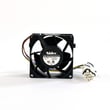
- Refrigerator evaporator fan motor WR60X26866 (moves cold air through the freezer and fresh food sections)
- Refrigerator temperature sensor WR55X10025 (helps the control board regulate temperatures)
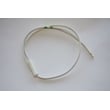
- Refrigerator defrost heater WR51X10132 (melts frost off the evaporator)
- Refrigerator defrost bi-metal thermostat WR50X10108 (helps control defrost cycling)
Last updated: February 2026
What is the most common problem with GE refrigerators?
The most common GE refrigerator complaint is cooling problems (fresh food section too warm, freezer too warm, or temperatures that swing). On your GE CYE22USHBSS bottom-mount refrigerator, many “cooling” calls trace back to airflow, fan operation, defrost issues, or a temperature sensor reading.
Cooling-related issues often show up as one or more of these symptoms:
- Fresh food is warm but freezer seems OK (or the reverse)
- Refrigerator runs a lot, or temperatures drift up and down
- Frost buildup on the back wall or in the freezer compartment
- Loud fan noise, humming, or popping sounds (some sounds are normal)
- Ice maker or dispenser performance drops because temperatures are off
Before replacing parts, these checks solve a lot of “not cooling” complaints:
- Give it time after power loss or first plug-in: the manual notes it can take 24 hours to reach set temperatures.
- Confirm doors are sealing: a poor seal causes warm temps and long run times.
- Avoid blocking vents: overpacked shelves restrict airflow between compartments.
- Clean condenser area (if accessible): dust buildup reduces heat transfer.
- Listen for fan changes: the manual notes fans can run at different speeds to maintain temps and save energy.
If the basics check out, these parts are frequently involved in cooling complaints on refrigerators like this:
| Symptom | Likely system | Example part on this model |
|---|---|---|
| Temps swing or read wrong | Temperature sensing/control | Refrigerator temperature sensor WR55X10025 |
| Warm fridge, weak airflow | Evaporator airflow | Refrigerator evaporator fan motor WR60X26866 |
| Frost buildup, warm temps | Defrost system | Refrigerator defrost heater WR51X10132 or refrigerator defrost bi-metal thermostat WR50X10108 |
For model-specific diagnostics steps and normal operating sounds (clicks, pops, water sounds, fan speed changes), use the owner's manual.
Cooling problems affect food safety, ice production, and energy use. Catching airflow or defrost issues early helps prevent heavy frost buildup and keeps the compressor from running excessively.
Last updated: February 2026