Installation guide
 Owner’s manual
 Error Codes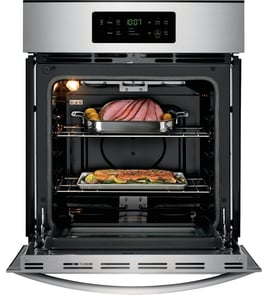


How do I know what size my wall oven is?
For Kenmore wall oven model 79048763901, the “size” is determined by the cabinet cutout width it fits: 27-inch or 30-inch. Measure your cabinet cutout opening (especially the width and height) and match those measurements to the cutout chart in the 79048763901 installation guide.
How to measure your wall oven opening (cutout)
Turn off power at the breaker before measuring around the oven, and measure the cabinet opening, not the oven door.
- Measure the cutout width (left to right) at the front of the opening.
- Measure the cutout height (top to bottom) at both sides.
- Measure the cutout depth (front to back) to confirm the oven will sit fully in the cabinet.
- Measure the cabinet width to confirm it meets the minimum for a 27-inch or 30-inch model.
- Check for obstructions like a junction box location or trim that reduces the opening.
Cutout sizes to compare against
Use this chart to identify whether your opening matches a 27-inch or 30-inch installation range.
| Nominal oven size | Cutout width range (G) | Cutout height range (H) | Minimum cabinet width |
|---|---|---|---|
| 27-inch | 24 7/8" to 25 1/4" | 27 5/16" to 28 1/2" | 27 1/8" |
| 30-inch | 28 1/2" to 29" | 27 5/16" to 28 1/2" | 30 1/8" |
Why it matters
Wall ovens are sold and installed by “nominal size” (27-inch or 30-inch), but cabinets are built to cutout dimensions. Matching the cutout range prevents fit problems, heat buildup from poor spacing, and installation delays.
Last updated: January 2026
Are electric wall ovens 110 or 220?
Most electric wall ovens, including Kenmore model 79048763901, are wired for a 240-volt (often called 220-volt) dedicated circuit and are hardwired to a junction box, not plugged into a standard 120-volt outlet. Confirm the exact electrical requirements in the 79048763901 installation guide.
What to expect for power and wiring
Electric wall ovens typically use a 2-hot-leg supply (L1 and L2) plus ground; some installations also include a neutral depending on the control design.
- 240V supply is the norm for heating performance (bake and broil elements)
- Hardwired connection to an electrical junction box is common for built-in ovens
- A strain relief is typically required where the armored cable enters the junction box
- Grounding is required; the oven must be connected to a grounded, permanent wiring system
- Always disconnect power at the breaker before any wiring work
120V vs 240V: quick comparison
| Item | 120V (standard outlet) | 240V (typical wall oven supply) |
|---|---|---|
| Common use | Small appliances, some gas ovens | Most electric wall ovens and electric ranges |
| Connection style | Plug-in receptacle | Hardwired to junction box (common) |
| Heating capability | Limited for full-size electric ovens | Designed for bake/broil performance |
Important installation notes for this Kenmore wall oven
We see installation guidance emphasizing safe electrical connection practices for this model family.
- Use a qualified installer for installation and service
- Provide a grounded electrical connection
- Keep slack in the cable so the oven can be moved for service
- Use a proper strain relief at the junction box
Why it matters
Using the wrong voltage or connection method can cause no-heat symptoms, nuisance breaker trips, or damage to wiring connections. Verifying the circuit type and junction box wiring before installation helps the oven heat correctly and operate safely.
Last updated: January 2026
What brand is best for a wall oven?
There is no single “best” wall oven brand for everyone; the best choice depends on your cooking features, reliability expectations, and service availability. For a Kenmore wall oven like model 79048763901, we recommend choosing a brand with strong parts support, clear documentation, and a feature set that matches how you bake and broil (convection, self-clean, controls). See the 79048763901 installation guide for the installation requirements that often influence brand and model selection.
What to compare when choosing a wall oven brand
- Service and parts availability in your area (controls, elements, sensors, door parts)
- Cooking performance features: convection fan, multi-rack baking, broil power
- Cleaning type: manual clean vs self-clean (and how often you will use it)
- Control style: touch panel vs knobs, error code clarity
- Fit and installation requirements: cutout size, cabinet support, electrical hookup
Installation fit matters more than most people expect
Even a top-rated brand is a bad choice if it does not fit your cabinet cutout or electrical setup. The Kenmore installation instructions emphasize measuring the cutout first and ensuring the cabinet base can support the oven’s weight.
| What to verify | Why it matters | Typical impact on brand choice |
|---|---|---|
| Cutout width/height/depth | Prevents gaps, binding doors, overheating | Some brands have tighter cutout tolerances |
| Cabinet base strength | Supports the oven safely | Heavier models may require cabinet reinforcement |
| Electrical connection method | Safe, code-compliant install | Some models require specific junction box access |
Reliability tip: choose brands with straightforward diagnostics
Wall ovens are electronics-heavy; when something goes wrong, clear diagnostics save time.
- Look for models with readable error codes and good troubleshooting documentation
- Prioritize brands with available sensors and control parts
- If you already own Kenmore, use the Kenmore 790 manual clean wall oven error codes reference to understand common fault patterns
Why it matters
A wall oven is a built-in appliance; replacing it is more than swapping a countertop product. The “best” brand is the one that fits your cutout, matches your cooking habits, and can be serviced quickly with available parts.
Last updated: January 2026