Owner’s manual
 Error Codes



How to remove bottom grille on GE refrigerator?
On the GE CYE22USHMSS bottom-mount refrigerator, the bottom grille (base grille) is typically removed by releasing its retaining clips or screws and then pulling the grille straight out from the front. We recommend following the exact fastener locations and release points shown in the CYE22USHMSS owner's manual to avoid cracking the grille or the surrounding trim.
Before you start
- Unplug the refrigerator or switch off power at the breaker (you will be working near wiring and moving panels).
- If the unit is tight to the wall, pull it forward carefully to create working room.
- Protect the floor; the manual recommends pulling the refrigerator straight out to help prevent floor damage.
How to remove the bottom grille (common method)
- Look along the top edge and corners of the grille for screws; remove them if present.
- If there are no screws, grip the grille near the left and right ends.
- Pull straight outward to pop the grille free from the retaining clips (avoid twisting).
- If it feels stuck, work one side loose first, then the other, using steady pressure.
- Set the grille aside on a towel to prevent scratches.
How to reinstall the grille
- Line up the grille tabs with the slots in the cabinet frame.
- Press evenly along the grille until the clips snap into place.
- Reinstall any screws you removed and tighten them snugly (do not overtighten).
Why it matters
The bottom grille helps protect components and supports proper airflow at the front base area. Removing it the right way prevents broken mounting tabs, rattles, and cosmetic damage.
Quick troubleshooting if it will not come off
| What you notice | Most likely cause | What we do next |
|---|---|---|
| Grille moves but will not release | Hidden screws at ends or underneath | Recheck for screws before pulling harder |
| One side pops out, other side stuck | Clip still engaged | Pull the stuck side straight out, not upward |
| Plastic flexes a lot | Tabs binding in slots | Press inward slightly, then pull outward evenly |
Last updated: February 2026
What is the most common problem with GE refrigerators ice maker?
The most common ice maker problem we see on GE refrigerators like model CYE22USHMSS is no ice or low ice production because the ice maker is not getting enough water (filter restriction, low water pressure, or a weak inlet valve) or the freezer is not cold enough for the ice maker to cycle. For model-specific operating details, use the owner's manual.
Quick checks that fix most “no ice” complaints
- Confirm the refrigerator is connected to the home water supply and the water is turned on.
- Make sure the ice maker is turned ON at the control panel.
- Wait long enough after installation; many units take 12 to 24 hours to begin making ice.
- Throw away the first 24 hours of ice production to clear the water line and avoid taste issues.
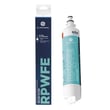
- Replace the water filter if water flow is slow or ice production drops; use GE refrigerator water filter RPWFE.
- Make sure nothing blocks the feeler arm (bin level arm) so the ice maker can cycle normally.
Why water supply issues are so common
Your ice maker depends on consistent water flow. A partially clogged filter or a weak valve can still dispense some water but not fill the ice maker mold correctly, leading to small cubes, hollow cubes, or no ice.
Most-likely causes and what you’ll notice
| Symptom | Most likely cause | What to do first |
|---|---|---|
| No ice at all | Ice maker OFF, no water supply, freezer too warm | Turn ice maker ON, verify water is on, set freezer colder |
| Small or hollow cubes | Restricted water flow | Replace filter, check supply line for kinks |
| Slow ice production | Low water pressure or filter restriction | Replace filter, confirm strong flow at dispenser |
| Buzzing during fill | Normal fill sound (can be louder with low pressure) | Monitor cube size and fill consistency |
Why it matters
When the freezer is too warm or water flow is restricted, the ice maker can cycle inconsistently, waste time trying to fill, and produce poor-quality ice. Fixing water flow and temperature first prevents unnecessary part replacement.
Parts that commonly solve ice and water problems
If the filter is new and the dispenser flow is still weak, the inlet valve is a common next step.
For step-by-step help with filter-related ice issues, use how to replace the water filter in a GE refrigerator.
Last updated: February 2026
Are bottom mount fridges better?
Yes, for many households a bottom-mount refrigerator like the GE CYE22USHMSS is the better layout because the fresh-food section sits at eye and waist level, so you reach everyday items (milk, produce, leftovers) without bending. The tradeoff is that freezer access is lower and typically drawer-based.
What “better” usually means in day-to-day use
- More ergonomic fresh-food access: you use the refrigerator compartment more often than the freezer.
- Better organization for fresh foods: shelves and bins are easier to see and sort.
- Freezer is a pull-out drawer: great for stacking, but small items can get buried.
- Often quieter-sounding operation: modern compressors and airflow can sound different than older units.
- Good fit for cooks: frequent fresh-food use benefits most from this configuration.
Bottom-mount vs top-freezer: quick comparison
| Feature | Bottom-mount (like CYE22USHMSS) | Top-freezer |
|---|---|---|
| Fresh-food access | Best (most-used items higher) | Good, but lower shelves require more bending |
| Freezer access | Lower drawer; more bending | Higher; easier quick access |
| Organization | Strong for fresh foods | Strong for freezer visibility |
| Best for | Families, meal prep, frequent fridge use | Budget-focused, frequent freezer use |
When a bottom-mount is the right choice
A bottom-mount is the best pick when you:
- open the fresh-food doors many times per day
- store lots of produce and refrigerated drinks
- want wide shelves for platters and meal prep
- prefer a freezer drawer for bulk items
Why it matters
Layout affects comfort and food waste. When fresh foods are easier to see and reach, they are more likely to get used before they expire, and you do less bending during everyday cooking.
For model-specific features and care tips for your GE CYE22USHMSS, use the owner's manual.
Last updated: February 2026