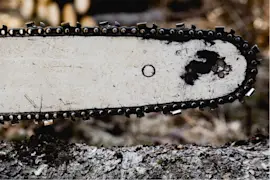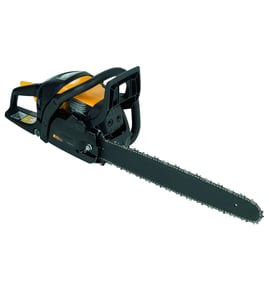

Is a 16 or 18-inch chainsaw better?
A 16-inch chainsaw is better for most homeowner jobs because it’s lighter, easier to control, and less tiring for trimming and limbing. An 18-inch chainsaw is better when you regularly cut thicker wood and want extra reach and cutting capacity.
How to choose the right bar length
- Choose 16-inch for pruning, storm cleanup, and cutting smaller firewood.
- Choose 18-inch if you often buck larger logs or fell small-to-medium trees.
- Prioritize control and safe handling over maximum bar length.
- Match bar length to engine power; longer bars need more torque to keep chain speed up.
- If your saw struggles in the cut, a shorter bar usually improves performance.
Quick comparison
| Feature | 16-inch bar | 18-inch bar |
|---|---|---|
| Best for | Limbing, trimming, general homeowner use | More frequent firewood, thicker trunks/logs |
| Handling | More maneuverable | Heavier, more fatigue over time |
| Cutting capacity | Great for smaller diameter wood | Better reach and larger diameter capability |
| Typical user | Occasional to regular homeowner | Regular cutter who needs more capacity |
What “better” means in real use
A longer bar does not automatically cut faster. If the engine is marginal for the bar length, the chain can bog down, cut slower, and increase kickback risk. For many users, a 16-inch setup feels smoother and more predictable.
Why it matters
Choosing the right bar length helps you cut more efficiently, reduces fatigue, and improves control, which is a key part of safer chainsaw operation. For safety best practices, follow how to prevent chainsaw injuries.
Last updated: January 2026
What does a 050 gauge mean for a chainsaw chain?
A .050 gauge chainsaw chain means the drive links (the tabs that ride in the guide bar groove) are 0.050 inches thick. For a Craftsman chainsaw model 91761406, the chain gauge must match the guide bar groove width so the chain fits correctly and runs safely.
How gauge fits with pitch and drive link count
Gauge is only one of the three sizing specs you need for a replacement chain:
- Gauge: thickness of the drive links (example: .050)
- Pitch: spacing of the chain’s rivets (common pitches include 3/8 in. and .325 in.)
- Drive link count: the number of drive links; this determines chain length
If pitch or drive link count is wrong, the chain will not fit the sprocket or bar length correctly, even if the gauge is right.
Quick gauge reference
| Gauge marking | Inches | Millimeters | How common it is |
|---|---|---|---|
| .043 | 0.043 | 1.1 mm | Less common |
| .050 | 0.050 | 1.3 mm | Very common |
| .058 | 0.058 | 1.5 mm | Very common |
| .063 | 0.063 | 1.6 mm | Less common |
How to confirm your chain gauge
Use one of these reliable checks:
- Look for gauge and pitch stamped on the guide bar (often near the mounting slot)
- Check the chain packaging or any markings on the chain tie straps
- Measure a drive link thickness with calipers (best method if markings are worn)
- Match the chain to the bar groove: a correct chain slides freely but has minimal side-to-side slop
Why it matters
A chain with the wrong gauge can bind in the bar groove (too thick) or wobble and derail (too thin). Either condition increases wear on the bar, sprocket, and clutch, and it can make cutting unsafe.
Related DIY help
If you are also dealing with starting or running issues while servicing the saw, use tips for a hard to start chainsaw for common fuel and carburetor checks.
Last updated: January 2026
What's the highest CC chainsaw?
The highest-CC chainsaws are professional, large-displacement gas models built for heavy-duty felling and milling; the most powerful current production option is commonly cited as the STIHL MS 881 MAGNUM (121.6 cc). For Craftsman model 91761406, CC varies by engine family, so we focus on safe, reliable performance and correct parts fit.
What “highest CC” really tells you
CC (cubic centimeters) is engine displacement; higher CC usually means more torque and the ability to pull longer bars in dense hardwood, but it also adds weight, fuel use, and kickback risk.
- Higher CC helps maintain chain speed under load
- Weight and balance matter as much as power for control
- Bar length must match powerhead capability and oiler output
- Chain type and sharpness can outperform “more CC” in many cuts
- PPE and safe cutting technique become even more critical as power increases
Practical guidance for choosing the right size
Most homeowners do best with a mid-range saw; most pros choose size based on the wood diameter and duty cycle.
| Use case | Typical CC range | Typical bar range |
|---|---|---|
| Limbing, storm cleanup | 30 to 45 cc | 12 to 16 in. |
| Firewood, medium trees | 45 to 60 cc | 16 to 20 in. |
| Large felling, milling | 70 cc and up | 24 in. and up |
Why it matters for your Craftsman 91761406
If your 91761406 feels underpowered, the fix is often maintenance or fuel delivery, not “more CC.” Start with the basics that most affect power:
- Fresh, correct fuel mix and clean fuel path
- Replace cracked or soft fuel line such as fuel ling 29774
- Address carburetor issues (surging, bogging) with carburetor 510217A
- Keep the air filter element clean (restricted airflow reduces power)
For step-by-step help, use tips for a hard to start chainsaw and chainsaw runs rough.
Last updated: January 2026
What size file to sharpen 3/8 chainsaw chain?
For a Craftsman chainsaw like model 91761406, a standard 3/8-inch pitch chain typically sharpens best with a 7/32-inch round file. The correct file size depends on the chain’s pitch and cutter style, so confirm the pitch stamped on the chain or listed on the bar.
Quick file size guide by chain pitch
- 3/8 pitch (standard): 7/32-inch round file
- .325 pitch: 3/16-inch round file
- 3/8 low-profile (Picco/LP): 5/32-inch round file
- If you are unsure, match the file to the cutter’s gullet so the file sits slightly above the top plate
How to confirm you have “3/8 standard” (not 3/8 low-profile)
Look for one of these identifiers:
- Pitch marking on the guide bar (often near the mounting slot)
- Pitch marking on the chain drive links or packaging
- The chain’s model code (many brands encode pitch and gauge)
If the chain is 3/8 low-profile, using a 7/32 file can over-size the gullet and change cutter geometry.
Sharpening basics that affect cutting performance
- File at a consistent top-plate angle (most chains are commonly 25 to 35 degrees)
- Keep file strokes even; count strokes per cutter
- Maintain depth gauges (rakers) at the correct height
- Replace the chain if cutters are too short or damaged
| What you’re sharpening | Most likely file type | Common result if wrong |
|---|---|---|
| 3/8 standard chain | 7/32 round file | Too small: slow cutting; too large: weak edge |
| 3/8 low-profile chain | 5/32 round file | Over-filing, aggressive bite, rough cutting |
| .325 chain | 3/16 round file | Poor edge shape, extra vibration |
Why it matters
Using the correct file size keeps the cutter’s edge angle and side plate shape correct, which improves cutting speed, reduces vibration, and helps your Craftsman saw cut straight with less effort.
For more technique and safety tips, see how to sharpen a chainsaw and how to prevent chainsaw injuries.
Last updated: January 2026