Installation guide
 Owner’s manual
 Error Codes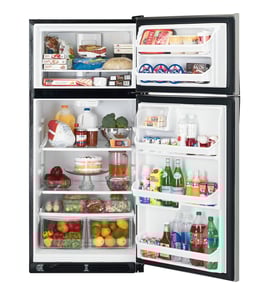




What is a top mount refrigerator?
A top-mount refrigerator (also called a top freezer refrigerator) has the freezer compartment on top and the fresh food section below. Your GE GIE21GTHCBB is a top-freezer design, which keeps everyday refrigerator items at eye level and frozen foods above.
How a top-mount layout is set up
- Freezer on top: frozen food storage and (on some models) the automatic icemaker area
- Fresh food below: main refrigerator shelves, door bins, and crisper drawers
- Single cooling system: cold air is produced at the evaporator and distributed to both sections
- Simple controls: temperature controls are typically inside the fresh food compartment
Why many people choose a top-mount refrigerator
Top-mount models are popular because they balance capacity, efficiency, and straightforward service access.
| Feature | Top-mount refrigerator | Common benefit |
|---|---|---|
| Freezer position | Top | Easy access to frozen items |
| Fresh food position | Bottom | Larger, wide shelf space |
| Typical maintenance | Basic (cleaning, leveling, door seals) | Lower upkeep complexity |
Tips for best performance on the GE GIE21GTHCBB
- Set temperatures and allow 24 hours for changes to stabilize.
- Keep vents clear so air can circulate between compartments.
- Level the refrigerator so doors close easily; adjust the front leveling legs as needed.
- Avoid sudden temperature changes on glass shelves (warm water on cold glass can crack it).
- If equipped with an icemaker, keep the water supply on and the icemaker switch on.
Why it matters
Knowing the top-mount (top-freezer) layout helps you troubleshoot faster. For example, airflow issues, door seal gaps, or leveling problems can affect both the freezer and fresh food temperatures.
For model-specific features and control locations, use the GIE21GTHCBB owner’s manual.
Last updated: January 2026
What is the high end GE refrigerator?
GE’s high-end refrigerator line is Monogram, which is GE Appliances’ luxury brand above standard GE models and typically positioned above GE Profile and GE Café in premium features, materials, and built-in styling options. For feature details that apply to your GE GIE21GTHCBB, use the GIE21GTHCBB owner’s manual.
How GE refrigerator lines typically compare
Monogram is designed as a luxury, built-in focused lineup; GE Profile and GE Café are premium consumer lines; standard GE models focus on value and everyday reliability.
| Line | Typical positioning | Common focus |
|---|---|---|
| Monogram | Luxury | Built-in designs, premium finishes, high-end configurations |
| GE Café | Premium | Style-forward designs, upgraded features |
| GE Profile | Premium | Performance features, smart and convenience options |
| GE | Core | Practical features, value, broad availability |
What this means for your GE GIE21GTHCBB (top-freezer)
Your GIE21GTHCBB is a top-freezer refrigerator, a style that usually prioritizes straightforward cooling performance and serviceable design over luxury built-in customization.
- Expect practical storage and temperature controls for everyday use
- Optional accessories may be available depending on configuration (for example, an icemaker kit)
- Repairs and maintenance are typically part-driven (fans, defrost system, door sealing)
Related parts customers often ask about
If you are upgrading convenience features or troubleshooting ice production, these model-matched parts are commonly relevant:
- GE refrigerator ice maker kit WR30X10093 for adding or restoring automatic ice making
- Refrigerator ice bin WR30X30034 if the bin is cracked or missing
- Refrigerator door switch WR23X20371 if the light or fan behavior changes when the door opens
Why it matters
Knowing the product tier helps set expectations for features, fit, and repair approach. Monogram models are usually built-in and design-driven; your GE GIE21GTHCBB is a dependable top-freezer platform where targeted part replacement often restores performance.
Last updated: January 2026
What is the most common problem with GE profile refrigerators?
The most common service complaint we see across GE Profile refrigerators is not cooling properly (warm fresh food section, soft ice cream, or temperature swings). On your GE GIE21GTHCBB top-mount refrigerator, cooling issues are often tied to airflow, defrost performance, or door sealing; start with the checks in the GIE21GTHCBB owner’s manual.
Most common GE Profile refrigerator problems (and what they usually point to)
- Not cooling or weak cooling: blocked vents, dirty condenser area, evaporator fan issue, or a defrost problem
- Strange noises: many humming, whooshing, and gurgling sounds are normal during operation
- Ice maker not working: water supply/shutoff valve issue, frozen fill path, or ice maker component failure
- Water leaking: defrost drain restriction, water line connection issue, or door left ajar causing excess frost melt
- Door not closing or popping open: leveling/roller adjustment or gasket sealing problems
Quick triage for “not cooling” (best first steps)
- Confirm controls are set to a cooling temperature, not “off”.
- Give it time after changes: allow up to 24 hours to fully stabilize after installation or major adjustments.
- Check installation conditions: GE recommends avoiding locations below 55°F or above 100°F for proper performance.
- Verify clearances for airflow (typical guidance from GE): sides 1/8 inch, top 1/8 inch, back 1 inch.
- Listen for normal operating sounds before assuming a failure.
Parts that commonly relate to these symptoms on GIE21GTHCBB
| Symptom | Common area to inspect | Example model-matched part |
|---|---|---|
| Warm refrigerator section | Evaporator airflow | Refrigerator evaporator fan assembly WR60X25798 |
| Frost buildup, warming | Defrost system | Refrigerator defrost heater WR09X24623 |
| No ice production | Ice maker system and water supply | GE refrigerator ice maker kit WR30X10093 |
Why it matters
Cooling and ice issues can be caused by simple setup problems (leveling, airflow clearances, temperature settings) that mimic a major failure. Ruling those out first saves time and helps you replace only the parts that actually fix the problem.
Last updated: January 2026