Installation guide
 Owner’s manual


What is the life expectancy of a KitchenAid dishwasher?
A KitchenAid dishwasher typically lasts 10 to 14 years. For your KitchenAid KUDS40CVBL0, lifespan depends most on installation quality, water conditions, and routine care like cleaning and using rinse aid correctly; following the KUDS40CVBL0 owner’s manual helps you get the full service life.
Most KitchenAid dishwashers fall into this range with normal household use:
- 10 to 14 years: typical service life
- Shorter life: hard water scale, frequent heavy loads, poor draining, or leaks
- Longer life: good water quality, correct detergent and rinse aid use, regular cleaning
These are common wear items and failure points over time:
- Drain components (clogs, worn impeller, slow drain)
- Wash pump and motor (noisy operation, weak spray)
- Door balance and hinges (door dropping, not staying open)
- Electronic controls (intermittent operation, dead panel)
- Seals and gaskets (leaks)
Use these habits to reduce strain on the pump, heater, and seals:
- Scrape off heavy food; avoid letting labels, bones, or glass enter the sump
- Clean the interior and address odors and buildup regularly
- Use rinse aid, but do not overfill; a secure lid helps prevent dispenser leaks
- Run hot water at the sink before starting a cycle (improves wash performance)
- Keep the drain path clear and make sure the drain hose routing is correct
| Usage pattern | What to expect | Best focus |
|---|---|---|
| Light (few loads/week) | Often reaches the high end of the range | Cleaning and leak prevention |
| Average (daily or near-daily) | Typical 10 to 14 years | Drain and pump health |
| Heavy (multiple loads/day) | Often shorter life | Water quality, loading, and maintenance |
Dishwashers usually do not fail all at once; performance drops first (poor cleaning, not draining, unusual noise). Catching those early signs and keeping up with care helps your KUDS40CVBL0 avoid pump damage, leaks, and control issues.
Last updated: January 2026
What is the most common problem with a KitchenAid dishwasher?
For the KitchenAid KUDS40CVBL0 dishwasher, the most common problems we see are poor cleaning (often tied to loading, spray coverage, or filtration) and won’t start / won’t run symptoms caused by a door not latching, a paused cycle, or a power issue. Use the KUDS40CVBL0 owner's manual troubleshooting section to narrow it down quickly.
- Dishes still dirty: blocked spray paths, overloaded racks, filter or sump soil buildup, or low water temperature
- Dishwasher won’t start: door not fully latched, cycle not selected, START/RESUME not pressed correctly, or a tripped breaker
- Not draining: drain path restriction, kinked hose, or a failing drain pump
- Leaks: door sealing surfaces dirty, worn seals, or a loose hose connection
- Buttons unresponsive: console/touchpad issues or control board problems
The manual notes it’s normal for the dishwasher to pause during a cycle; if the START/RESUME light is blinking, press START/RESUME and make sure the door is firmly closed and latched.
- Press START/RESUME, then close the door firmly (especially if controls are on the top edge of the door)
- Confirm a cycle is selected before starting
- Check the home breaker/fuse supplying the dishwasher
- Remove loading issues: keep items from blocking spray arms and the rear wash area
- Clean out visible debris in the bottom (around the sump area)
If the basic checks pass and the symptom repeats, these parts are common suspects on dishwashers like the KUDS40CVBL0.
| Symptom | Common part to check | What it affects |
|---|---|---|
| Won’t drain / water left in tub | Dishwasher drain pump WPW10348269 | Pumps water out during drain |
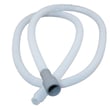
| Won’t drain / slow drain | Dishwasher drain hose 8269144A | Carries drain water to disposal/standpipe |
| Dead or intermittent power | Fuse W10258275 | Protects the control circuit |
| Random behavior / won’t run | Dishwasher electronic control board WPW10084141 | Runs cycles and manages inputs |
Catching the “most common” issues early saves time and prevents secondary problems. For example, a simple drain restriction can look like a pump failure, and a door that is not fully latched can look like an electrical problem.
Last updated: January 2026
How do I find the model number on my KUDS40CVBL0?
On your KitchenAid KUDS40CVBL0 dishwasher, the model number is printed on the model and serial label inside the tub, near the door opening. Look along the right-hand or left-hand side of the dishwasher interior, close to the door.
- Open the dishwasher door fully.
- Look for a sticker or metal tag near the door opening.
- Check the right interior side wall first, then the left.
- Wipe the area with a damp cloth if the label is dusty or spotted.
- Write down the full model number and the serial number (both are useful for parts matching).
| Label item | What it’s used for |
|---|---|
| Model number (example: KUDS40CVBL0) | Ensures the correct parts and diagrams for your exact dishwasher |
| Serial number | Helps identify production details when troubleshooting or confirming compatibility |
We use the full model number to match the exact KitchenAid parts and diagrams for your dishwasher. Even small model-number differences can change items like the dishwasher electronic control board WPW10084141, door seal, or pump components.
- If you’re ordering parts, copy the model number exactly as shown.
- If the label is hard to read, take a photo with your phone and zoom in.
- For additional location details and troubleshooting guidance, check the owner's manual.
Last updated: March 2026