Owner’s manual
 Error Codes




What is the advantage of a bottom mount fridge?
A bottom-mount refrigerator like the KitchenAid KBFC42FTS07 keeps the fresh-food compartment at eye and waist level, so you reach everyday items with less bending. The freezer stays below, which is convenient for bulk storage and helps keep frequently used foods easiest to access.
- Less bending for fresh foods, drinks, and leftovers (the most-used section is higher)
- Easier organization of produce and deli items because shelves are at a natural viewing height
- Freezer drawer/bins can hold bulky items and make it simpler to separate frozen foods
- Better ergonomics for many households, especially if you are in and out of the refrigerator often
| Feature | Bottom-mount refrigerator | Top-mount refrigerator |
|---|---|---|
| Fresh-food access | Higher and easier | Lower and requires more bending |
| Freezer access | Lower drawer/bins | Higher shelf-style |
| Best for | Frequent fresh-food use | Frequent freezer use |
Most households open the refrigerator section far more than the freezer. With a bottom-mount design, the foods you use most are positioned where you can see and grab them quickly, which reduces strain and can help you keep temperatures steadier by shortening door-open time.
- Keep everyday items on the middle shelves for fastest access
- Store raw meats on the lowest refrigerator shelf to reduce drip risk
- Use freezer bins by category (meat, vegetables, prepared foods) to cut search time
- Follow the temperature and airflow guidance in the owner's manual
Last updated: February 2026
What's the average lifespan of a KitchenAid refrigerator?
KitchenAid refrigerators typically last 12 to 15 years on average, and many run 10 to 17 years with normal use and good maintenance. For your KitchenAid KBFC42FTS07 bottom-mount refrigerator, routine care like keeping airflow clear and replacing filters on schedule helps you reach the upper end of that range.
A refrigerator’s life is mostly driven by compressor run time, airflow, and how hard the sealed system has to work.
- Maintenance habits (cleaning, filter changes, door seal care)
- Room temperature and ventilation around the cabinet
- Door opening frequency and how full the compartments are
- Water quality (affects dispenser and ice maker components)
- Dust and pet hair buildup near the condenser area
These steps reduce strain on the compressor, fans, and controls.
- Replace the water filter on schedule; use the correct fit such as refrigerator filter EDR3RXD1
- Keep vents inside the fresh food and freezer sections unblocked
- Clean the condenser area periodically (frequency depends on dust and pets)
- Confirm doors close and seal fully; avoid slamming drawers/doors
- If cooling seems uneven, inspect for frost buildup and listen for fan operation
| Item | Typical interval | Why it matters |
|---|---|---|
| Water filter | About every 6 months | Protects water flow, ice quality, and valve performance |
| Condenser area cleaning | Every 6 to 12 months | Improves heat removal and reduces compressor run time |
| Door gasket wipe-down | Monthly | Prevents air leaks that cause long run times |
| Temperature check | Seasonally | Keeps food safe and avoids overworking the system |
When airflow is restricted or filters are overdue, the refrigerator runs longer to hold temperature. That extra run time accelerates wear on key components like the condenser fan, evaporator fan, and compressor.
Use the care and maintenance schedule in the owner's manual for KBFC42FTS07 to match your exact configuration (filter location, control settings, and recommended temperatures).
Last updated: February 2026
What is the most common problem with KitchenAid refrigerators?
For KitchenAid refrigerators like model KBFC42FTS07, the most common issues we see are ice maker problems (no ice, slow ice, small cubes) and cooling or temperature swings caused by airflow restrictions, dirty condenser coils, or a failing fan or sensor. Use the KBFC42FTS07 owner's manual for model-specific checks and settings.
- Ice maker not making ice or slow production: water supply issue, clogged filter, or ice maker failure
- Fresh food section warm but freezer cold: evaporator fan or airflow/icing problem
- Both sections warm: condenser airflow problem, condenser fan issue, or sealed-system concern
- Frost buildup or water leaks: defrost drain restriction or door seal issue
- Unusual humming, rattling, or clicking: fan blade interference or fan motor wear
- Confirm the temperature settings and allow 24 hours after any adjustment.
- Make sure vents inside the refrigerator and freezer are not blocked by food packages.
- Check for heavy frost on the freezer back wall (often signals an airflow or defrost issue).
- If you have a dispenser, flush water for a few minutes to clear trapped air after any filter change.
- If ice is slow or tastes off, replace the water filter and reset the filter indicator if your model has one.
| Problem area | Common part involved | What it affects |
|---|---|---|
| Water quality and ice production | Refrigerator filter EDR3RXD1 | Ice maker fill rate, taste/odor, dispenser flow |
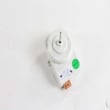
| Freezer-to-fridge airflow | Maytag refrigerator evaporator fan motor W11671461 | Cooling consistency, warm fresh food section |
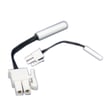
| Temperature feedback | Refrigerator temperature sensor WP2188820 | Temperature swings, overcooling or warming |
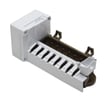
| Ice production mechanism | Refrigerator ice maker WPW10277450 | No ice, intermittent ice, small batches |
Ice maker and temperature complaints often share the same root cause: restricted airflow or restricted water flow. Fixing the underlying cause protects food safety, reduces compressor run time, and prevents repeat failures.
Last updated: February 2026
Why is water collecting in the bottom of my KitchenAid refrigerator?
Water collecting in the bottom of your KitchenAid KBFC42FTS07 refrigerator is usually caused by a clogged or frozen defrost drain, which forces defrost water to spill into the fresh food compartment instead of flowing to the drain pan.
- Defrost drain clogged with food particles, sludge, or ice
- Drain tube frozen from repeated door openings or warm, humid air
- Drain trough iced over after a heavy frost event
- Door not sealing well, creating excess frost that overwhelms the drain
- Refrigerator not level, so water runs forward instead of toward the drain
- Unplug the refrigerator and remove items from the bottom shelf/crispers.
- Look for ice or standing water at the bottom rear of the fresh food section.
- Melt ice with warm water (not boiling) and towels.
- Clear the drain hole using a pipe cleaner or flexible zip tie.
- Flush the drain with warm water until it flows freely to the drain pan.
- Follow our step-by-step article: how to get rid of refrigerator puddles
| What you see | What it usually means | What to do next |
|---|---|---|
| Sheet of ice on the floor of the fridge | Drain is frozen or blocked | Thaw and flush the drain line |
| Water only after defrost cycles | Drain restriction | Clean drain hole and tube |
| Frost buildup near vents | Air leak or airflow issue | Check door seal and avoid blocking vents |
| Water near the filter area | Filter/cap not seated | Reseat filter and cap |
If the water is related to the filter housing area (not the drain), make sure the filter is fully seated and the cap is installed correctly.
Standing water can refreeze into a thick ice layer, restrict airflow, and lead to warmer temperatures in the refrigerator section. Fixing the drain issue early helps protect food temperatures and prevents recurring leaks.
For model-specific access points and panel removal details, use the owner's manual.
Last updated: February 2026