Owner’s manual
 View engine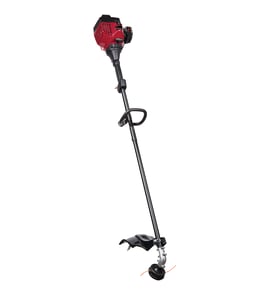


How to replace trimmer line on Craftsman Weedwacker?
To replace trimmer line on your Craftsman high wheel line trimmer model 917773750, disconnect the spark plug wire, remove the worn line from the carrier plate, then install new .155-inch line cut to 18-3/4 inches and seat it under the retainer clips. See the 917773750 owner's manual for the diagrams and line-length gauge marks.
Step-by-step: replace the trimmer line
- Disconnect the spark plug wire and move it where it cannot touch the plug.
- Pull out and remove the worn trimmer line from the line carrier plate.
- Cut new bulk line to 18-3/4 in. (or use pre-cut line made for this unit).
- Fold one piece of line in half.
- Insert the folded end through the carrier plate opening to the back side of the retainer clip.
- Pull both ends outward until the line is fully seated under the retainer clip.
- Repeat for the other side; confirm all lines are the same length, then reconnect the spark plug wire.
Cutting the line to the correct length (bulk line)
Your 917773750 uses a built-in length gauge on the debris shield to help you measure before installing.
| Line type | What to do | Target length |
|---|---|---|
| Pre-cut line | Install as-is | Already correct |
| Bulk line | Measure using the debris shield gauge, then cut | 18-3/4 in. |
Common mistakes that cause poor cutting
- Using the wrong diameter line; this model uses .155 diameter line.
- Installing uneven lengths; uneven line causes vibration and weak cutting.
- Letting the line wear below half its original length before replacing.
- Trimming with the head contacting concrete or asphalt; it wears the trimmer head and line faster.
Why it matters
Correct line diameter and length help the trimmer cut cleanly, reduce vibration, and prevent extra wear on the trimmer head components (including the mower ball and debris shield area).
Last updated: February 2026
What size is the fuel line on a Craftsman trimmer?
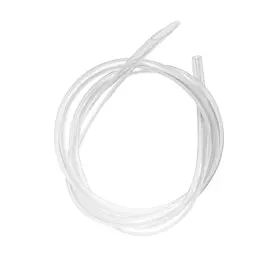
For the Craftsman high wheel line trimmer model 917773750, the manual content we have for this model lists fuel type and capacities but does not specify a fuel line inside diameter or outside diameter. For most small-engine Craftsman trimmers, fuel line is commonly sized by ID/OD and must match the tank grommet and carburetor fittings; we recommend confirming the exact size using the 917773750 owner's manual and a quick measurement of your existing line.
How to identify the correct fuel line size (fast and accurate)
Use the old line as your template; fuel line sizing is based on inside diameter (ID) and outside diameter (OD).
- Remove the old line and cut a clean, square end.
- Measure ID (hole size) and OD (outside width) with a caliper.
- Match the new line to the tank grommet fit; it should seal tightly.
- Match the new line to the carburetor inlet; it should slide on firmly without splitting.
- Replace any hardened grommet or cracked primer/fuel fittings at the same time.
Typical fuel line sizes you will see on small gas trimmers
These are common ranges used across many small-engine trimmers; choose the one that matches your measured ID/OD.
| Common use case | Typical ID | Typical OD |
|---|---|---|
| Small return/vent line | 1/16 in to 3/32 in | 1/8 in to 5/32 in |
| Main fuel supply line | 3/32 in to 1/8 in | 3/16 in to 1/4 in |
Why it matters
A fuel line that is too small can restrict fuel flow and cause surging or stalling. A line that is too large can leak air or fuel, leading to hard starting and poor performance. Correct sizing also prevents the line from slipping off under vibration.
Related model-specific tip
When you are servicing the fuel system, it is a good time to verify other consumables listed for this model, such as the specified trimmer line diameter and length in the 917773750 owner's manual.
Last updated: February 2026
Why is my Craftsman Weedeater not starting?
If your Craftsman high wheel line trimmer model 917773750 will not start, the most common causes are stale fuel, a dirty air filter, a fouled spark plug, or a throttle/choke setting issue. Start with basic fuel and ignition checks, then move to airflow and control-cable inspection using the 917773750 owner's manual.
Quick checks (fastest fixes first)
- Drain old fuel and refill with fresh, properly mixed fuel (if your engine requires mix) or fresh straight gas (if 4-cycle).
- Move the throttle to FAST and set the choke for a cold start.
- Check the spark plug: clean or replace if wet, black, or damaged.
- Inspect the air filter; replace if dirty or oil-soaked.
- Confirm the stop switch (if equipped) is in the ON/RUN position.
Air, fuel, spark: what to test
A no-start condition is usually one of these three systems.
| System | What you notice | What to do |
|---|---|---|
| Fuel | Smell of gas, won’t fire at all, or only fires briefly | Replace old fuel; check for fuel flow and a clogged carburetor jet |
| Spark | Engine cranks but never “catches” | Replace spark plug; verify spark with a spark tester |
| Air | Plug looks wet, engine seems flooded | Replace/clean air filter; open choke after it pops |
Model-specific items to inspect on 917773750
This model uses a belt-driven high-wheel trimmer setup; if the engine starts but the head does not spin, that is a separate drive issue.
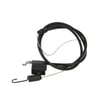
- If the throttle feels loose or does not return smoothly, inspect the control linkage and consider replacing the control cable 532181699.
- If the engine runs but the trimmer head does not engage, inspect the belt condition and tension; the correct belt is the high-wheel trimmer driveshaft belt 532185476.
Why it matters
A clogged air filter or incorrect choke/throttle setting can flood the engine (too much fuel, not enough air), while a worn spark plug prevents ignition. Fixing the root cause prevents repeated hard-starting and reduces wear on the starter and engine.
Last updated: February 2026