Owner’s manual
 Error Codes


What is the most common problem with Samsung refrigerators?
The most common issue we see with Samsung refrigerators, including the Samsung RS27FDBTNSR, is a cooling performance problem caused by restricted airflow or frost and ice buildup around the evaporator area, which can make the fresh food section warm even when the freezer seems okay. Use the RS27FDBTNSR owner's manual to confirm the correct operating and care steps for your exact configuration.
What it usually looks like in real life
Common symptoms customers report with side-by-side units include:
- Refrigerator side warms up, freezer stays closer to normal
- Temperature swings or food freezing in the refrigerator section
- Fan noise, rubbing, or intermittent buzzing (often when frost builds up)
- Weak airflow from vents (blocked vents or frost restriction)
- Ice maker or dispenser performance issues that show up after cooling problems start
Quick checks that fix many “cooling problem” complaints
Before replacing parts, we recommend these model-safe checks that match Samsung’s usage cautions:
- Keep food packages away from rear vents so air can circulate properly.
- Do not block air holes; blocked airflow can lead to overcooling in spots and poor cooling elsewhere.
- Make sure doors close fully and seals are clean so humidity does not feed frost buildup.
- If you notice burning smell, smoke, or unusual electrical odor, unplug the refrigerator and arrange service.
- If the unit will be unused for 3 weeks or more, empty it, shut off the water, unplug it, dry the interior, and leave doors open to prevent odors and mold.
Parts that are commonly involved when cooling is inconsistent
If the quick checks do not help, these components are frequently involved in cooling and airflow complaints:
| Symptom | Common area to inspect | Example part for this model |
|---|---|---|
| Warm refrigerator section | Evaporator airflow | Evaporator fan motor assembly |
| Frost and airflow restriction | Defrost sensing/control | Temperature sensor |
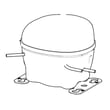
| Poor overall cooling | Sealed system/compressor | Samsung refrigerator compressor MKV190CL2BASH |
Why it matters
Cooling problems are rarely “just temperature”; they affect food safety, ice production, and energy use. Keeping vents clear and seals tight helps the RS27FDBTNSR maintain stable temperatures and reduces frost-related airflow restrictions.
Last updated: February 2026
What does FD mean on Samsung refrigerator?
On Samsung refrigerators like model RS27FDBTNSR, FD means the unit is in forced defrost mode. Forced defrost is a built-in service/test function that runs the defrost heater to clear frost from the evaporator so airflow and cooling can return to normal.
What you should do when you see FD
- Wait for the forced defrost cycle to finish if you intentionally started it.
- If you did not start it, power-cycle the refrigerator (unplug for 2 to 5 minutes, then plug back in).
- Check that the doors are fully closing and sealing; warm air leaks can cause heavy frost.
- Listen for the evaporator fan; a stalled fan can mimic a frost problem.
- If FD returns repeatedly, use the troubleshooting steps in the RS27FDBTNSR user manual.
Common reasons FD shows up (and what it points to)
FD itself is not an “error code”; it is a mode. If it keeps coming back, it usually points to a defrost or airflow issue.
| What you notice | What it often means | What to check first |
|---|---|---|
| Freezer warms up, then recovers | Frost buildup restricting airflow | Door left ajar, gasket sealing, vents blocked |
| Loud fan noise or no fan sound | Fan hitting ice or fan not running | Frost on rear panel, fan operation |
| Water/ice under crisper or on freezer floor | Defrost drain issue | Drain trough and drain path for ice blockage |
| FD appears after a power outage | Control reset or test mode triggered | Power-cycle, then monitor |
Why it matters
Forced defrost helps clear frost that can block the evaporator and reduce airflow. When airflow drops, temperatures rise, ice production slows, and the compressor may run longer than normal.
Last updated: February 2026
What are the dimensions of the Samsung RS27FDBTNSR?
For the Samsung RS27FDBTNSR side-by-side refrigerator, the installation table in the RS27FDBTNSR owner's manual lists key fit dimensions such as 48 in overall width with doors open and an enclosure depth of 27.6 in (701 mm); it also shows a minimum to maximum enclosure height range of 83.5 to 84.3 in.
Dimensions you can use for planning (from the manual)
These measurements are the most useful when you are checking doorway clearance, cabinet opening size, and door swing.
- Doors open (90°): A = 44.5 in (1129 mm), B = 52.5 in (1333 mm)
- Doors open (130°): F = 46.3 in (1176 mm)
- Front/side reference: A = 48 in (1219 mm)
- Enclosure depth: 27.6 in (701 mm)
- Enclosure height: 83.5 in min to 84.3 in max (2121 to 2141 mm)
Quick fit table
| What you are measuring | Dimension shown in manual | What it helps with |
|---|---|---|
| Enclosure depth | 27.6 in | Cabinet depth and rear clearance planning |
| Enclosure height | 83.5 to 84.3 in | Opening height and leveling range |
| Door swing (90°) | 44.5 in and 52.5 in | Space needed to open doors and remove bins |
| Door swing (130°) | 46.3 in | Extra clearance for wider access |
Why it matters
Refrigerator “overall” dimensions and “doors open” dimensions solve different problems. The enclosure depth and height help you confirm the unit will physically fit the cutout, while the door-open measurements help you avoid blocked doors, damaged trim, and poor airflow.
Tips before you move the refrigerator into place
- Measure all doorways and turns from delivery path to the kitchen.
- Confirm the floor is flat and strong to reduce vibration and noise.
- Leave space on the left, right, back, and top for air circulation.
- If you use the dispenser, confirm a nearby water supply and grounded outlet.
Last updated: February 2026
Why does my Samsung refrigerator dispense water but not ice?
If your Samsung RS27FDBTNSR refrigerator dispenses water but not ice, the water system is working but the ice-making path is blocked or not producing. Most fixes are simple: allow enough time for ice production, confirm freezer temperature, clear clumped ice in the bin, and check for a frozen fill tube.
Quick checks that fix most “no ice” issues
- Wait at least 12 hours after installation or a long outage for the first ice; allow 24 hours to build a full bin.
- Set the freezer to 0°F (-18°C) and keep doors closed as much as possible.
- Remove the ice bin and break up or discard clumped ice; stuck cubes can stop dispensing.
- Dispense ice with the cup pressed against the center of the dispenser lever (the lower part may not activate).
- If ice is discolored, stop using the ice.
Step-by-step: what to do next
- Empty the ice storage bin completely, then reinstall it fully seated.
- Check the freezer for frost buildup around the ice room or fill area; heavy frost often points to airflow or door-seal issues.
- Replace an overdue water filter; restricted flow can reduce or stop ice production.
Helpful references:
- RS27FDBTNSR owner's manual
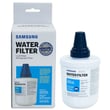
- Refrigerator water filter DA29-00003F
- Why your Samsung fridge stopped making ice and how to fix it
What the symptoms usually mean
| Symptom | Most likely cause | What we recommend |
|---|---|---|
| Water dispenses normally, no ice made | Freezer too warm or not enough time | Set to 0°F, wait 12 to 24 hours |
| Ice made but will not dispense | Ice clumped in bin | Empty bin, discard clumps |
| Ice output weak or slow | Filter restriction | Replace filter, then purge water |
Why it matters
Ice production depends on freezer temperature, airflow, and steady water flow. Even when the dispenser still gives water, a warm freezer, clumped ice, or a restricted filter can stop the ice maker from cycling normally.
Last updated: February 2026