Installation guide
 Owner’s manual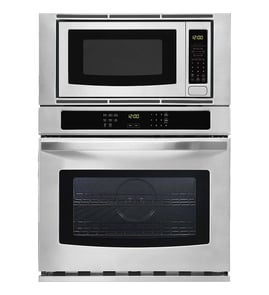





What are the disadvantages of a microwave oven combo?
A microwave/oven combo like the KitchenAid KEMS379BSS00 saves space, but the main disadvantages are higher purchase and repair costs, more complex installation (cabinet cutout and electrical requirements), and reduced flexibility because if one section fails, you may lose both cooking options until it’s repaired. See the KEMS379BSS00 installation guide for cutout and power details.
Common disadvantages (what we see most often)
- Higher total cost than buying a separate microwave and wall oven.
- More complex repairs because components are stacked and share controls, wiring, and safety interlocks.
- Downtime risk: one failure can take out your main cooking setup.
- Installation constraints: you must match cabinet cutout width, height, and depth, plus proper circuit sizing.
- Tighter service access: built-in units can require removal from the cabinet for some repairs.
- Learning curve: more modes (convection, sensor cooking, etc.) can mean more settings to manage.
Installation and electrical trade-offs
Built-in combos are less forgiving than countertop microwaves or freestanding ranges. For example, the installation instructions for this style of 27-inch and 30-inch built-in microwave/oven combination call out specific cutout dimensions and power requirements. Use the KEMS379BSS00 installation guide to confirm your cabinet cutout and electrical supply before committing to replacement or remodel work.
| Topic | Combo unit impact | What to plan for |
|---|---|---|
| Cabinet fit | Must match cutout specs | Measure cutout width, height, depth |
| Electrical | Higher amperage draw than a microwave alone | Dedicated circuit, correct wiring |
| Serviceability | Harder to pull and access | Allow time for removal and re-install |
Why it matters
A combo unit is a great space-saver, but it is a single point of failure in the kitchen. Planning for installation requirements and understanding repair complexity helps you avoid surprises with scheduling, cost, and downtime.
Last updated: February 2026
What is the life expectancy of a KitchenAid wall oven?
A KitchenAid wall oven typically lasts 10 to 15 years. For your KitchenAid KEMS379BSS00 wall oven/microwave combo, lifespan depends most on heat exposure (especially self-clean cycles), ventilation, and keeping electrical connections tight and protected.
Typical life expectancy (what to expect)
Most built-in electric wall ovens fall into this range:
| Usage and care level | Typical lifespan | What usually fails first |
|---|---|---|
| Light use, good ventilation, gentle cleaning | 15 years | Control components, door parts |
| Average family use | 10 to 15 years | Bake element, sensor, control |
| Heavy use, frequent high-heat self-clean | 8 to 12 years | Thermal protection, electronics |
What extends the life of a KEMS379BSS00
We see the longest-lasting units when owners focus on heat management and basic upkeep:
- Keep vents clear and avoid blocking airflow around the built-in cabinet opening.
- Use self-clean sparingly; high heat stresses wiring, thermal fuses, and control boards.
- Wipe spills after the oven cools to reduce smoke and overheating during future bakes.
- Avoid slamming doors; it protects hinges, glass, and door alignment.
- Use the correct rack positions and cookware to prevent hot spots and long bake times.
Parts that commonly affect “end of life”
A wall oven often feels “worn out” when a few key parts start failing more often. On this model, common repair items include:
- Oven bake element W11545804 (no heat or uneven baking)
- Oven electronic control WPW10708464 (dead display, erratic temps, error codes)
- Temperature sensing and safety devices (overheating shutdowns)
Why it matters
A built-in combo unit like the KEMS379BSS00 runs hot in a tight cabinet. The installation requirements call for a fully enclosed recessed area, proper clearances, and a grounded electrical supply; meeting those requirements reduces heat stress and electrical damage over time. Use the KEMS379BSS00 installation guide to confirm cabinet cutout, support, and electrical connection basics.
Last updated: February 2026
How to reset a KitchenAid wall oven?
To reset your KitchenAid KEMS379BSS00 wall oven/microwave combo, we recommend power-cycling the unit: turn the circuit breaker OFF until the display goes dark, then turn it back ON. When power returns, the display should light briefly and you may see “PF” (power failure), which confirms the reset.
Quick reset steps (power cycle)
- Turn the oven OFF using CANCEL/OFF.
- Switch the dedicated oven breaker OFF at your home electrical panel.
- Wait 1 to 5 minutes.
- Switch the breaker back ON.
- Set the clock and any preferences again.
- Test a basic function like BROIL for the lower oven.
What “PF” means after a reset
“PF” indicates a power interruption. After a reset on KEMS379BSS00, seeing “PF” is normal and tells us the control rebooted successfully. Clear it by pressing CANCEL/OFF, then reprogram the clock.
If the oven still will not run after resetting
Use this checklist to narrow down the cause:
- Confirm the household breaker is not tripped (and is fully seated).
- Verify the electrical supply is connected and stable.
- If the display stays blank after restoring power, recheck the breaker and wiring connection.
- If an error code appears, look it up and follow the recommended checks.
- If the oven runs but does not heat after 5 minutes, stop the test and proceed with troubleshooting.
| Symptom after reset | Most likely direction | What to do next |
|---|---|---|
| Display shows “PF” | Normal reboot | Press CANCEL/OFF; reset clock |
| Display blank | Power supply issue | Check breaker, junction box connection |
| Error code shows | Control detected a fault | Use KitchenAid wall oven error codes |
Why it matters
A reset clears temporary control glitches after a power flicker and is the fastest first step before replacing parts like an oven electronic control WPW10708464 or checking heat-related components.
For model-specific operating steps and display messages, follow the KEMS379BSS00 installation guide.
Last updated: February 2026