Installation guide
 Owner’s manual
 Error Codes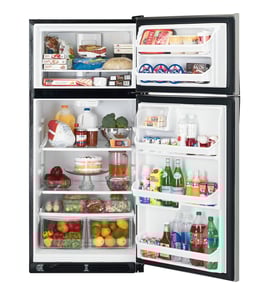


How to move a Westinghouse fridge?
To move your White-Westinghouse WRT5B1EW4 top-mount refrigerator safely, we recommend emptying it, turning the controls to OFF, disconnecting power, and using a hand truck loaded from the side with padding and straps. Keep the cabinet protected and the doors secured during transport.
Safe moving steps (WRT5B1EW4)
- Remove all food and ice.
- Turn the temperature controls to “O” (OFF).
- Unplug the refrigerator.
- If you have an ice maker, turn it off and close the water supply valve.
- If using a handcart (dolly), load from the side for better balance.
- Pad the cabinet with moving blankets; strap the refrigerator tightly to the dolly.
Protect the refrigerator before you roll it
The manual calls out a few details that prevent damage while moving:
- Adjust the rollers all the way up to protect them during sliding or moving.
- Keep the cabinet padded to avoid scratches and dents.
- Leave doors closed and secured (tape or a strap) so they do not swing open.
Water line tip (if connected)
If your WRT5B1EW4 is connected to a household cold water line, plan enough slack so the refrigerator can be pulled out for cleaning and service. The installation guidance commonly adds extra length so the unit can move without stressing the tubing.
| Item | What we recommend | Why it helps |
|---|---|---|
| Hand truck position | Load from the side | Reduces tip-over risk |
| Cabinet protection | Blankets plus straps | Prevents scratches and shifting |
| Rollers | Rollers adjusted up | Helps avoid roller damage |
| Water supply | Valve closed (if equipped) | Prevents leaks during transport |
Why it matters
Moving a top-mount refrigerator incorrectly can damage rollers, dent the cabinet, or strain the water supply line (if equipped). A few prep steps protect the sealed system, doors, and finish so the refrigerator cools normally after it is set back in place.
For model-specific moving and installation details, follow the WRT5B1EW4 owner's manual.
Last updated: February 2026
What temperature should my Westinghouse fridge be set at?
For the White-Westinghouse WRT5B1EW4, we set the fresh food (refrigerator) section to 34°F to 40°F (with 37°F as the best target) and the freezer to 0°F or colder. Make changes gradually and give the temperatures time to stabilize between adjustments (see the WRT5B1EW4 owner's manual).
Recommended temperature targets
Use these as your day-to-day goals for safe food storage:
- Refrigerator: 34°F to 40°F (best target: 37°F)
- Freezer: 0°F or lower
- After changing a control: allow about 24 hours for temperatures to stabilize
- After first start-up: run 8 to 12 hours with doors closed before loading food
How to adjust the controls on this model
This refrigerator uses control knobs; small changes make a big difference.
- Move the refrigerator control in small increments.
- Turning the refrigerator control colder affects both the refrigerator and freezer temperatures.
- If you make the refrigerator colder, you may need to adjust the freezer control warmer to balance.
- Keep food from blocking cold air vents so air can circulate.
Quick reference table
| Compartment | Best target | Acceptable range | Notes |
|---|---|---|---|
| Fresh food (fridge) | 37°F | 34°F to 40°F | Avoid overcrowding shelves for even cooling |
| Freezer | 0°F | 0°F or lower | Runs most efficiently when at least 2/3 full |
Why it matters
Correct temperature settings help prevent food spoilage, reduce uneven cooling, and keep the refrigerator from running longer than necessary. If temperatures swing, airflow issues (blocked vents, overpacked shelves) are often the first thing we correct.
Last updated: February 2026
How do I reset my Westinghouse fridge not cooling?
For your White-Westinghouse WRT5B1EW4 top-mount refrigerator, the most effective “reset” is a power reset: unplug it (or turn off the breaker) for 5 minutes, then restore power and allow a full cool-down period. After power is restored, keep doors closed and give it 8 to 12 hours to cool before judging results (24 hours for full stabilization). See the WRT5B1EW4 owner's manual for control settings and troubleshooting.
Step-by-step reset and quick checks
- Unplug the refrigerator for 5 minutes (or switch the circuit breaker off, then on).
- Confirm the temperature control is not set to "O" (OFF).
- Make sure the plug is firmly seated in the outlet.
- Keep both doors closed as much as possible during the cool-down period.
- Do not block interior air vents with food; airflow is required for even cooling.
- If the unit just restarted, wait 20 minutes in case it is in a defrost cycle.
Temperature controls: what to adjust (and what to expect)
Turning the refrigerator control affects both compartments; the freezer control changes only freezer temperature. Make small changes and wait for temperatures to stabilize.
| What you change | What it impacts | What to do next |
|---|---|---|
| Refrigerator control | Refrigerator and freezer temps | Adjust in small increments; wait up to 24 hours |
| Freezer control | Freezer temp only | If freezer is too cold, move to a warmer setting |
When “not cooling” is really an airflow or defrost issue
If you hear the evaporator fan running but temperatures stay warm, check for heavy frost on the freezer back wall (a defrost problem) or weak airflow.
Common parts involved in cooling and defrost on this model include:
- Refrigerator defrost timer 215846602
- Refrigerator defrost heater 240356220
- Refrigerator evaporator fan motor 5303918549
- Refrigerator air damper 241542001
Why it matters
A power reset clears minor control interruptions, but proper cool-down time and correct control settings prevent food-safety issues and help you avoid unnecessary part replacement.
Last updated: February 2026
What is the common fault in the Westinghouse fridge?
For the White-Westinghouse WRT5B1EW4 top-mount refrigerator, the most common “fault” customers notice is a cooling problem (warm fresh-food section, weak airflow, or temperature swings). In practice, this is usually tied to airflow restrictions, a defrost-system issue, or a temperature control problem; our owner's manual troubleshooting section covers several of these common occurrences.
Most common symptoms and what they usually point to
- Fridge warm, freezer cold: restricted airflow or a stuck/failed air damper
- Both sections warm: power supply issue, control set to “0”, or a sealed-system/compressor problem
- Frost buildup on freezer back wall: defrost system not clearing ice
- Clicking sounds: can be normal cycling from the cold control/defrost timer
- Fan noise changes or no airflow: evaporator fan blade or motor issue
Quick checks we recommend first (no parts yet)
- Confirm the temperature control is not set to “0”.
- Make sure the plug is fully seated in the outlet; avoid outlets controlled by a wall switch.
- Give temperatures 24 hours to stabilize after any control change.
- Reduce door openings and confirm vents are not blocked by food packages.
- If the unit just stopped cooling, allow about 20 minutes in case it is in a defrost cycle.
Parts that commonly solve cooling complaints on this model
If the quick checks do not help, these model-matched parts are common fixes for inconsistent cooling and airflow:
| Symptom you see | Likely system | Example part on this page |
|---|---|---|
| Frost buildup, warming over time | Defrost system | Refrigerator defrost timer 215846602 or refrigerator defrost heater 240356220 |
| Weak or no airflow from freezer | Evaporator fan | Refrigerator evaporator fan blade 5308000010 or refrigerator evaporator motor 5303918549 |
| Temperature swings | Temperature control | Refrigerator temperature control thermostat 241537103 |
| Fridge warm, freezer OK | Airflow control | Refrigerator air damper 241542001 or refrigerator air damper 240362601 |
Why it matters
A top-mount refrigerator like the WRT5B1EW4 cools the fresh-food section by moving cold air from the freezer. When airflow is blocked or frost builds up on the evaporator, the freezer can look “fine” while the refrigerator side warms up.
Last updated: February 2026