Owner’s manual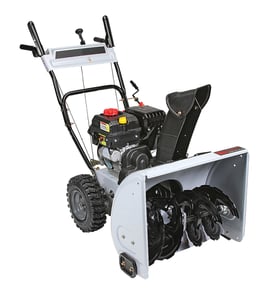




How to find snowblower model number?
The model number for a snowblower is printed on the machine’s ID label; for Craftsman model 536881850, you’ll use that full number to match the correct operator’s manual and order the right parts for your exact snow thrower.
On most Craftsman snow throwers, the model and serial information is on a label or metal tag on the rear area of the unit.
- Check the rear of the snowblower frame between the wheels
- Look near the lower handle mounting area (behind the operator position)
- Wipe off snow, salt, and grime; the label can be hard to read when dirty
- Use a flashlight and take a photo; zooming in often reveals faded numbers
- Write down the full model number exactly as shown (including dots or dashes if present)
Your operator’s manual identifies this snow thrower as Model 536.881850 (often shown without the dot as 536881850). Use the full model number when searching parts diagrams and maintenance instructions in the 536881850 operator’s manual.
| What you see | What it means | What to do |
|---|---|---|
| 536.881850 | Model number format used in the manual | Use it to match the correct manual and parts |
| 536881850 | Model number format used on many parts sites | Use it when searching parts and diagrams |
| Serial number | Production identifier | Record it for service and warranty records |
Using the exact model number prevents ordering the wrong Craftsman snowblower parts (belts, chute components, cables) and ensures procedures like assembly, adjustments, and maintenance match your snow thrower’s configuration.
Last updated: January 2026
How many years should a snowblower last?
A gas snowblower like the Craftsman 536881850 typically lasts 10 to 20 years with normal residential use and consistent maintenance. The biggest factors are off-season storage, regular lubrication, and staying ahead of common wear items such as belts and shear pins.
| Snowblower type | Typical lifespan | What usually ends it first |
|---|---|---|
| Gas, homeowner grade | 10 to 20 years | Belts, friction/drive wear, carburetor fuel issues |
| Gas, heavy-duty | 15 to 25 years | Auger/impeller wear, gearbox wear |
| Electric (corded/battery) | 5 to 10 years | Motor/electronics, battery capacity loss |
We see the longest life when you follow the maintenance schedule and storage steps in the 536881850 owner's manual. Focus on these habits:
- Check engine oil before use and at least every 8 hours of run time
- Change engine oil every 50 hours or at least once per year
- Check the spark plug about every 25 hours; replace about every 100 hours
- Run the machine a few minutes after blowing snow to help prevent auger and impeller freeze-up
- Tighten and inspect fasteners (especially shear bolts) regularly
- Store it safely: let the engine cool and keep it away from ignition sources
Some parts are designed to wear out and get replaced; planning for them helps you reach the 10 to 20 year range.
- Drive and auger belts (for example, the snowblower drive belt 1733324SM and snowblower gas belt 585416MA)
- Shear pins (for example, kit shearbol 1501227MA)
- Cables, pulleys, and bearings as the machine ages
A snowblower that is lubricated, tuned up, and stored correctly starts easier, throws snow farther, and is less likely to break a belt or shear a pin mid-storm. That maintenance is what turns a 5 to 10 year machine into a 10 to 20 year machine.
Last updated: January 2026
What is the most common problem with snow blowers?
The most common problem we see with snow blowers like the Craftsman 536881850 is a clogged discharge chute, followed closely by no-start conditions from fuel and ignition issues. The owner’s guide also highlights that chute clogs are a frequent issue and must be cleared safely.
- Clogged discharge chute or auger housing: snow stops throwing or dribbles out of the chute.
- Starting problems: engine cranks but will not start, or starts then stalls.
- Auger not turning: auger drive is engaged but the auger does not move (often related to shear pins/bolts).
- Drive system problems: unit will not move or slips under load (commonly belt, idler, or traction issues).
- Abnormal vibration after hitting something: vibration is a warning sign; stop and inspect before continuing.
The Craftsman 536881850 536881850 owner’s manual calls out chute clogs as a leading cause of injury when people try to clear them by hand. Use this safe process:
- Shut off the engine.
- Wait about 10 seconds for the impeller to stop.
- Release the auger drive lever.
- Pull out the safety key.
- Disconnect the spark plug wire.
- Clear the chute using a clean-out tool (not your hands).
| Symptom | Most likely cause | Good first step |
|---|---|---|
| Snow will not discharge | Chute/impeller clog | Clear with clean-out tool and follow shutdown steps |
| Auger will not turn | Shear pins/bolts damaged | Inspect auger hardware and replace damaged fasteners |
| Unit will not drive | Worn/slipping drive belt | Inspect and replace the snowblower drive belt 1733324SM if worn |
| Auger drive weak | Worn auger belt or cable out of adjustment | Check belt condition and cable tension |
These problems are common because snow is wet, heavy, and can hide debris. Clearing clogs the right way and stopping immediately after abnormal vibration prevents damage to the auger/impeller system and reduces the risk of injury.
Last updated: January 2026
Is it cheaper to repair or replace a snowblower?
For the Craftsman snow thrower model 536881850, it’s usually cheaper to repair when the problem is a normal wear item (belts, cables, shear pins, tune-up parts). Replacing the snowblower makes more sense when the repair total approaches about half the cost of a comparable new unit or when major drivetrain damage keeps returning.
- Repair if the machine starts reliably and the issue is isolated (no repeated failures).
- Repair if the fix is a wear part like an auger belt, drive belt, cable, or shear pins.
- Replace if the unit has severe rust on the auger housing/frame or multiple systems failing at once.
- Replace if it vibrates abnormally after impacts and damage is extensive (the manual treats vibration as a warning to stop and inspect).
- Replace if you need major drivetrain work (friction wheel, hex shaft, bearings) and labor adds up quickly.
These are common cost patterns for gas snowblowers like the 536881850; parts-only costs vary, and labor can be the biggest factor.
| Scenario | Usually choose | Why |
|---|---|---|
| Worn belt, stretched cable, broken shear pins | Repair | Low parts cost, fast turnaround |
| Needs belt plus adjustment and basic tune-up | Repair | Restores performance without major teardown |
| Worn friction wheel or drive system teardown | Depends | Parts may be reasonable; labor/time can be high |
| Structural rust or repeated major failures | Replace | Reliability drops; repairs stack up |
If your 536881850 won’t throw snow or won’t drive, these are common fixes that are typically cost-effective:
- Snowblower drive belt 1733324SM (ground drive issues)
- Snowblower gas belt 585416MA (auger not discharging snow)
- Kit shearbol 1501227MA (auger stops after hitting a hard object)
The manual also notes that whenever belts are adjusted or replaced, cable adjustments are typically needed, so plan for that extra step. See the 536881850 owner’s manual for the exact procedure and safety steps.
A snowblower that is correctly maintained and repaired promptly is safer and more reliable. The manual emphasizes stopping the engine, disconnecting the spark plug wire, and inspecting for damage after striking a foreign object; that inspection often determines whether you’re looking at a simple parts repair or a bigger replacement decision.
Last updated: January 2026