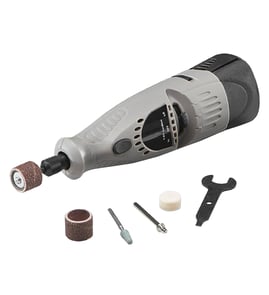

How to attach flex shaft to rotary tool?
To attach a flex shaft to your Craftsman rotary tool model 572251471, unplug the corded tool, remove the nose cap/collet nut as needed, then secure the flex shaft coupling to the tool’s threaded nose and make sure the inner drive cable fully seats in the drive socket before tightening. Test at low speed first.
Step-by-step: attach the flex shaft safely
- Unplug the rotary tool from the outlet.
- Remove any bit or accessory; loosen and remove the collet nut if the flex shaft requires it.
- If the flex shaft has a removable inner drive cable, slide the cable into the tool’s drive socket until it bottoms out.
- Thread the flex shaft coupling onto the tool’s nose by hand until fully seated; tighten snugly (hand-tight is typically enough).
- Route the flex shaft in a smooth curve; avoid tight bends that cause chatter and heat.
- Run the tool at low speed for 10 to 20 seconds; then increase speed gradually.
Quick troubleshooting if it chatters, slips, or will not spin
| What you notice | Most common cause | What to do |
|---|---|---|
| Handpiece does not turn | Inner cable not fully engaged | Unthread coupling, re-seat cable fully, reattach |
| Vibration or whipping | Shaft bent too tightly | Re-route for a larger-radius curve |
| Slips under load | Coupling not fully seated | Re-thread coupling straight; tighten snugly |
| Gets hot quickly | Friction from kinks or dry cable | Straighten routing; lubricate cable if your flex shaft design allows |
Why it matters
A flex shaft transfers power through an inner cable; full engagement at the drive socket and a gentle bend radius prevent premature wear, reduce vibration, and give you better control for sanding, grinding, and polishing.
Related DIY help
If the tool will not run after reassembly, use how to use a multimeter to test electrical parts video to check the cord, switch, and power path.
Last updated: February 2026
What size shank is the Craftsman 572251471 variable-speed flexible shaft?
The Craftsman 572251471 variable-speed flexible shaft rotary tool typically uses a 1/8-inch (3.2 mm) shank accessory size, which is the most common standard for rotary tool bits and collets. For the best fit, match the bit shank to the collet size you have installed.
How to confirm the shank size on your tool
We recommend a quick physical check so you buy the right accessories and avoid slippage.
- Unplug the rotary tool (or remove the battery if applicable).
- Loosen the collet nut and remove the bit.
- Measure the bit shank with a ruler or caliper (most common is 1/8 inch).
- Check whether your collet has a stamped size marking.
- Test-fit a known 1/8-inch shank bit; it should slide in smoothly and clamp evenly.
Common rotary tool shank sizes (what fits what)
Most Craftsman rotary tools and flexible shafts are built around the 1/8-inch standard, but some kits include alternate collets.
| Shank size | Metric equivalent | Typical use |
|---|---|---|
| 1/8 in | 3.2 mm | Most grinding stones, sanding drums, cut-off wheels |
| 3/32 in | 2.4 mm | Smaller engraving and detail bits |
| 1/16 in | 1.6 mm | Very small carving and precision accessories |
Why it matters
Using the correct shank size helps the collet clamp concentrically, which reduces vibration, improves control, and prevents the accessory from spinning in the collet under load.
If the bit slips or wobbles
- Reseat the bit; insert it fully, then pull it back out about 1/16 inch before tightening.
- Inspect the collet for cracks, rounding, or debris.
- Tighten the collet nut firmly (do not overtighten to the point of stripping).
- Replace worn accessories; bent shanks cause wobble.
- If you suspect an internal wiring or speed-control issue, use our guide: how to use a multimeter to test electrical parts video.
Last updated: February 2026
What is the average lifespan of 572251471?
For the Craftsman 572251471 variable-speed flexible shaft (rotary tool), the average lifespan is about 5 to 10 years with normal DIY use. Heavy, frequent use and high-speed grinding can shorten life; good maintenance and correct accessories extend it.
What affects lifespan most
- Load and speed: running high RPM under heavy pressure overheats the motor and flex shaft
- Accessory choice: dull bits and oversized attachments strain bearings and the drive cable
- Ventilation: clogged vents increase heat and wear
- Flex shaft care: kinks, tight bends, and lack of lubrication accelerate cable wear
- Storage and handling: drops and crushed housings lead to early failure
Quick care checklist (adds years)
- Let the tool do the work; use light pressure and make multiple passes.
- Keep bends gentle; avoid tight loops in the flexible shaft.
- Blow out dust from vents after messy jobs (wood, drywall, metal).
- Stop if you smell hot insulation or feel power fading; let it cool.
- Replace worn accessories early; they cost less than a motor or shaft.
Typical lifespan by use pattern
| Use pattern | What “normal” looks like | Typical lifespan |
|---|---|---|
| Occasional DIY | short projects, light cutting/sanding | 8 to 10 years |
| Regular DIY | weekly use, mixed accessories | 5 to 8 years |
| Heavy use | long run times, high load, frequent grinding | 2 to 5 years |
Why it matters
A rotary tool usually fails from heat and mechanical wear (bearings, brushes, flex shaft cable). Matching speed to the job and reducing load prevents overheating, which is the fastest way to shorten service life.
For help confirming you have the exact model before ordering maintenance items, use [how to find your appliance model number (and what it means for parts)].
Last updated: March 2026