Installation guide
 Owner’s manual
 Error Codes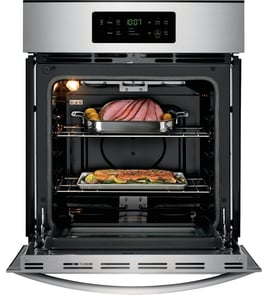



How to find wall oven model number?
For Kenmore wall oven model 79048779900, the model and serial number are printed on the serial plate along the interior side trim and are visible when you open the oven door. Use the exact model number when ordering parts or checking installation requirements in the 79048779900 owner’s manual.
Where to look on the oven
Check these spots in this order (most common first):
- Open the oven door and look along the interior side trim for the serial plate.
- If you have a double wall oven, check the lower oven interior side trim.
- Use a flashlight and look for a metal or foil label with Model and Serial fields.
- Write down the full model number and serial number exactly as shown.
- Keep the information with your appliance records for future service and parts lookup.
What the serial plate label looks like
The label typically includes the same key fields you need for parts and service.
| Label item | What it’s used for |
|---|---|
| Model number (example: 79048779900) | Matching the correct parts diagrams and parts |
| Serial number | Identifying production details for service |
| Lot number/letter (if shown) | Helps narrow down exact configuration |
Why it matters
Kenmore wall ovens can look similar across different series, but parts like the oven temperature sensor, wire harness, or control panel can vary by model. Using the exact model number helps ensure the replacement part fits and the installation cutout and electrical requirements match.
Last updated: January 2026
What is the best brand for electric wall ovens?
Brand “best” depends on what you value most (reliability, baking performance, features, or service access). For a Kenmore electric wall oven like model 79048779900, the best choice is the brand that fits your cutout, electrical requirements, and cooking needs, then is installed correctly per the installation guide.
How to choose the best brand for your kitchen
When comparing electric wall oven brands, we recommend focusing on these practical factors first:
- Fit and cutout compatibility: cabinet opening size, trim overlap, and depth
- Electrical requirements: 208/240V supply and proper grounding
- Cooking features you will actually use: convection, probe, self-clean vs manual clean
- Serviceability: parts availability (heating elements, temperature sensor, control board)
- Noise and cooling: many models use a cooling fan that can run after shutoff
What matters most for performance (regardless of brand)
Even a top-rated wall oven can bake poorly if installation or temperature sensing is off.
- Verify the oven is secured with mounting brackets to reduce tipping risk
- Confirm the unit is level in the cabinet cutout
- Use an oven thermometer to check temperature accuracy
- If temperatures swing widely, the temperature sensor is a common suspect
If you are troubleshooting temperature accuracy on this Kenmore model, the frigidaire range oven temperature sensor 316217002 is a key part in the temperature feedback loop.
Quick comparison: what “best” usually means
| If you care most about | Prioritize | What to check before buying |
|---|---|---|
| Even baking | Convection design, stable temperature control | Temperature calibration options, sensor/control quality |
| Easy cleaning | Self-clean features and door lock design | Venting, heat management, cabinet clearances |
| Long-term ownership | Parts availability and service network | Common parts like sensors, fans, control panels |
| Quiet operation | Cooling fan design | Fan run-on behavior after cooking |
Why it matters
Wall ovens are built-in appliances; the “best” brand is the one that fits your cabinet and power supply and runs safely. The installation instructions for 79048779900 also note these ovens are not approved for stackable or side-by-side installation, so correct configuration is part of getting the best results.
Last updated: January 2026
Are all 30 inch wall ovens the same size?
No. “30-inch” is a category label, not an exact measurement. For the Kenmore 79048779900 wall oven, the installation guide shows the oven is about 30 inches wide, but the required cabinet cutout width and other dimensions can vary by brand, series, and single vs. double oven design; always measure and match the cutout specs in the 79048779900 installation guide.
What “30-inch” usually means (and what varies)
Most 30-inch electric wall ovens are designed to fit a similar cabinet opening, but these details commonly differ:
- Cutout width range (the cabinet opening you need)
- Cutout height (single vs. double ovens are very different)
- Cutout depth (critical for trim to sit flush)
- Overall oven depth (how far it extends into the cabinet)
- Trim and spacer requirements (some models require side spacers and specific clearances)
Typical sizing: single vs. double wall ovens
Use this as a quick planning guide; confirm exact cutout dimensions before ordering an oven.
| Wall oven type | Nominal width label | What changes most | What to verify first |
|---|---|---|---|
| Single wall oven | 30-inch | Cutout height and depth | Cutout width, depth, and front clearance |
| Double wall oven | 30-inch | Cutout height (much taller) | Cutout height range and support requirements |
Model-specific notes that affect fit
For built-in ovens like the Kenmore 79048779900, installation requirements can be as important as the width:
- The cabinet base must support the oven’s weight (30-inch models are typically heavier than 27-inch models).
- Leave enough clearance in front for the door to open fully.
- Do not remove any factory spacers if equipped; they help center the oven and prevent heat buildup.
- The cutout depth is critical so the decorative trim sits correctly and the oven operates normally.
Why it matters
If the cutout is even slightly off, the oven may not sit flush, the trim may gap, the door may bind, or excess heat can build up around the cabinet. Matching the cutout dimensions and clearances prevents installation problems and protects surrounding cabinetry.
Last updated: January 2026
What is the disadvantage of a wall oven?
A wall oven like the Kenmore 79048779900 typically costs more to buy and install than a freestanding range, and repairs can take longer because the unit is built into cabinetry. You also need a separate cooktop, which can increase total kitchen cost and space planning.
Common disadvantages (and what to plan for)
- Higher total cost: wall oven plus cabinet cutout work plus electrical hookup.
- More complex installation: it must be installed and grounded correctly; anti-tip hardware is required.
- Harder access for service: built-in placement can make troubleshooting and part replacement more involved.
- Not flexible for layout changes: moving it later usually means cabinet and electrical changes.
- Heat management matters: the oven must be centered in the cutout (spacers, if equipped, help prevent excess heat buildup).
Installation and electrical considerations
The installation guide for this model emphasizes qualified installation and proper grounding, and it also notes these ovens are not approved for stackable or side-by-side installation. For electrical planning, circuit size is based on the oven’s wattage.
| What you’re planning | What typically changes | What to check |
|---|---|---|
| New wall oven install | Cabinet cutout, junction box, breaker size | Installation guide |
| Replacing an older unit | Cutout dimensions and wiring may not match | Measure cutout first |
| Adding a separate cooktop | More wiring and countertop/cabinet planning | Cooktop specs and circuit needs |
Why it matters
Most wall oven complaints come from planning issues, not cooking performance. When the cutout, ventilation space, and electrical circuit are correct, a wall oven is convenient and consistent; when they are not, you can end up with overheating around cabinets, nuisance shutdowns, or costly rework.
Last updated: January 2026