Owner’s manual
 Error Codes




Is it worth repairing an LG washer?
Yes, repairing an LG washer is usually worth it when the problem is isolated to one system and the repair cost is clearly lower than replacing the washer. For LG WM4500HBA, we base the decision on the symptom, the likely part involved, and whether the washer is otherwise operating normally (fill, drain, spin, and lock).
How we decide for LG WM4500HBA
We use a simple, model-aware checklist before recommending parts or service:
- Confirm the symptom and any error code shown on the display.
- Rule out setup issues first (load balance, leveling, drain hose height, water supply valves).
- Identify whether the failure is likely a single component (door lock, inlet valve, drain pump).
- Compare repair cost to replacement cost using a realistic baseline for a similar front-load washer.
- Consider whether the washer has had repeated failures in different systems.
For operating checks, error-code meanings, and maintenance steps specific to this washer, use the WM4500HBA owner’s manual.
Repairs that are commonly “good value”
These are the types of fixes that often restore normal operation without major teardown:
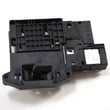
- Door won’t lock or unlock, or door-related errors: inspect the latch and wiring; replace the LG washer door lock EBF61315802 if it’s not engaging.
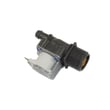
- Won’t fill or fills slowly: clean inlet screens; if the valve is sticking or not opening, the washer water inlet valve 5220FR2006Z is a common repair path.
- Drain problems (slow drain, standing water): clean the drain pump filter and check the drain hose routing.
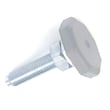
- Excess vibration: verify all four leveling feet are solid on the floor and loads are balanced.
Cost-to-benefit guide (practical baseline)
We do not have a model-specific “replacement price” for WM4500HBA from the provided information, so we use a typical front-load washer replacement range to apply the rule.
| Scenario | Typical decision | Why |
|---|---|---|
| One clear symptom tied to one part | Repair | Predictable outcome and controlled cost |
| Multiple symptoms across unrelated systems | Evaluate first | Could be wiring or control-related |
| Repeated breakdowns in different areas | Consider replacement | Total cost and downtime add up |
Why it matters
WM4500HBA is a high-efficiency front-load washer; when the tub, motor drive, and controls are generally stable, replacing a single failed component can restore performance for far less than replacing the entire appliance.
Last updated: January 2026
What are the common errors on an LG washing machine?
Common error messages on the LG WM4500HBA washer include fill problems (IE), drain problems (OE), unbalanced loads (UE), door/lock issues (dE variants), and sensor or motor-related faults (tE, PE, LE). Use the WM4500HBA manual to confirm the exact code and the model-specific checks.
Most common LG WM4500HBA error codes and what they usually mean
- IE (inlet error): washer is not filling fast enough (closed faucets, kinked hoses, clogged inlet screens).
- OE (water outlet error): washer is not draining (kinked drain hose, clogged drain path, drain pump filter blocked).
- UE (unbalance error): load cannot balance for spin (too small load, mixed heavy and light items, tangled laundry).
- dE, dE1, dEz, dE4 (door open error): door not fully latched or a door lock issue.
- tE (temperature sensor error): control sensed a temperature sensor problem.
- PE (pressure sensor error): water level sensing problem.
- LE (motor locked error): motor issue or load-related stall.
Quick checks we recommend before replacing parts
- Power reset: unplug for 1 minute (or switch off the breaker), then retry.
- Water supply: verify both faucets are fully open and hoses are not pinched.
- Drain setup: confirm the drain hose is not kinked and the standpipe height is within the manual’s range.
- Clean filters: clean inlet screens and the drain pump filter (expect water to spill when opening the filter area).
- Reduce suds: use HE detergent and avoid overdosing; oversudsing can contribute to drain and spin problems.
Parts that are commonly involved (when the same code keeps returning)
If basic checks do not stop the error from coming back, these model-compatible parts are often involved.
| Error code | System involved | Example compatible part for WM4500HBA |
|---|---|---|
| dE variants | Door latch/lock system | LG washer door lock EBF61315802 |
| IE | Water inlet system | Washer water inlet valve 5220FR2006Z |
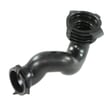
| OE | Drain path (hose, filter, pump) | Washer drain hose AEM74772904 |
| vs | Vibration sensing | LG washer vibration sensor EBD48922806 |
Why it matters
Error codes are the washer’s way of preventing flooding, overheating, and motor damage. Addressing IE, OE, UE, and dE issues early can reduce repeat shutdowns and help protect components like the inlet valve, door lock, and drain system.
Last updated: January 2026
What does HWA mean on LG washer?
For the LG WM4500HBA washer, “HWA” is not a code we can verify from the model-specific information for this unit. Your owner’s manual identifies the model family as WM4500H*A, but it does not define “HWA” as a suffix or variant for this washer.
What we can confirm for WM4500HBA
From the WM4500HBA manual, LG documents this washer under the WM4500H*A model family and provides operating, installation, and troubleshooting details, but it does not include a key that decodes letter suffixes like “HWA.”
Here are model-specific details the manual does confirm:
- Model family shown: WM4500H*A
- Product type: LG front-load washer
- Max spin speed listed: 1300 RPM
- Electrical requirement listed: 120 V~, 60 Hz
- The manual focuses on use, care, and troubleshooting rather than model-name decoding
What “HWA” usually means (general guidance)
Across LG laundry products, letter groups in the model name often help identify a variant (such as finish/color or a retail configuration). However, the exact meaning of “HWA” can vary by product line and year, so we do not recommend relying on a universal definition.
Common things LG model suffixes may indicate:
- Exterior color or finish
- Feature package (steam options, smart features)
- Retail bundle or region configuration
- Minor design revisions that can affect parts fit
Why it matters for parts and service
Even small model-name differences can affect compatibility for parts tied to the door, controls, or wiring.
| If you’re doing this | Use this identifier |
|---|---|
| Ordering replacement parts | The full model from the rating label (including any “/00”) |
| Looking up operating instructions | The model family in the manual (WM4500H*A) |
| Fixing a door lock issue | Match the exact part to your model (example: LG washer door lock EBF61315802) |
Quick checks we recommend
- Match the full model number from the washer’s rating label before ordering parts
- If you see “HWA” on paperwork or a listing, compare it to the rating label on your washer
- Use the manual’s troubleshooting section to confirm symptoms before replacing parts
Why it matters
Using the exact model identifier prevents ordering a look-alike part that mounts differently or has different electrical connectors.
Last updated: January 2026
What is the average lifespan of an LG washing machine?
LG washing machines typically last 10 to 15 years. For your LG WM4500HBA washer, that same 10 to 15-year range is the practical expectation when it’s installed correctly, used with HE detergent, and kept on a regular cleaning and maintenance routine (see the WM4500HBA manual).
What affects lifespan the most
A washer’s service life is usually determined by how hard it’s worked and how well it’s maintained, not just the brand.
- Load size and frequency (daily heavy loads shorten life)
- Proper leveling to reduce vibration and stress on suspension parts
- Using HE (High-Efficiency) detergent and avoiding oversudsing
- Monthly drum cleaning (Tub Clean) and door seal care
- Promptly addressing drain, fill, or door-lock issues before they cascade
Maintenance habits that help WM4500HBA reach the high end of the range
These are the highest-impact habits we recommend for this LG front-load washer:
- Run the Tub Clean cycle monthly (more often if you notice odor)
- Leave the door open after loads to dry the drum and gasket
- Clean the drain pump filter periodically to prevent OE drain problems
- Check and clean inlet filter screens if filling slows or an IE code appears
- Keep detergent amounts modest; too much detergent can cause residue and odors
Quick lifespan expectations by usage
| Household usage pattern | Typical lifespan expectation |
|---|---|
| Light use (few loads/week) | 12 to 15 years |
| Average use (most households) | 10 to 15 years |
| Heavy use (daily, large loads) | 8 to 12 years |
Why it matters
A front-load washer like the LG WM4500HBA spins at high speed; vibration, oversudsing, and clogged filters are common causes of premature wear. Consistent cleaning and correct detergent use reduce strain on the motor, pump, and door seal so you get more years before major repairs.
Last updated: January 2026
What size is the wm4500hba?
The LG WM4500HBA washer measures 27 in. wide x 39 in. high x 33 1/4 in. deep. With the door open, the maximum depth is 53 1/4 in. For the full specifications and installation clearances, see the WM4500HBA manual.
Dimensions at a glance
- Width: 27 in. (70 cm)
- Height: 39 in. (99 cm)
- Depth (door closed): 33 1/4 in. (84 cm)
- Max depth with door open: 53 1/4 in. (135.5 cm)
- Net weight: 201.5 lb (91.4 kg)
Clearance planning tips
Even with the correct washer dimensions, we recommend planning for space around the cabinet for hoses, airflow, and vibration control.
- Leave at least 1 in. on each side
- Leave at least 4 in. behind the washer
- Make sure the floor is solid and level (front-load washers spin fast and can vibrate if not leveled)
- Keep the power outlet accessible (LG recommends the outlet be within 60 inches of either side)
Quick reference table
| Measurement | WM4500HBA value |
|---|---|
| Width | 27 in. |
| Height | 39 in. |
| Depth (door closed) | 33 1/4 in. |
| Depth (door open) | 53 1/4 in. |
Why it matters
Correct sizing helps prevent installation problems like kinked inlet hoses, a pinched drain hose, or a washer that cannot be leveled properly. Those issues can lead to leaks, noise, or poor draining over time.
Last updated: January 2026