Installation guide
 Owner’s manual
 Error Codes




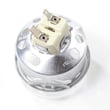
How to clean the igniter on a KitchenAid gas stove?
On the KitchenAid gas range model KFGG500ESS2, we clean the surface-burner igniter by turning all controls off, letting the cooktop cool, removing the burner cap, then wiping around the igniter and gas tube opening with a damp cloth so the burner can spark and light reliably. See the KFGG500ESS2 owner’s manual.
Safe, effective igniter cleaning steps
- Turn all burner knobs off; make sure the cooktop is completely cool.
- Lift off the burner grate (if needed) and remove the burner cap from the burner base.
- Wipe the igniter area gently with a damp cloth; avoid soaking the igniter.
- Clean the gas tube opening with a damp cloth.
- If burner ports are clogged, clear them with a straight pin (do not enlarge the ports; do not use a toothpick).
- Reinstall the burner cap, aligning the pins correctly, then test ignition.
What to avoid (prevents damage and misfires)
| Avoid | Why it matters |
|---|---|
| Oven cleaners, bleach, rust removers | Can damage finishes and components and leave residues that affect ignition |
| Abrasive pads or steel wool near controls | Can scratch surfaces and damage control areas |
| Flooding the igniter with water | Moisture can cause weak sparking or delayed ignition |
| Enlarging burner ports | Changes flame pattern and can cause uneven heating |
Quick checks after cleaning
- Normal behavior: all surface burners may click when you turn one knob to the light position; only the selected burner should light.
- Flame check: adjust the flame so it does not extend beyond the edge of the pan.
- If clicking continues without lighting: recheck cap alignment and confirm ports and the igniter tip are clean and dry.
When a part is the real fix
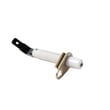
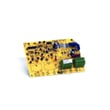
If the burner still will not light after cleaning and drying, the ignition system may need a replacement component. For this model, common ignition-related parts include the spark module (red) WPW10475149 and the electrode WPW10515459.
Why it matters
A clean igniter area, clear burner ports, and a properly seated burner cap help the burner light quickly, reduce delayed ignition, and keep flames even for safer, more consistent cooking.
Last updated: February 2026
Where can I find my KitchenAid range model number?
On your KitchenAid gas range model KFGG500ESS2, the model number and serial number are printed on the oven frame behind the top right side of the oven door. This label is the best reference for ordering parts and getting accurate service information; see the KFGG500ESS2 owner's manual.
How to locate the model number label
- Open the oven door.
- Look at the oven frame (the front frame around the oven opening).
- Check behind the top right side of the open door area for the model and serial label.
Quick tips that prevent parts-ordering mistakes
- Copy the model number exactly as printed (letters and numbers).
- Record the serial number too; it helps confirm production details.
- Take a clear photo of the label for future reference.
- Use the model number when selecting parts like an igniter, electrode, or control board.
- If the label is hard to read, wipe it gently with a damp cloth and dry it.
What the model number is used for (and why it matters)
We use your model number to match the correct KitchenAid parts diagrams and compatible replacement parts. Even small model-number differences can change burner components, oven igniters, and console parts.
| You need | Use this from the label | Why it matters |
|---|---|---|
| Replacement parts | Model number (KFGG500ESS2) | Ensures correct fit and wiring/connector match |
| Troubleshooting help | Model and serial number | Speeds up diagnosis and avoids wrong parts |
| Service scheduling | Model and serial number | Confirms the exact unit being serviced |
If you are ordering a common repair part
For example, if the oven is not heating properly, you may be looking for an igniter. Using the exact model number helps you choose the correct part, such as the range oven igniter WPW10324262 when it matches your symptom and diagram.
Last updated: February 2026
What is the average lifespan of KFGG500ESS2?
A KitchenAid KFGG500ESS2 gas range typically lasts 13 to 15 years with normal household use and routine care. Keeping burners clean, ensuring proper ignition, and addressing weak heating early helps you get the full service life from this range.
What affects lifespan most
- Burner and igniter wear from heavy cooking and boil-overs
- Heat stress on electronic controls and touch panels
- Oven door seal condition (heat loss makes components work harder)
- Cleaning habits (avoiding harsh abrasives on surfaces and knobs)
- Proper leveling and stable installation
Quick upkeep checklist (high impact)
- Clean burner heads and ports regularly; dry fully before reassembly.
- If the oven takes longer to light or smells like unburned gas, inspect the igniter and burner flame pattern.
- Replace a dim or failed oven light with the correct light bulb 8009.
- Confirm the range is level; adjust feet if needed.
- Follow the cleaning and care steps in the KFGG500ESS2 owner's manual.
Common “wear” parts vs. “long-life” parts
| Category | Examples on this model | Typical reason for replacement |
|---|---|---|
| Wear items | Light bulb, burner head, electrode | Normal use, spills, corrosion |
| Ignition/heating | Oven igniter, burner igniter | Slow ignition, no-heat, weak flame |
| Controls | Spark module, membrane switch | Clicking issues, intermittent response |
Why it matters
A range that is slow to ignite or losing heat often runs longer to do the same job; that extra runtime accelerates wear on igniters, gas valve components, and control parts. Catching ignition and sealing issues early is the simplest way to extend the life of your KFGG500ESS2.
Last updated: March 2026