 Installation guide
 Owner’s manual



How do I find the dimensions of my dishwasher?
To find the dimensions of your GE GDF620HSJ5SS dishwasher, we measure the opening and the dishwasher itself: height from the floor to the underside of the countertop, width between the cabinet sides, and depth from the back wall to the cabinet face. Use the installation guide for the exact fit and clearance requirements.
Measure in inches with a tape measure; take each measurement in at least two spots (front and back) because cabinets and floors can be out of square.
- Height: floor to the underside of the countertop (measure left and right)
- Width: inside cabinet opening, left to right (front and back)
- Depth: back wall to the front of the cabinet opening (not the door)
- Toe-kick clearance: floor to the bottom edge area where the toe panel sits
- Utility space: where the drain hose, hot water line, and wiring route through the cabinet
The installation instructions for this dishwasher call out key placement and routing details that affect real-world “dimensions” during install.
| Item to check | What “good” looks like | Why it affects fit |
|---|---|---|
| Electrical connection location | Right front area of the dishwasher | Impacts where wiring must reach and route |
| Cable reach (hardwired) | Extends at least 24 inches from rear wall | Prevents strain when sliding unit in |
| Receptacle height (corded) | About 6 to 18 inches above the floor in sink cabinet | Ensures plug access without pinching |
| Toe-kick position | Toe-kick stays in contact with the floor | Confirms final height and leveling are correct |
Dishwasher “dimensions” are not just the box size; leveling legs, toe-kick height, and how the drain hose and wiring route can change whether the unit slides in smoothly and sits flush with adjacent cabinets.
- Remove bulky items from the cabinet opening so the tape sits flat
- Measure the floor for slope; leveling legs can change final height
- Confirm the front panel will sit flush with adjacent cabinets when centered
- Make sure utility lines are not trapped or crushed behind the dishwasher
Last updated: February 2026
Can a clogged drain cause an FTD error?
Yes. On the GE GDF620HSJ5SS dishwasher, an FTD (fail to drain) error commonly happens when water cannot leave the tub because the drain path is restricted, such as a clogged filter, air gap, disposer connection, or a kinked/crushed drain hose (see the owner's manual).
- Turn off power at the breaker before inspecting wiring or internal components.
- Remove and rinse the Ultra-Fine Filter and Fine Filter; trapped debris is a top cause of slow or no draining.
- If your setup has an air gap, remove the cover and cap and clean out buildup.
- If the dishwasher drains into a disposer, make sure the disposer inlet is clear and the drain plug has been removed.
- Inspect the drain hose for kinks, crushing, or sagging loops that can trap water.
- Confirm the drain loop or air gap is installed correctly; an incorrect drain line setup can cause standing water.
The installation requirements matter because too much hose length or too high of a drain connection can reduce pump-out performance.
| Item | Requirement for proper draining |
|---|---|
| Max drain connection height | 72 inches above bottom of dishwasher |
| Max total drain hose length | 12 feet |
If your hose is kinked inside the cabinet, pull the excess hose through the cabinet opening so it cannot be crushed when the dishwasher is pushed back into place.
If the filters and hose are clear but the unit still will not drain, the drain pump or drain hose can be the next likely issue.
| Symptom | Common next suspect |
|---|---|
| Hums but does not move water | Drain pump |
| Drains slowly, hose looks restricted | Drain hose |
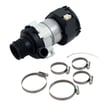
Model-matched parts we list for this dishwasher include the dishwasher drain pump WD19X25187 and the dishwasher drain hose WD24X10062.
Running with poor drainage can leave dirty water in the sump, reduce cleaning performance, and trigger repeat drain errors. Clearing the restriction and confirming correct drain routing usually restores normal operation.
Last updated: February 2026
How do I fix my GE dishwasher failure to drain?
For a GE GDF620HSJ5SS dishwasher that won’t drain, we start by checking the drain path for simple restrictions (air gap, disposer plug, and a kinked drain hose). If the drain path is clear, the next likely causes are a clogged filter area or a failing drain pump.
- Cancel the cycle: press and hold Start/Reset for 3 seconds to force a drain (the unit should begin draining).
- Confirm the door is fully latched.
- If your drain hose connects to a garbage disposal, make sure the disposer knockout plug was removed.
- If you have an air gap, remove the cover and clean it.
- Check the drain hose routing under/behind the dishwasher; straighten any kinks.
- Open the door after draining and verify the tub actually emptied.
For the exact cancel/drain procedure and the install checks (air gap, disposer plug, hose kinks), follow the installation guide.
A restricted filter area can slow draining and leave standing water.
- Remove and rinse the filters; clean debris from the filter screen area.
- Clean out the sump area (glass, labels, food) so water can reach the pump.
- Reinstall filters correctly and run a short cycle to recheck draining.
Our rule of thumb: clean filters every other month, or sooner if wash performance drops or dishes feel gritty (that is a strong clue the filters are restricted). See the filter cleaning steps in the owner's manual.
If the drain line is clear and filters are clean, focus on the drain pump and related drain components.
| Symptom | Most common cause | What we do next |
|---|---|---|
| Hums but won’t drain | Pump jam or failing | Inspect pump area; replace pump if needed |
| Drains slowly | Partial clog in hose/air gap/filter area | Recheck hose routing, air gap, filters |
| Won’t drain after cancel/drain | Pump not running or control issue | Check pump wiring and control diagnostics |
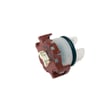
If you determine the pump is not moving water, the model-specific replacement part is the dishwasher drain pump WD19X25187.
A dishwasher that can’t drain can leave dirty water in the sump, cause odors, and reduce cleaning performance. Fixing the drain path early also helps prevent pump strain and repeat clogs.
Last updated: February 2026
How do I reset the H2O code on my GE dishwasher?
To clear an H2O (water) code on your GE GDF620HSJ5SS dishwasher, we reset the cycle and confirm the unit is actually filling. Cancel the current cycle (press and hold Start for 3 seconds), let it drain, then restart a new cycle and verify the door is fully latched per the owner's manual.
- Press and hold Start for 3 seconds to cancel; close the door so the dishwasher drains.
- After draining stops, select a normal wash cycle.
- Press Start and close the door within 4 seconds so the cycle begins.
- Listen for filling and check that water enters within the first few minutes.
- If the display goes dark while the door is open, close and open the door or press any button to wake it.
H2O usually points to a fill problem (not enough water entering) or a condition that makes the dishwasher think it is not filling correctly.
- Water supply valve: Make sure the shutoff valve under the sink is fully open.
- Door latch: Confirm the door closes firmly; a weak latch can interrupt the start sequence.
- Flood float: If the float is stuck, the dishwasher may stop filling; remove the filter and gently free the float area.
- Kinked or restricted lines: Check the water line and drain hose routing under the sink and behind the unit.
- Leak condition: If your dishwasher detects a leak, some cycles can cancel; inspect for moisture under the unit.
| Symptom | Most likely cause | What we do next |
|---|---|---|
| No sound of filling after restart | Water valve closed or supply issue | Open valve; confirm household water is on |
| Starts then stops quickly | Door not fully latched | Inspect latch and strike; replace if worn |
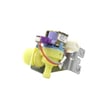
| Intermittent fill issues | Inlet valve not opening consistently | Test/replace the dishwasher water inlet valve WD15X26140 |
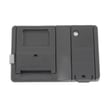
| Powers on but behaves erratically | Control issue | Check wiring and consider the dishwasher electronic control board WD21X24901C |
When the dishwasher does not fill correctly, wash pressure drops and detergent may not dissolve, leading to poor cleaning and longer cycle behavior. Resetting the cycle is fast, but confirming actual water entry prevents repeat H2O errors.
Last updated: February 2026





