 Owner’s manual
 Error Codes



Where is the model number on a Kenmore side by side refrigerator?
On your Kenmore side-by-side refrigerator model 10641179710, the model number is printed on the model and serial number label attached to the refrigerator cabinet. Use that label to record both the model and serial number for parts lookup and service history; see the owner's manual.
Where to look on the refrigerator
Check these common label locations used on Kenmore 106.4113 and 106.4117 series side-by-side units:
- Inside the fresh food (refrigerator) compartment on a side wall
- Near the top front frame, just inside the refrigerator door opening
- Behind the base grille at the bottom front (less common)
- Inside the freezer compartment on a side wall (sometimes)
What the label includes (and why it matters)
The label typically lists both identifiers you need:
| Item | What it’s used for | Example format |
|---|---|---|
| Model number | Matching the correct parts diagrams and parts list | 106.4113*, 106.4117* |
| Serial number | Dating and tracking the specific unit | Letters plus numbers |
Tips to read it correctly
Use these quick checks so you capture the right information the first time:
- Write the model number exactly as shown (including dots and any suffix characters)
- Record the serial number exactly as shown (often starts with letters)
- Take a clear photo of the label before ordering parts
- Use the model number when selecting parts like a door gasket, evaporator fan motor, or defrost heater
Why it matters
Kenmore side-by-side refrigerators can look similar across multiple 106-series models, but parts such as door gaskets, switches, and fan components can vary by model. Using the exact model number from the label helps ensure the right fit and prevents repeat repairs.
Last updated: February 2026
How can I tell how many cubic feet my Kenmore refrigerator is?
For your Kenmore 10641179710 side-by-side refrigerator, the most reliable way to confirm cubic feet is to check the model and serial label inside the cabinet and the specifications section in the 10641179710 owner's manual. If you cannot find a listed capacity, you can calculate it from the interior measurements.
Where to find the cubic feet (fastest checks)
Look in these common spots inside the fresh food section:
- On a side wall near the top front
- Behind or beside the crisper pan area
- Along the ceiling liner near the light housing
- On the model and serial number label (often near the crisper area)
If the label does not show capacity, use the specs pages in the 10641179710 owner's manual to confirm the exact total volume for your specific configuration.
How to calculate cubic feet yourself
If you need a quick estimate, measure the usable interior of each compartment (refrigerator and freezer) and add them together.
- Measure height x width x depth in inches (interior only).
- Multiply to get cubic inches.
- Divide by 1,728 to convert to cubic feet.
Quick conversion table
| What you have | What to do | Result |
|---|---|---|
| Interior inches (H x W x D) | Multiply | Cubic inches |
| Cubic inches | Divide by 1,728 | Cubic feet |
Tips so your measurement is accurate
- Measure to the inside liner, not the door bins.
- Subtract space taken by fixed features (ice maker housing, air tower, thick shelves) for a more realistic “usable” number.
- Measure both compartments separately; side-by-side designs often have different depths and shelf layouts.
Why it matters
Knowing cubic feet helps us match the right accessories and parts for your Kenmore 10641179710, and it also helps when comparing storage capacity, airflow needs, and organization options.
You can also order model-matched replacement parts from the list for this model, or search by model number on Sears PartsDirect.
Last updated: February 2026
What are the most common problems with Kenmore refrigerators?
The most common issues we see on Kenmore refrigerators like model 10641179710 are cooling problems, ice maker and water dispenser troubles, leaks, frost buildup, and unusual noises. Many of these start with airflow restrictions, door sealing problems, or a defrost system fault; our owner's manual walks through the basic checks.
Common problems and what to check first
- Not cooling or warm temperatures: confirm controls are set correctly and allow 24 hours after a new install or major change for temps to stabilize.
- Runs all the time: longer run times are normal with energy-efficient compressors, but frequent door openings and warm rooms increase run time.
- Frost buildup: check for blocked vents and poor door sealing; a defrost failure can also cause heavy frost.
- Water leaks: look for ice buildup in the freezer, a clogged drain path, or doors not closing fully.
- Noisy operation: fan noise often points to the evaporator area (ice contact, worn fan motor, or damaged blade).
- Lights not working: door switch issues are common.
Parts that commonly solve these symptoms (when diagnosis confirms)
If troubleshooting points to a failed component, these model-matched parts are commonly involved:
| Symptom | Likely area | Example part for this model |
|---|---|---|
| Frost buildup, warm fridge | Defrost system | Refrigerator defrost heater WP2323198 |
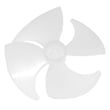
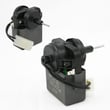
| Warm fridge, noisy freezer | Evaporator fan | Refrigerator evaporator fan motor WP2315549 and refrigerator evaporator fan blade WP2169142 |
| Moisture, sweating, poor cooling | Door seal | Door gasket (color-specific options) |
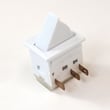
| Light stays off or won’t turn off | Door switch | Refrigerator light switch W11384469 |
Why it matters
Most “big” refrigerator complaints (warm temps, ice maker failures, leaks) trace back to airflow and sealing. When vents are blocked or a door gasket leaks, the refrigerator runs longer, temperatures swing, and frost and moisture problems follow.
Quick tips that prevent repeat problems
- Keep food packages from blocking interior air vents.
- Make sure bins and shelves are seated so doors close completely.
- Minimize long door openings, especially in humid rooms.
- If doors look uneven or the cabinet rocks, level and align the unit per the manual.
- When you need replacement parts beyond the list for this model, search by model number on Sears PartsDirect.
Last updated: February 2026
How wide is a Kenmore side by side refrigerator?
Most Kenmore side-by-side refrigerators are about 36 inches wide. For Kenmore model 10641179710, the owner's manual lists a normal minimum cabinet cut-out width of 36 inches, which is the standard opening width needed to install the refrigerator.
What “36 inches wide” means for fit
The cabinet cut-out width is the space your kitchen opening needs so the refrigerator can slide in without binding.
- Plan for a 36 inch opening for the refrigerator body
- Leave 1/2 inch clearance on each side and at the top for ventilation
- Leave 2 inches behind the refrigerator for airflow (and extra room for the water line if you have an ice maker)
- If installing next to a wall, allow about 2 inches on the hinge side (varies by setup) so doors can swing open
Quick sizing guide (typical for side-by-side units)
| Measurement | Typical value | What to check |
|---|---|---|
| Width (cabinet opening) | 36 in | Opening between cabinets/walls |
| Side/top clearance | 1/2 in | Ventilation space |
| Rear clearance | 2 in | Airflow and water line room |
How we recommend measuring before you buy parts or move the fridge
- Measure the cabinet opening width at the front and back
- Measure the pathway (doorways, hallways) the refrigerator must pass through
- Confirm door swing space, especially if a wall is close to the hinge side
- If doors look uneven after moving, follow the leveling and alignment steps in the owner's manual
Why it matters
A side-by-side refrigerator that is squeezed into a tight opening can run hotter, cool poorly, and develop door-seal gaps that lead to frost or moisture. Correct width and clearances help the compressor and condenser breathe and keep temperatures stable.
Ordering fit-related parts
If you find the doors are not sealing well after installation or leveling, we stock door-seal and door-related parts for model 10641179710. You can also search by model number on Sears PartsDirect.
Last updated: February 2026
What causes a side-by-side refrigerator to stop cooling?
On Kenmore side-by-side refrigerator model 10641179710, a “not cooling” problem is typically caused by a power issue, temperature controls set too warm, blocked airflow, or a failed cooling or defrost component (fan, heater, compressor). Confirm control operation in the 10641179710 owner's manual.
Quick checks first (fastest fixes)
- Verify the cord is fully plugged into a grounded 3-prong outlet (no extension cord).
- Test the outlet with a lamp; reset a tripped breaker or replace a blown fuse.
- After installation or a power outage, allow 24 hours for full cooling.
- Adjust refrigerator and freezer controls in small steps; colder settings do not cool faster.
- Make sure interior vents are not blocked by food packages.
Airflow and frost restriction (most common “runs but warm” causes)
- Listen for the evaporator fan in the freezer; if it is not running, both sections warm up.
- Check for heavy frost on the back freezer panel; frost can block airflow across the evaporator.
- If the fan runs but airflow is weak, inspect for a damaged blade.
Model-matched parts that fit these symptoms:
Symptom guide
| Symptom | Most likely area | Next step |
|---|---|---|
| No lights, no sound | Power supply | Outlet, breaker, cord connection |
| Runs a lot but warm | Airflow or frost | Check vents, fan, frost pattern |
| Frost on back freezer wall | Defrost system | Diagnose heater and defrost circuit |
| Freezer warm too | Sealed system/compressor | Check condenser airflow; service if needed |
Why it matters
Food can spoil quickly when cooling stops. Starting with power, control settings, and airflow prevents unnecessary part replacement and helps you pinpoint when a component failure is the real cause.
You can order model-specific replacement parts from the parts list for 10641179710, or search by model on Sears PartsDirect.
Last updated: February 2026










