Installation guide
 Error Codes




Where is the model number on a Whirlpool RBD275PDB12?
On the Whirlpool RBD275PDB12 wall oven, the model number is printed on the model and serial rating plate. You will find that rating plate on the oven door or on the oven frame (the front frame area you see when the door is open). For exact placement details, use the installation guide.
Where to look (fast checklist)
- Open the oven door and look along the door perimeter for a rating plate label
- Check the oven frame just inside the door opening (often along the side trim area)
- For double ovens, check both doors and frames; the rating plate can be on the upper oven door
- Wipe the area with a dry cloth; grease and glare can hide the print
- Use a flashlight and look from an angle to reduce reflection
What the rating plate includes
The rating plate typically lists the key identifiers you need for parts and service.
| Item on rating plate | What it’s used for |
|---|---|
| Model number (RBD275PDB12) | Matching the correct parts diagrams and replacement parts |
| Serial number | Identifying production details for service and compatibility |
| Electrical rating (voltage/kW) | Confirming proper circuit sizing and installation requirements |
Why it matters
We use the model number to match your exact Whirlpool wall oven configuration. That prevents ordering the wrong door hinge, oven light, or temperature sensor, and it also helps confirm electrical requirements before any installation or repair.
Tip for ordering the right part
Once you have the model number, match it exactly (including all letters and numbers) before selecting parts such as the wall oven temperature sensor WPW10131825.
Last updated: February 2026
How long do Whirlpool wall ovens last?
Most Whirlpool electric wall ovens, including model RBD275PDB12, last 13 to 15 years with normal household use. With consistent cleaning, correct installation clearances, and timely replacement of wear parts like door gaskets and sensors, it’s common to reach 15 to 20 years.
Typical lifespan and what affects it
A wall oven’s life is mainly driven by heat stress, door sealing, and electrical reliability.
- Usage frequency: daily baking and frequent broiling shortens lifespan
- Self-clean cycles: heavy use increases heat stress on wiring and controls
- Door seal condition: heat leaks make components run hotter
- Power quality: loose connections can damage terminals and wiring
- Installation fit: correct cutout and ventilation reduce overheating
For model-specific installation requirements (cutout dimensions, junction box placement, grounding), use the installation guide.
What “end of life” usually looks like
These symptoms often show up years before a wall oven fully fails:
- Oven temperature swings, long preheat times
- “F” error codes or intermittent heating
- Door not closing tightly, heat escaping around the frame
- Light failures or repeated bulb burnouts
- Tripping breaker or signs of overheating at connections
Common parts that extend service life
Replacing a few key parts can restore performance and reduce stress on other components:
- Wall oven temperature sensor WPW10131825 (helps stabilize baking temperatures)
- Range oven door gasket WP4455381 (reduces heat loss and protects surrounding components)
- Terminal block WP8203546 (addresses heat damage from loose power connections)
Quick decision guide: repair or replace
| What you’re seeing | Most likely impact | Typical next step |
|---|---|---|
| Uneven baking, temp off | Higher wear on elements and controls | Test/replace sensor, verify calibration |
| Heat leaking at door | Longer run times, hotter cabinet | Replace door gasket, inspect hinges |
| No heat or “F” code | Heating or control circuit issue | Check wiring, thermostat, sensor |
| Breaker trips | Electrical connection or component short | Inspect terminal block and wiring |
Why it matters
A wall oven that runs hot due to poor sealing or incorrect installation clearances can shorten the life of wiring, thermostats, and electronic controls. Keeping the door sealing correctly and the electrical connections tight helps your RBD275PDB12 reach its full expected lifespan.
Last updated: February 2026
How to reset error code on Whirlpool oven?
To reset an error code on your Whirlpool RBD275PDB12 wall oven, press CANCEL to clear the display. If the code returns, reset power at the circuit breaker for 1 minute, then restore power; after a power interruption, “PF” commonly appears and can be cleared with CANCEL. Refer to the installation guide for the model’s power-up and “PF” display behavior.
Quick reset steps (in order)
- Press CANCEL once; wait 10 seconds.
- If the code reappears, turn the oven OFF and switch the circuit breaker OFF.
- Leave power off for 1 minute.
- Turn the breaker ON and let the control finish powering up.
- If “PF” shows, press CANCEL to clear it.
- Run a short test: select BAKE, press START, then cancel after 2 minutes.
What the code means after a reset
If an “F” code comes back after a breaker reset, the control is detecting a repeatable fault. On this model, common causes include an oven temperature sensing problem, an overheat protection trip, or a wiring/connection issue.
| What you see | What it usually indicates | What to check next |
|---|---|---|
| “PF” | Power failure or power was interrupted | Clear with CANCEL; verify breaker is stable |
| “F” plus a number | A fault the control is detecting again | Check sensor, high-limit, wiring, and connections |
Parts that commonly relate to recurring “F” codes
We see these parts involved often when the oven won’t regulate temperature correctly or trips on heat:
- Wall oven temperature sensor WPW10131825 (sensor feedback to the control)
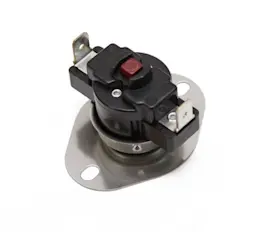
- Range high-limit thermostat WP9759243 (overheat safety device)
- Terminal block WP8203546 (power connection point)
- Cooking appliance 14-gauge splicing wire, 200-degree c (red) 242831 (high-heat wiring repairs)
Why it matters
Clearing the code helps you separate a one-time glitch (like “PF” after a brief outage) from a true failure. If the code returns immediately, troubleshooting the sensor, high-limit thermostat, and wiring prevents repeated shutdowns and uneven baking.
Last updated: February 2026