Installation guide
 Owner’s manual
 Error Codes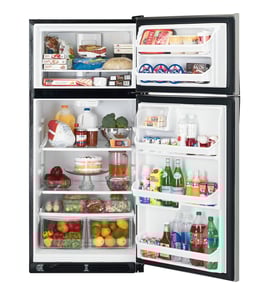



What are the disadvantages of a top mount fridge?
Top-mount refrigerators like the Frigidaire LFHT1831QP3 are reliable and space-efficient, but the main disadvantages are convenience and organization: you bend more to reach fresh-food items, the freezer is less accessible for bulky items, and premium features like in-door water and ice are less common.
Common disadvantages (what most owners notice)
- More bending for daily use: the refrigerator section sits lower, so produce, deli items, and drinks often require bending.
- Less flexible organization: many top-mount designs have fewer adjustable bins and specialty zones than some bottom-freezer styles.
- Freezer access can feel tight: wide pizza boxes and large trays can be harder to maneuver in a top freezer.
- Fewer built-in dispenser options: in-door water and ice are less common on basic top-mount models.
- Door swing clearance matters: if the hinge side is near a wall, you may need extra space to open the door wider.
What you can do to minimize the downsides
We recommend these practical setup tweaks for LFHT1831QP3-STYLE top-mount units:
- Store everyday items at waist level; keep less-used items in lower crisper areas.
- Use clear bins to group snacks, condiments, and breakfast items for faster access.
- Keep the freezer organized by category (meat, frozen meals, ice) to reduce door-open time.
- Confirm you have proper airflow clearance (sides/top and back) and do not block the toe grille.
- Let temperatures stabilize after adjustments; many refrigerators need about 24 hours to fully settle.
Quick comparison: top mount vs bottom freezer
| Feature | Top mount (like LFHT1831QP3) | Bottom freezer |
|---|---|---|
| Fresh-food access | Lower, more bending | Higher, easier reach |
| Freezer access | Eye-level, but often narrower | Pull-out drawer, easier for large items |
| Organization features | Typically simpler | Often more flexible |
| Dispenser availability | Less common | More common |
Why it matters
A top-mount refrigerator can be a great fit for smaller kitchens and straightforward cooling needs, but if you access fresh food frequently or want maximum organization, the layout can feel less convenient over time. For placement and clearance guidance specific to your unit, follow the owner's manual.
Last updated: February 2026
Which is better, top mount or bottom mount refrigerator?
A top-mount refrigerator (like the Frigidaire LFHT1831QP3) is usually the better choice if you want lower cost, strong energy efficiency, and simpler repairs. A bottom-mount is usually better if you want everyday fresh-food items at eye level and easier access to the refrigerator section.
Quick comparison
| Feature | Top mount (freezer on top) | Bottom mount (freezer on bottom) |
|---|---|---|
| Everyday access | Freezer is easiest to reach | Fresh food is easiest to reach |
| Typical price | Lower | Higher |
| Energy use | Typically lower | Typically higher |
| Repair complexity | Typically simpler | Typically more complex |
| Best for | Budget, efficiency, fewer features | Convenience, organization, less bending |
How to choose for your kitchen and habits
Pick a top-mount if most of these are true:
- You use the freezer often (frozen meals, bulk storage)
- You want a straightforward refrigerator with fewer electronics
- You want strong efficiency and lower long-term operating cost
- You have a tighter space and want a simpler door layout
- You prefer easier DIY maintenance (cleaning, basic part swaps)
Pick a bottom-mount if most of these are true:
- You cook with fresh ingredients daily and want them at eye level
- You want wider refrigerator shelves and easier organization
- You want less bending for milk, produce, and leftovers
- You are OK with a higher purchase price for convenience
Why it matters (real-world comfort and performance)
“Better” usually comes down to how often you open each compartment. If you open the refrigerator section far more than the freezer, a bottom-mount can feel more comfortable day to day. If you want a reliable, efficient layout with fewer complications, a top-mount is the practical pick.
Tips that help either style run better
No matter which style you choose, installation and airflow matter for temperature stability and energy use:
- Keep the toe grille area clear so air can circulate
- Install on a level, solid floor so doors seal correctly
- Avoid placing the refrigerator in direct sun or near heat sources
- Allow clearance around the cabinet for airflow (sides/top and back)
- Follow the setup and positioning steps in the owner's manual
Last updated: February 2026
What is the upper part of a fridge called?
On the Frigidaire LFHT1831QP3 top-mount refrigerator, the upper compartment is the freezer. It is designed to keep foods frozen, and it also helps the refrigerator maintain proper temperatures by circulating cold air between compartments (as described in the owner's manual).
What the freezer does (and why it matters)
The freezer is more than just a storage box for frozen food; it is a key part of the cooling system.
- Keeps food at freezing temperatures for long-term storage
- Supplies cold air that helps cool the fresh-food (refrigerator) section
- Works with the evaporator fan to circulate air through both compartments
- Contains vents that should stay clear for proper airflow
- May include features like an ice maker on some configurations
Common “upper compartment” terms you might see
Different manuals and parts diagrams may use slightly different wording.
| What you call it | Common name | What it refers to |
|---|---|---|
| Upper part of the fridge | Freezer compartment | The top section where food freezes |
| Top section | Freezer | Same as above |
| Upper cabinet area | Freezer area | General reference to the freezer space |
Tips for better freezer performance
We see cooling complaints caused by airflow and control settings more often than failed parts.
- Do not block freezer air vents with boxes or bags
- After a power outage, allow cooling to restart and stabilize before adjusting controls
- Adjust temperatures gradually; small knob changes, then wait for temperatures to stabilize
- Let the refrigerator run with doors closed for at least 8 hours before loading food after first setup
- If temperatures drift, check that doors close fully and seals are making contact
Related parts you might replace if the freezer is not cooling well
If the freezer is warm or airflow is weak, these are common repair areas.
- Evaporator fan motor: refrigerator motor 242077705
- Defrost system: refrigerator defrost heater 242044008
Last updated: February 2026
What is the most common problem with Frigidaire refrigerators?
Cooling complaints are the most common issue we see with Frigidaire refrigerators, including the Frigidaire LFHT1831QP3. Typical symptoms are a warm fresh-food section, heavy frost in the freezer, or longer run times; these problems usually trace back to airflow, dirty coils, or a door that is not sealing.
Most common causes (and what to check first)
- Dirty condenser coils: Reduced heat release makes the compressor work harder and cooling suffers.
- Airflow problems in the freezer: A weak or failed evaporator fan can cause warm fridge temps.
- Door seal leaks: A torn or warped gasket lets warm, moist air in, leading to frost and temperature swings.
- Controls set incorrectly: Give temperature changes 24 hours to stabilize after adjusting.
- Defrost-related frost buildup: Excess frost can block airflow and mimic a “not cooling” problem.
If you suspect an airflow issue, our how to fix your evaporator cooling fan guide walks through common checks and symptoms.
Quick symptom-to-cause guide
| Symptom | Most likely cause | What to do next |
|---|---|---|
| Fridge warm, freezer cold | Poor airflow from freezer | Listen for fan; check for frost blocking vents |
| Frost on freezer back wall | Defrost problem or door leak | Inspect gasket; look for heavy ice buildup |
| Noisy or vibrating | Cabinet not level | Level the unit; confirm it is stable |
| Beeping | Door left open | Close door; press the light switch if needed |
Parts that commonly solve these problems on LFHT1831QP3
When a seal is leaking, replacing the gasket is a common fix. For this model, options include:
- Frigidaire refrigerator door gasket (white) 242193206
- Frigidaire refrigerator door gasket (black) 242193212
If frost buildup points to a defrost failure, a common repair is the refrigerator defrost heater 242044008.
Why it matters
Cooling and frost issues usually get worse over time. Fixing airflow restrictions or a leaking door gasket helps the refrigerator hold steady temperatures, reduces compressor run time, and protects food quality.
For model-specific operating details and normal sound descriptions (fans, gurgling, sizzling during defrost), use the owner's manual.
Last updated: February 2026