Owner’s manual
 Error Codes



How to clean coils on Kenmore upright freezer?
To clean the coils on your Kenmore 2539262010 upright freezer, unplug the freezer, expose the condenser area (often behind the lower base panel), then gently brush and vacuum dust off the coils and nearby airflow openings so the unit can release heat efficiently.
Steps to clean the condenser coils
- Unplug the freezer to prevent shock and to keep the fan from pulling dust while you work.
- Pull the freezer out so you can access the lower back area and the floor underneath.
- Remove the base panel if equipped; many upright models use two screws on the front base panel (our 2539262010 owner's manual shows base panel removal with two front screws).
- Brush loose dust first, then vacuum:
- Use a soft coil brush to loosen packed lint.
- Vacuum with a crevice tool along the coil fins and the floor area.
- Clean the surrounding airflow path (vents, grille openings, and the area around the compressor) so air can move freely.
- Reinstall the base panel, push the freezer back carefully, then restore power.
What to use (and what to avoid)
- Soft coil-cleaning brush
- Vacuum with crevice tool
- Dry microfiber cloth for the grille
- Avoid water spray, harsh cleaners, and hard bristle brushes that can bend fins
How often we recommend cleaning
Most upright freezers run best when coils are cleaned every 6 to 12 months. Clean more often if you have pets, heavy dust, or the freezer sits in a laundry or utility area.
| Home condition | Coil cleaning interval |
|---|---|
| Typical home | Every 12 months |
| Pets or dusty area | Every 6 months |
| Tight airflow space | Every 3 to 6 months |
Why it matters
Dirty condenser coils trap heat; that forces longer run times, warmer cabinet temperatures, and higher energy use. Keeping coils and the lower grille clean helps your Kenmore 2539262010 maintain stable freezing and reduces strain on the sealed system.
Parts you might replace during service
Coil cleaning usually does not require parts, but if you are servicing the lower area and find a damaged drain tube or related hardware, you can match parts by model:
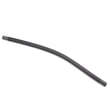
- Hose 5304512272 (drain tube)
For ordering, use the parts list for model 2539262010 or search by model number on Sears PartsDirect.
Last updated: February 2026
How do I know if my compressor is bad in my Kenmore freezer?
If your Kenmore upright freezer model 2539262010 is not holding temperature and you also hear the compressor running loudly for long periods (or it repeatedly tries to start), the compressor or sealed system is likely failing. Use the checks below to rule out airflow, power, and control settings first; see the 2539262010 owner's manual for normal sounds and operating notes.
Quick checks before blaming the compressor
- Confirm the temperature control is not set to OFF (OFF stops the compressor but does not disconnect power).
- Give the freezer time after startup; many units need about 4 hours to cool down completely.
- Make sure there is 3 inches of clearance on all sides for airflow.
- Check that the door closes and seals; do not let packages extend past the shelf fronts.
- Verify the outlet is properly grounded and not controlled by a wall switch.
Signs that point to a compressor or sealed-system problem
These symptoms together are stronger evidence than any single sign:
- Freezer stays warm even though the compressor runs for long stretches.
- Repeated clicking or short cycling (tries to start, then stops).
- Unusual loud running that does not settle down after the freezer has been on for a while.
- Exterior cabinet feels warm; some warmth is normal, but poor cooling plus constant running is not.
What “normal” can look like on this model
| What you notice | Often normal | Often a problem |
|---|---|---|
| Exterior walls warm | Yes; can feel noticeably warmer than room temp | Only if cooling is poor too |
| Louder sound when compressor starts | Yes; start-up can be louder | If it clicks and fails to run |
| Cooling after first plug-in | Up to about 4 hours | Still warm after many hours |
Why it matters
A weak compressor can run longer, waste energy, and still fail to keep food safely frozen. Ruling out airflow, door sealing, and power issues first prevents unnecessary sealed-system work.
Parts that may be involved (sealed system)
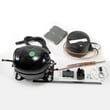
Sealed-system repairs are specialized, but these parts are commonly associated with compressor performance:
You can order replacement parts for your Kenmore 2539262010 from the parts list for this model, or search by model number on Sears PartsDirect.
Last updated: February 2026
Where is the model number on a Kenmore upright freezer?
On Kenmore upright freezer model 2539262010, the model and serial number plate is located on the upper left wall inside the freezer compartment. Write down both numbers exactly as shown; they are what we use to match the correct diagrams and replacement parts; see the 2539262010 owner's manual.
Where to look (in order)
Use a flashlight and check these common label locations:
- Upper left interior wall inside the freezer (primary location for this upright model)
- Side wall inside the cabinet near the front opening
- Ceiling area inside the freezer (some upright designs)
- Behind the kick plate or lower front grille (if equipped)
- Back exterior panel (less common)
What to record from the plate
Copy the information exactly, including any dashes or extra digits.
- Model number
- Serial number
- Purchase date (helpful for your records)
Quick reference
| Item on label | What it’s used for | Example |
|---|---|---|
| Model number | Selecting the correct parts list and diagrams | 2539262010 |
| Serial number | Identifying the production run for the unit | (varies) |
Why it matters
Kenmore freezers can look similar across model series, but shelves, covers, screws, and refrigeration components can differ. Using the exact model and serial from the plate prevents ordering a part that does not fit.
Last updated: February 2026
Why is my Kenmore upright freezer not freezing?
If your Kenmore upright freezer 2539262010 runs but will not freeze, the most common causes are incorrect temperature control settings, poor airflow around the cabinet, or warm air leaking in through a door that is not sealing (often from the freezer not being level). Use the 2539262010 owner's manual for the correct setup steps.
Quick checks (do these first)
- Allow a full 4-hour cool-down after plugging in before judging temperature.
- Set the temperature control to the factory starting point (typically 4), then adjust one number at a time and wait several hours.
- Keep food packages from extending past shelf fronts so the door closes fully.
- Level the freezer so the door aligns and seals properly.
- Leave about 3 inches of clearance on all sides for air circulation.
Symptoms and what they usually mean
| What you notice | Most likely issue | What to do |
|---|---|---|
| Runs a lot; sides feel warm | Normal heat transfer; clearance may be tight | Restore 3-inch clearance; improve room airflow |
| Frost builds fast; temps rise | Door not sealing; frequent openings | Level unit; reduce openings; keep door path clear |
| Frost reaches 1/4 to 1/2 inch | Needs defrosting and cleaning | Defrost; use a plastic scraper only |
When it points to a repair
If setup, leveling, and clearance are correct and temperatures still stay warm, the problem is typically in the cooling system or airflow.
- During manual defrost, if you find water or ice around the drain area, inspect the drain tube and replace the hose 5304512272 if it is cracked, kinked, or leaking.
- If cooling is weak and steady, a sealed-system check often includes refrigerant flow components such as the filter drier 5303305677 (sealed-system work requires a technician).
Why it matters
Warm air leaks, poor circulation, and incorrect control settings can mimic major failures; correcting them often restores normal freezing and prevents recurring frost and moisture problems.
Last updated: February 2026