Installation guide
 Owner’s manual
 Error Codes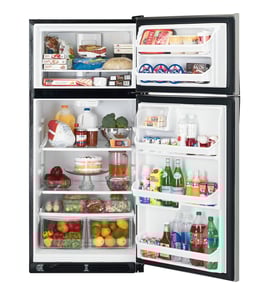



What are the disadvantages of a top mount fridge?
A top-mount refrigerator like the Frigidaire FFTR18G2QW4A is typically affordable and reliable, but its main disadvantages are convenience and organization: fresh-food items sit lower (more bending), freezer access is at eye level, and you usually get fewer built-in storage and dispenser features than higher-end layouts.
Common disadvantages you may notice
- More bending for daily use: The refrigerator compartment is below the freezer, so you reach down more often for produce, drinks, and leftovers.
- Less “premium” organization: Many top-mount designs have fewer adjustable bins, dividers, and specialty drawers than some bottom-mount or French door models.
- Fewer external features: Water and ice dispensers are less common on basic top-mount models.
- Freezer crowding: The freezer can feel smaller or harder to organize, especially with bulky items.
- Door-swing clearance needs: In tighter kitchens, door swing can limit access to shelves and crisper drawers.
What to check on your FFTR18G2QW4A to reduce the downsides
We recommend using the setup and adjustment steps in the FFTR18G2QW4A owner's manual to get the best day-to-day usability.
- Level the cabinet so doors close smoothly and shelves sit square
- Confirm door seals fully on all sides to prevent temperature swings
- Adjust shelves to put most-used items at waist level
- Set temperatures, then allow about 24 hours for changes to stabilize
- Keep airflow paths clear so the refrigerator cools evenly
Quick comparison: top-mount vs other layouts
| Layout | Main drawback | Main advantage |
|---|---|---|
| Top-mount freezer | More bending for fresh food; fewer premium features | Lower cost; simpler design |
| Bottom-mount freezer | Freezer access requires bending | Fresh food at eye level |
| French door | More parts and features to maintain | Wide fresh-food access; flexible storage |
Why it matters
Most “disadvantages” of a top-mount refrigerator are usability issues, not cooling performance issues. When shelves, door bins, and temperature controls are set up correctly, a top-mount model can store food safely and run efficiently with fewer feature-related repairs.
Last updated: January 2026
Are top mount or bottom mount fridges better?
Top-mount and bottom-mount refrigerators can both be “better”; for a Frigidaire FFTR18G2QW4A top-mount, the main advantages are simpler design and typically lower energy use, while the main tradeoff is bending more often to reach fresh-food items. Your best choice depends on how you use the refrigerator day to day.
Quick comparison
| Feature | Top-mount (freezer on top) | Bottom-mount (freezer on bottom) |
|---|---|---|
| Fresh-food access | Lower, more bending | Higher, easier on back/knees |
| Freezer access | Eye level | Lower drawer, more bending |
| Typical efficiency | Often better | Often slightly higher energy use |
| Repair complexity | Often simpler | Often more complex (drawers, rails) |
| Cost | Often lower | Often higher |
When a top-mount is the better pick
A top-mount refrigerator like the FFTR18G2QW4A is usually the right fit when you want practical storage and straightforward ownership.
- You want a typically more energy-efficient layout (fewer features, simpler airflow design).
- You use the freezer frequently and prefer it at eye level.
- You want a simpler refrigerator style that is often easier to service.
- You prefer a lower purchase price compared to many bottom-mount models.
- You do not mind bending to reach crisper drawers and lower shelves.
When a bottom-mount is the better pick
Bottom-mount models usually win on convenience for fresh-food access.
- You use the refrigerator section far more than the freezer.
- You want less bending for everyday items like milk, produce, and leftovers.
- You prefer wide refrigerator shelves at a more comfortable height.
- You are willing to trade some simplicity for convenience features.
Why it matters (real-world comfort and performance)
Most households open the fresh-food door more often than the freezer. If comfort and accessibility are your top priority, bottom-mount can feel better. If efficiency, simplicity, and freezer access matter most, a top-mount like the FFTR18G2QW4A is often the better value.
Tips to make a top-mount easier to live with
- Keep everyday items on the middle shelf to reduce bending.
- Use the crisper humidity controls correctly to help produce last longer.
- Confirm door seals close fully and the cabinet is level to support consistent temperatures.
For model-specific use and setup details (including leveling and door sealing checks), follow the FFTR18G2QW4A owner's manual.
Last updated: January 2026
What is the upper part of a fridge called?
In a Frigidaire top-mount refrigerator like model FFTR18G2QW4A, the upper section is the freezer compartment. It’s the coldest area of the appliance and is designed to keep foods frozen; on some versions it also supports an ice maker and ice storage.
What you’ll typically find in the upper (freezer) compartment
Common freezer-area components include:
- Freezer shelf (for organizing frozen foods)
- Ice tray or ice bucket (depending on configuration)
- Air vents and an air duct (to move cold air)
- Freezer door bins (for smaller items)
- Temperature control access (on some models)
For the exact layout and names used for your refrigerator, use the FFTR18G2QW4A owner's manual.
Freezer vs. refrigerator compartment (quick comparison)
| Compartment | Typical location | Main purpose | Typical target temp |
|---|---|---|---|
| Freezer compartment | Upper section (top-mount) | Long-term frozen storage | 0°F |
| Fresh food compartment | Lower section | Refrigerated storage | 37°F |
Why it matters
Knowing the correct compartment name helps when you’re ordering parts, reading troubleshooting steps, or adjusting controls. For example, airflow from the freezer helps cool the fresh food section, so blocking freezer vents with food can affect temperatures in both compartments.
Related tips for this model
If temperatures are off, we recommend these basics first:
- Adjust controls gradually and wait about 24 hours between changes
- Keep freezer and refrigerator air vents clear for circulation
- Confirm doors seal fully on all sides
- Allow at least 8 hours of cool-down time after startup before loading food
Last updated: January 2026
What is the most common problem with a Frigidaire refrigerator?
Cooling complaints are the most common issue we see with Frigidaire refrigerators like model FFTR18G2QW4A: the fridge or freezer is too warm, temperatures swing, or the unit seems to run too much. Many “cooling problems” trace back to airflow, temperature control settings, or door sealing issues.
What to check first (fast, no parts)
- Confirm the refrigerator/freezer control is not set to “0” (off).
- Allow 24 hours after any control change for temperatures to stabilize.
- If the unit is not running, wait 20 minutes and recheck (it may be in a defrost cycle).
- Make sure the door closes fully and is not held open by overpacked shelves.
- If the cabinet light is out, check the bulb and make sure the light switch is not stuck.
For model-specific control locations and operating guidance, use the FFTR18G2QW4A owner's manual.
Common symptoms and the most likely causes
| Symptom | Most common cause | What we recommend |
|---|---|---|
| Refrigerator too warm | Airflow problem or control setting | Verify vents are not blocked; adjust control and wait 24 hours |
| Freezer OK, fridge warm | Air not moving from freezer to fridge | Check for frost buildup and listen for fan operation |
| Not running at all | Power issue or defrost cycle | Check outlet/breaker; wait 20 minutes and recheck |
| Ice maker not working (some models) | Water supply/pressure or freezer not cold enough | Confirm water is on; verify freezer temp; check arm position |
When a part is commonly involved
If basic checks do not fix a warm refrigerator or poor airflow, the evaporator fan system is a frequent next step. On this model, a common repair part is the refrigerator evaporator fan motor 242077705.
If you have door sweating, frost, or temperature instability, a worn door seal is also common. Match the gasket color to your unit, such as the Frigidaire refrigerator door gasket (white) 242193206 or Frigidaire refrigerator door gasket (black) 242193212.
Why it matters
A refrigerator that cannot hold steady temperatures can spoil food, overwork the compressor, and create frost or moisture problems. Catching airflow and sealing issues early is usually the simplest, lowest-cost path to restoring normal cooling.
Last updated: January 2026