 Owner’s manual
 Error Codes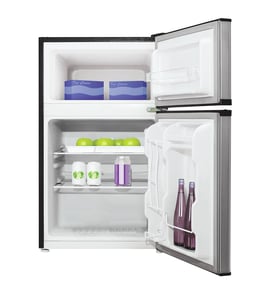


How can I tell the cubic feet of my refrigerator?
The most reliable way to tell cubic feet for your Jenn-Air JUD248CWRS01 is to calculate it from the usable interior dimensions: measure interior width, height, and depth in inches, multiply them, then divide by 1,728 to convert cubic inches to cubic feet. For model-specific specs, check the JUD248CWRS01 owner's manual.
- Empty the compartment you want to measure (main cavity, not door bins).
- Measure interior width (left wall to right wall) in inches.
- Measure interior height (floor to ceiling) in inches.
- Measure interior depth (back wall to inside front edge) in inches.
- Multiply:
width x height x depth = cubic inches. - Divide by 1,728 to get cubic feet.
If the interior measures 18 in (W) x 20 in (H) x 16 in (D):
| Item | Value |
|---|---|
| Cubic inches | 5,760 |
| Cubic feet (5,760 ÷ 1,728) | 3.33 |
- Measure the main refrigerated cavity you actually load.
- Measure to the inside edges (don’t include gasket thickness).
- Use the same approach each time (shelves in vs. shelves out) so comparisons are consistent.
Cubic feet is the standard capacity number used to compare compact refrigerators and undercounter units; it helps you confirm the appliance fits your beverage, wine, or food storage needs.
Last updated: February 2026
What is the average lifespan of a KitchenAid refrigerator?
Most KitchenAid refrigerators last 14 to 17 years on average with normal household use and basic maintenance. For your Jenn-Air JUD248CWRS01 refrigerator drawers, the same lifespan range is a solid expectation; the exact service life depends most on airflow, door sealing, and condenser cleanliness (see the owner's manual).
A refrigerator’s life is mainly driven by how hard the sealed system and fans have to work.
- Condenser coil cleanliness: dirty coils raise compressor run time
- Door gasket condition: air leaks cause temperature swings and frost
- Ventilation/air circulation: blocked airflow makes cooling uneven
- Room temperature and installation location: hotter spaces shorten life
- Water and ice maker upkeep (if equipped): leaks and clogs create avoidable damage
These steps help you get closer to the high end of the 14 to 17 year range.
- Vacuum condenser area regularly (frequency depends on dust and pets)
- Keep drawers closing squarely; avoid slamming
- Clean and inspect the door gasket; replace if torn or not sealing
- Maintain proper air circulation inside; do not pack items tightly against vents
- If you have an ice maker, check fill and drain areas for slow leaks
If performance issues show up, these parts are often involved.
| Symptom | Common area to check | Example part for JUD248CWRS01 |
|---|---|---|
| Warm temps, long run times | Cooling system control or airflow | Refrigerator electronic control board WPW10281540 |
| Frost buildup, weak airflow | Evaporator fan motor | Evaporator motor W10854409 |
| Water leaking or no ice | Water supply to ice maker | Refrigerator water tube 8201597 |
| Condensation, poor closing | Door sealing | Refrigerator gasket WPW10204700 |
A refrigerator that is struggling to cool (often from restricted airflow or a poor seal) runs longer and hotter. That extra workload accelerates wear on major components like the compressor and evaporator, which can shorten overall lifespan.
Last updated: February 2026
How do I troubleshoot my JUD248CWRS01?
For the Jenn-Air JUD248CWRS01 refrigerator drawers, start with power and control settings: confirm the unit is plugged into a grounded 3-prong outlet, check the house breaker or fuse, and make sure both drawer controls are not set to Off. Use the JUD248CWRS01 owner's manual troubleshooting section for model-specific checks.
- Verify the power cord is fully plugged into a grounded 3-prong outlet.
- Reset a tripped circuit breaker or replace a blown household fuse.
- Confirm the upper and lower drawer controls are not set to Off.
- If the drawers are not cooling, turn them Off, then On to reset the controls.
- Allow time for temperatures to stabilize after changes (especially after loading food).
It is normal for the compressor to run frequently. The manual notes that at normal room temperatures, you can expect the motor to run about 80% of the time, and it runs longer when the room is warm or after adding a lot of food.
| What you notice | Likely cause | What to do |
|---|---|---|
| Runs longer on hot days | Warm room temperature | Improve ventilation around the unit, keep doors closed |
| Runs longer after stocking | Warm food load | Let it recover; avoid overloading at once |
| Constant running with poor cooling | Control needs reset or a cooling issue | Power-cycle Off to On; then move to deeper checks |
- Check door sealing: a torn or loose gasket leaks cold air and increases run time (see refrigerator gasket WPW10204700).
- Look for airflow blockage inside drawers; keep vents clear of containers.
- If you have an ice maker model, confirm the shut-off arm is not stuck in the off position (see arm-shut W10281546).
- If temperatures are erratic, a sensor issue is common; the temperature sensor is the thermistor (see refrigerator thermistor W10205063).
Power issues, control settings, and air leaks cause most “won’t run” or “runs all the time” complaints. Fixing those first prevents unnecessary parts replacement and helps the compressor maintain stable temperatures.
Last updated: March 2026






