Owner’s manual
 Error Codes

Does unplugging a refrigerator reset the ice maker?
Yes. On the Samsung RF32FMQDBSR refrigerator, unplugging the unit is a reliable “hard reset” that clears many ice maker control glitches; leave it unplugged about 5 minutes, then restore power and allow several hours for temperatures to stabilize and ice production to resume. See the RF32FMQDBSR owner's manual for model-specific reset and test steps.
- Turn the ice maker OFF (if your control panel has an Ice On/Off option).
- Unplug the refrigerator (or switch the breaker OFF).
- Wait 5 minutes.
- Plug back in (or turn breaker ON).
- Turn the ice maker ON.
- Wait for cooling recovery; first ice typically appears after the freezer is back near 0°F.
Most “no ice” problems are not a control-board glitch; they are water supply, airflow, or freezing issues.
- Confirm the freezer is cold enough (target 0°F).
- Make sure the ice bin is seated and not jammed with clumped ice.
- Verify the water supply valve is fully open and the line is not kinked.
- If the dispenser has weak or no water, suspect a supply issue or a valve problem.
- Listen for the ice room fan; if it is not running, ice production can stall.
| Symptom | What it usually points to | What we check next |
|---|---|---|
| No water to ice maker and dispenser | Water supply or inlet valve issue | Water pressure, line kinks, valve function |
| Ice maker runs but no ice drops | Frozen fill tube or ice jam | Defrost ice room, clear bin and chute |
| Ice is small/hollow | Low water flow | Filter condition, inlet valve, pressure |
| Warm freezer, no ice | Cooling/airflow problem | Door seal, fan operation, condenser airflow |
If troubleshooting points to a failed component, these are common ice-related suspects for RF32FMQDBSR:
- Refrigerator water inlet valve DA62-04027A (controls water flow to the ice maker and dispenser)
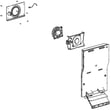
- Refrigerator ice room fan motor assembly DA31-00070E (moves cold air to the ice room)
- Refrigerator temperature sensor DA32-10104N (helps regulate temperatures that impact ice making)
A hard reset can fix a temporary electronics lockup, but ice makers depend on correct freezer temperature, steady water flow, and proper airflow. Checking those basics prevents repeat failures and wasted time replacing the wrong part.
Last updated: February 2026
What are the disadvantages of a bottom freezer?
Bottom-freezer refrigerators (including Samsung RF32FMQDBSR) make you bend or squat to reach frozen foods, and the deep drawer layout can hide items. They also tend to cost more up front than comparable top-freezer models, especially in larger French-door styles.
- More bending and lifting: You reach down for everyday freezer items and lift heavier foods up and out.
- Items get buried: Stacked bags and boxes can be harder to see and organize.
- Less convenient for kids: The freezer drawer is easy to open, which can lead to spills and longer door-open time.
- Higher purchase price: Bottom-freezer and French-door designs typically cost more than basic top-freezer units.
- Drawer clearance needed: You need space in front of the refrigerator to pull the freezer drawer fully open.
| Feature | Bottom freezer | Top freezer |
|---|---|---|
| Fresh food access | Easier (at eye level) | Requires more bending |
| Freezer access | More bending | Easier reach |
| Organization | Deep drawer, can bury items | Shelves, easier visibility |
| Typical cost | Higher | Lower |
- Use bins or baskets to separate meats, vegetables, and quick-grab items.
- Keep a “top layer” zone for daily items (ice packs, waffles, frozen fruit).
- Avoid overfilling; leave room so air can circulate and items stay visible.
- Store heavy items (large roasts) closer to the front to reduce lifting strain.
- Follow the storage and loading guidance in the RF32FMQDBSR owner's manual.
Freezer layout affects daily comfort, food organization, and how long the door stays open (which can impact temperature stability and ice quality over time).
Last updated: February 2026
What is the common problem with Samsung fridge ice maker?
The most common Samsung refrigerator ice maker problems on model RF32FMQDBSR are ice buildup in the ice room, slow or no ice production, and cubes that are small or hollow. These issues usually trace back to airflow restrictions, temperature being too warm, or water supply problems.
- Ice maker stops making ice or makes very little
- Ice clumps or frost buildup around the ice room
- Small, hollow, or misshapen cubes
- Ice will not dispense even though the bin has ice
- Fan noise near the ice room or freezer
Use these steps first; they solve the majority of “no ice” and “ice clumping” calls.
- Confirm the ice maker is turned ON and not in a “lock” or “off” mode (see the RF32FMQDBSR owner's manual)
- Set the freezer to a typical target of 0°F; ice makers struggle when temps drift warmer
- Dump old ice and dry the bin; clumped ice can block the auger and chute
- Make sure the ice bin seats fully and the door closes tightly (warm air causes frost)
- Check household water supply: shutoff valve fully open, line not kinked
- Replace a restricted filter on schedule; low flow causes small or hollow cubes
If the checks above do not help, these components are frequent causes of poor ice production or ice room icing.
| Symptom | Common cause | Example part for RF32FMQDBSR |
|---|---|---|
| Frost/ice buildup, weak airflow | Ice room fan not running | Refrigerator ice room fan motor assembly DA31-00070E |
| Slow ice, warm ice room | Evaporator fan not moving cold air | Refrigerator evaporator fan motor (model-specific) |
| No water to ice maker, tiny cubes | Water inlet valve not opening fully | Refrigerator water inlet valve DA62-04027A |
An ice maker depends on two things: steady cold airflow and steady water flow. When either one drops (fan issue, frost restriction, warm freezer, clogged filter, low water pressure), the ice maker either stops or produces poor-quality cubes.
For model-family troubleshooting steps and display codes, use Samsung rf32fm model 4 door refrigerator error codes.
Last updated: February 2026
What is the most common problem with Samsung refrigerators?
The most common problem we see on Samsung refrigerators (including the Samsung RF32FMQDBSR) is a cooling issue caused by airflow restriction from frost or ice buildup around the evaporator area. That can make the fresh food section warm even while the freezer still seems cold; ice maker and dispenser complaints are also very common.
- Refrigerator section warms up or swings temperature
- Freezer seems OK but food in the fridge spoils faster
- Fan noise, buzzing, or a “whooshing” sound that comes and goes
- Frost on the back wall inside the refrigerator compartment
- Ice maker slows down, stops, or clumps ice
- Water dispenser flow is weak or intermittent
Start with the basics, then move to the most failure-prone cooling and ice-making components.
| What you notice | Most likely area | What to do first |
|---|---|---|
| Fridge warm, freezer OK | Evaporator frost buildup, evaporator fan airflow | Check for heavy frost; verify fan runs with door switch pressed |
| Noisy fridge, poor cooling | Fan motor or ice buildup hitting fan | Inspect fan area for ice; clear blockage and confirm fan operation |
| No ice or slow ice | Ice room airflow, ice maker area, water supply | Confirm water supply is on; check for frozen fill tube or ice blockage |
| No water at dispenser | Water inlet valve or frozen line | Check household water pressure; inspect for frozen reservoir/line |
If you suspect a fan or airflow problem on this model, common related parts include the refrigerator evaporator fan motor DA31-00287B and the refrigerator condenser fan motor assembly DA97-15765B.
A restricted-airflow cooling problem can snowball: temperatures rise, the compressor runs longer, ice production drops, and frost buildup gets worse. Catching it early helps protect food and reduces strain on major sealed-system components.
Use the RF32FMQDBSR owner's manual to confirm the correct temperature settings, control panel functions, and any model-specific reset or diagnostic steps before replacing parts.
Last updated: February 2026
What's the lifespan of a bottom freezer fridge?
Most bottom freezer refrigerators, including Samsung bottom-mount models like RF32FMQDBSR, typically last 15 to 20 years with normal household use and routine maintenance. Lifespan is most affected by condenser airflow, door seal condition, and how hard the ice maker and dispenser systems work.
A bottom freezer (bottom-mount) design usually runs efficiently, but it also has multiple fans, sensors, and ice and water components that can need service over time.
- Typical service life: 15 to 20 years
- Common mid-life repairs: evaporator fan, condenser fan, temperature sensor, water inlet valve
- Big-ticket repairs: sealed system or compressor work
These are the most common conditions that push a refrigerator into early repairs:
- Dust and pet hair restricting condenser airflow
- Doors not sealing fully (warm air leaks cause longer run times)
- Heavy ice maker use or frequent dispenser use
- Overpacked compartments blocking air vents
- Power surges or repeated breaker trips
We recommend these habits to help your RF32FMQDBSR reach the upper end of the 15 to 20 year range:
- Vacuum condenser area and keep rear and toe-kick airflow clear
- Keep freezer at 0°F and fresh food at 37°F (typical targets)
- Confirm doors close on their own and gaskets are clean
- Replace filters on schedule and flush the water system after changes
- Address fan noise or warming early (small airflow issues become cooling failures)
If cooling performance drops, these parts are often involved:
| Symptom | Common system | Example part for this model |
|---|---|---|
| Warm fridge, freezer OK | Fresh food airflow | Evaporator fan motor (model-specific) |
| Warm freezer, poor ice | Freezer airflow | Ice room fan motor assembly |
| No water or slow fill | Water supply control | Water inlet valve |
| Clicking, won’t start | Start protection | Compressor overload protector |
For model-specific operating and care guidance, use the RF32FMQDBSR owner's manual.
A refrigerator that runs longer to hold temperature uses more energy and wears out components faster. Keeping airflow clear and temperatures stable reduces compressor run time and helps prevent premature failures.
Last updated: February 2026