 Installation guide
 Owner’s manual



Can a clogged drain cause an FTD error?
Yes. On the GE GDF630PGM0WW dishwasher, an FTD (fail to drain) condition commonly happens when water cannot leave the tub due to a clog or restriction in the drain path (air gap, disposer connection, or a kinked drain hose). See the drain checks in the GDF630PGM0WW installation guide.
- Cancel the cycle by pressing and holding Start/Reset for about 3 seconds so the dishwasher begins draining.
- Open the door and confirm whether the water level drops.
- Check the air gap (if your setup has one) and clean it.
- If the dishwasher drains into a garbage disposer, make sure the disposer inlet plug was removed.
- Inspect the drain hose for kinks or pinches behind or under the dishwasher.
- Confirm the kitchen sink drains normally; a slow sink can point to a household drain restriction.
The dishwasher expects water to pump out during drain periods. If the drain line is blocked, the pump cannot move water out fast enough, so the control interprets it as a drain failure.
| What you see | Most likely cause | What to do |
|---|---|---|
| Water stays in tub after cancel/drain | Air gap or disposer connection clogged | Clean air gap; run/clear disposer |
| Water drains slowly | Kinked hose or partial blockage | Straighten hose; clear restriction |
| No drain sound or weak drain | Drain pump issue or obstruction at pump | Inspect sump area; consider pump service |
If the drain path is clear but the dishwasher still will not drain, the drain pump or drain hose can be the next suspects.
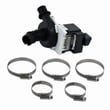
- Dishwasher drain pump asm WD19X24829 (moves water out during drain)
- Dishwasher drain hose WD24X10062 (carries water to the sink/disposer)
Running with standing water can lead to odors, poor cleaning, and repeated drain errors. Clearing the restriction restores normal draining and helps protect the pump.
Last updated: January 2026
How do I reset my dishwasher after error code?
On your GE GDF630PGM0WW dishwasher, the most reliable “reset” after an error code is a power reset (turn the breaker off, then back on) and then canceling the current cycle by pressing and holding Start/Reset for 3 seconds so the unit drains and clears the cycle state. See the GDF630PGM0WW owner’s manual for the exact control behavior.
- Turn the dishwasher circuit breaker OFF.
- Wait 1 to 5 minutes.
- Turn the breaker ON.
- Press and hold Start/Reset for 3 seconds to cancel the cycle (the dishwasher should drain).
- Close the door and start a fresh cycle.
These items commonly prevent a restart even after a reset:
- Door not fully latched (a misaligned latch can stop the cycle from starting).
- Control lock enabled (controls appear unresponsive).
- Drain issue leaving water in the tub (the unit may pause or refuse to proceed).
- No water entering (water supply valve off or a fill problem).
- A recurring fault that needs troubleshooting, not just a reset.
If the door will not latch consistently, a worn latch can cause repeated “won’t start” symptoms; the correct replacement for this model is the GE dishwasher door latch lock WD21X10490.
| Symptom after reset | What to do next | Common cause |
|---|---|---|
| Lights on, won’t start | Confirm door closes firmly; press Start and close door promptly | Door not latched, control lock |
| Starts then stops and drains | Cancel cycle (Start/Reset 3 sec) and retry | Temporary control glitch |
| Water remains in bottom | Check drain hose routing and disposer/air gap | Drain restriction or kink |
| No water enters | Verify water supply is on and power is on | Supply valve off, fill issue |
Resetting clears temporary control glitches and cancels a stuck cycle, but if the same error code returns, it is pointing to a specific problem (drain, fill, heating, or wash system) that needs correction so the dishwasher can run normally.
Last updated: January 2026
What is the most common problem with GE dishwashers?
For the GE GDF630PGM0WW dishwasher, the most common issues we see are “won’t run” complaints (power, control lock, or door not latching) and drainage or cleaning problems caused by buildup that restricts water flow. Start with the quick checks in the GDF630PGM0WW owner's manual.
- Dishwasher won’t run: tripped breaker, wall switch off, control panel locked, or a door latch problem
- Not draining: drain path restriction (filter area, hose routing, disposer connection) or a drain pump issue
- Not cleaning well: spray arm ports clogged, low water flow, or circulation issues
- Not drying: heater or settings related; also affected by rinse aid use and cycle selection
- Suds/overflow: wrong detergent (hand dish soap) or rinse aid spill
- Reset the breaker and confirm any nearby wall switch is ON.
- Make sure the door closes firmly; a weak latch can prevent starting.
- Check that the control panel is not locked (lock feature can stop operation).
- Use only automatic dishwasher detergent; hand soap causes heavy suds and poor washing.
- If wash performance is poor, inspect spray arms for debris and verify dishes are not blocking the detergent cup.
| Symptom | Commonly involved part | What it affects |
|---|---|---|
| Won’t start or stops mid-cycle | GE dishwasher door latch lock WD21X10490 | Confirms the door is closed so the control will run |
| Poor cleaning, low spray | Dishwasher spray arm, lower WD22X33499 | Water distribution to the lower rack |
| No heat, poor drying | Dishwasher heating element WD05X35098 | Water heating and drying performance |
A GE dishwasher that won’t start is often a simple power or latch condition, while cleaning and draining problems are frequently caused by restricted water flow. Catching these early helps prevent repeat cycle failures and reduces strain on the circulation and drain systems.
Last updated: January 2026





