



How deep does a rear tine tiller go?
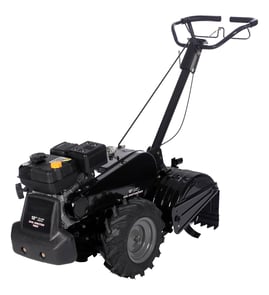
Most rear-tine tillers like the Poulan PRRT65A typically till about 6 to 8 inches deep in average soil; with multiple passes and the depth stake set for maximum bite, many setups can reach up to around 10 inches. Actual depth depends on soil conditions, tine wear, and depth-stake adjustment.
Rear-tine tillers are designed for garden-bed prep and soil mixing, not deep trenching.
| Situation | Typical depth you can expect |
|---|---|
| First pass in firm or compacted soil | 2 to 4 inches |
| Normal garden prep (most common) | 6 to 8 inches |
| Multiple passes in workable soil | Up to about 10 inches |
Use these adjustments and techniques to increase depth without overloading the drive system:
- Set the depth stake (drag bar) to a shallower setting first, then step it down deeper on later passes.
- Make 2 to 3 passes, crossing the area in different directions.
- Reduce forward speed so the tines have time to dig.
- Till when soil is slightly moist (not muddy); dry clay and wet soil both limit depth.
- Check tine condition; rounded or bent tines reduce bite and depth.
We recommend staying in the 2 to 4 inch range when you are breaking sod, working rocky soil, or tilling near irrigation lines and shallow roots.
Tilling too deep in one pass can cause belt slip, poor tine rotation, and extra wear on the drive components. If your tiller struggles to dig or the tines slow under load, inspect the drive belt and related hardware; a worn belt is a common cause on rear-tine units. The husqvarna rear-tine tiller drive belt 591372401 is one of the drive items listed for this model.
For step-by-step technique and setup tips, use our guide: tips for using a rear tine tiller.
Last updated: February 2026
How heavy is a rear tine tiller?
Most rear-tine tillers weigh about 150 to 300 lb; heavier units track straighter and dig more consistently, while lighter units are easier to maneuver and transport. For the Poulan PRRT65A, use the weight on the unit’s ID/spec label (often on the frame) to get the exact number for your configuration.
These ranges cover most homeowner and prosumer rear-tine tillers:
- Light-duty: 150 to 200 lb
- Mid-duty: 200 to 275 lb
- Heavy-duty: 275 to 350 lb
If the label is missing or unreadable, you can still get close:
- Weigh the tiller on a bathroom scale using the front-end then rear-end method (add the two readings).
- Remove loose add-ons before weighing (drag stake accessories, tool caddies, etc.).
- Account for common weight adders such as a counterweight and heavier tine assemblies.
- If you are comparing to shipping weight, remember crating and fluids can change the number.
Weight directly affects performance and handling:
- More weight improves traction and reduces hopping in hard soil.
- Heavier units hold consistent tilling depth more easily.
- Lighter units are easier to turn at row ends and load for transport.
| Goal | Lighter tiller (150 to 200 lb) | Heavier tiller (275 to 350 lb) |
|---|---|---|
| Transport and storage | Easier to move | Harder to load/lift |
| Hard, compacted soil | May bounce more | Digs and tracks straighter |
| Operator effort | Easier steering | More effort to pivot |
If your PRRT65A feels unusually hard to move or the tines stall, inspect the drive system; a worn belt can make the tiller act “overloaded.” Our how to replace a tiller drive belt guide pairs well with checking the husqvarna rear-tine tiller drive belt 591372401.
Last updated: February 2026
How to adjust rear tine tiller?
On a Poulan PRRT65A rear-tine tiller, most “adjustment” issues come down to the drive system: the belt and the control cable that tightens the belt. We adjust it so the wheels and tines engage firmly without slipping, and fully disengage when you release the lever.
- Shut the engine off and let all moving parts stop; disconnect the spark plug wire.
- Inspect the belt path and pulleys for debris, mud, or a belt that is glazed or cracked.
- Check cable free play at the handle control; too much slack causes slipping.
- Confirm the belt tensioner/idler moves freely and returns when released.
- Test engagement: wheels and tines should pull strongly under load, not squeal or stall.
Most rear-tine tillers use a control cable to pull an idler pulley against the belt. The goal is correct tension when engaged.
| Symptom | Most likely adjustment issue | What to change |
|---|---|---|
| Tines/wheels slip under load | Cable too loose or belt worn | Remove slack; replace belt if worn |
| Tines/wheels creep when “off” | Cable too tight | Add slack until fully disengaged |
| Engagement feels sudden/jumpy | Belt glazed or pulley binding | Clean/inspect pulleys; replace belt |
A stretched or worn belt will keep slipping even with the cable tightened. For the PRRT65A, a common fix is replacing the husqvarna rear-tine tiller drive belt 591372401.
Correct belt and cable adjustment protects the pulley and gear case components, improves tilling performance, and prevents premature belt wear. It also helps the tiller stop driving immediately when you release the control.
For step-by-step visuals and the typical adjustment sequence, use our DIY guide how to replace a tiller drive belt.
Last updated: February 2026
Why did 65 get bad reviews?
This Poulan PRRT65A rear-tine tiller page is for replacement parts and repair help, so “65” here fits best as a PRRT65A tiller-related question (not the movie). Most negative PRRT65A-STYLE reviews come from performance or durability issues such as poor tilling, drive problems, or hard shifting; those symptoms usually trace back to wear in the belt, chain, or gear case components.
When a rear-tine tiller feels unreliable, customers usually describe one or more of these:
- Tines or wheels do not pull consistently (slipping drive)
- Weak tilling or bouncing in hard soil (depth and tine setup issues)
- Grinding noises from the transmission area (chain or gear case wear)
- Hard shifting or popping out of gear (shift linkage wear)
- Frequent belt adjustments or belt breakage (pulley alignment or belt wear)
A good starting point for symptom-based troubleshooting is rear tine tiller troubleshooting tips wheels and tines.
On the PRRT65A, these parts are frequent contributors when the tiller “works, but not well”:
- Drive belt: husqvarna rear-tine tiller drive belt 591372401
- Drive chain: tiller chain, #25-50 532102134 or chain 532106147
- Gear case sealing (leaks lead to internal wear): rally tiller gear case gasket 532431022
- Shifting components: tiller shift rod 532109337 and shifter shaft 532154466
| Symptom | Most likely area | Common related part |
|---|---|---|
| Tines won’t turn but wheels do | Tine drive, chain, belt | Husqvarna rear-tine tiller drive belt 591372401 |
| Wheels and tines won’t turn | Main drive, belt, linkage | Pulley 592642101 |
| Oil seepage at gear case | Gear case sealing | Rally tiller gear case gasket 532431022 |
| Hard to shift | Linkage, shift parts | Tiller shift rod 532109337 |
Rear-tine tillers like the Poulan PRRT65A rely on solid belt tension, good chain condition, and a sealed gear case to transfer engine power to the wheels and tines. When any of those wear, the tiller can feel underpowered or inconsistent, which is what typically drives negative reviews.
Last updated: February 2026