Owner’s manual
 Error Codes



How to remove bottom grill from KitchenAid refrigerator?
On KitchenAid refrigerator model KRMF706EBS01, the bottom grill (base grille/toe kick) pulls straight off the lower frame. Use both hands to grasp it firmly and pull toward you; to reinstall, align the tabs and snap it back into place (see the KRMF706EBS01 user manual).
- Open the freezer drawer for better access.
- Stand centered in front of the grill.
- Grasp the grill with both hands near the ends.
- Pull the grill straight toward you to release the retaining clips.
- Set it aside on a soft surface to avoid scratches.
- Pull evenly from both ends; twisting can crack the plastic.
- Check for packing tape or debris along the top edge.
- If the refrigerator is tight to the floor, raise the front slightly by turning the brake feet counterclockwise (after the grill is off).
- Avoid using a screwdriver as a pry bar; it can damage the finish and clips.
- Line up the ends of the grill with the openings near the leveling/brake feet.
- Push the grill straight back until it snaps into place.
| Part | Other name | What it does |
|---|---|---|
| Bottom grill | Base grille, toe kick | Covers the brake feet/rollers and provides airflow access for cleaning |
We remove the base grille to access the brake feet for leveling and to clean dust from the front condenser area, which helps cooling performance and reduces noise.
Last updated: January 2026
What is the disadvantage of a bottom freezer refrigerator?
On the KitchenAid KRMF706EBS01, the biggest disadvantage of the bottom-freezer layout is that you still have to bend down and pull out a large drawer to reach frozen foods. Organization is usually better than older “single-bin” drawers, but deep storage can still hide items.
- More bending for frozen items: the freezer is low, so frequent freezer use can be less comfortable.
- Drawer clearance: the freezer drawer extends outward and needs aisle space in front of the refrigerator.
- Items can get buried: even with dividers and tiers, small packages can slide behind larger items.
- Heavier drawer feel when loaded: a full freezer can feel heavy to open and close.
- More parts in the drawer system: glides, brackets, and front panels can need adjustment if the drawer gets misaligned.
KRMF706EBS01 includes features intended to improve freezer usability, so the “hard to organize” complaint is usually less severe than on basic drawer freezers.
- Use the built-in sections to group foods (breakfast, meats, vegetables).
- Keep quick-grab items near the top/front.
- Avoid overloading so the drawer closes fully and seals.
| Topic | Bottom freezer (KRMF706EBS01) | Top freezer (typical) |
|---|---|---|
| Freezer access | Bend and pull out drawer | Less bending for freezer |
| Frozen-food visibility | Better with tiers/dividers, but can still stack | Often easier to scan shelves |
| Kitchen clearance | Needs space for drawer extension | Needs space for door swing |
Freezer layout affects daily comfort and how often food gets forgotten. If you use frozen foods multiple times a day or have mobility concerns, the bending and drawer clearance are usually the deciding tradeoffs.
For model-specific use and care tips (including door and drawer alignment), see the KRMF706EBS01 refrigerator user manual.
Last updated: January 2026
What is the most common problem with a KitchenAid refrigerator?
On the KitchenAid KRMF706EBS01, the issues we most often help customers troubleshoot are ice maker and water dispenser problems and cooling that is too warm or inconsistent. Exact “most common” failure rates vary by home and usage, so we recommend starting with the model’s built-in troubleshooting steps in the KRMF706EBS01 refrigerator manual.
These quick checks solve a large share of everyday complaints without replacing parts.
- Confirm doors and drawers close fully; the dispenser won’t operate with doors open.
- Check that air vents aren’t blocked by food packages.
- Verify the temperature set points are at the recommended factory settings (37°F fridge, 0°F freezer).
- If ice is slow or hollow, confirm the water shut-off valve is fully open and the supply line isn’t kinked.
- If water tastes off or looks gray after a filter change, flush the system (the manual calls for dispensing about 3 gallons).
If the basic checks don’t help, these model-compatible parts are often related to the symptom.
| Symptom you notice | What it often points to | Model-compatible part example |
|---|---|---|
| No ice, slow ice, or dispenser not filling | Water supply control issue | Refrigerator water inlet valve assembly WPW10341329 |
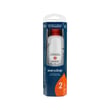
| Low water flow or poor ice quality | Restricted water filter | Refrigerator cartridge wrap assembly EDR2RXD1 |
| Warm temps or temperature swings | Airflow/sensing problem in the cooling system | Refrigerator evaporator fan and temperature sensor assembly W11087438 |
| Ice maker stops cycling | Ice maker assembly issue | Refrigerator ice maker W11658802 |
Ice and cooling symptoms can look like major failures, but on KRMF706EBS01 they’re often caused by airflow blockage, water supply limitations, or a filter that needs flushing or replacement. Starting with the right checks helps avoid unnecessary parts.
Last updated: January 2026