Owner’s manual
 Error Codes


How to move a Kenmore refrigerator?
To move a Kenmore refrigerator model 10641123211 safely, we recommend emptying it, protecting the floor, and rolling it straight out with controlled, side-to-side “walking” pressure. Keep the refrigerator upright to protect the sealed cooling system and avoid door damage.
Before you move it (prep checklist)
- Unplug the power cord and secure it so it cannot snag.
- Remove food, bins, and loose shelves; tape doors shut or use a strap.
- Turn off the water supply to the ice maker and disconnect the water line if needed.
- Protect floors with a hard floor runner or plywood; avoid dragging on vinyl.
- Use an appliance dolly with a strap; keep the unit upright.
How to move it across the floor
- Stand at the front corners, grip both sides, and “walk” the refrigerator forward by gently pushing side to side while guiding it straight.
- Keep knees bent and back straight; use legs, not your lower back.
- Move slowly over thresholds; lift slightly with help rather than forcing the wheels.
Door, hinge, and clearance tips
A side-by-side is easiest to move when doors stay aligned and closed. If a door swings or sags after moving, inspect the hinge area and cam parts.
- Check that the doors close fully and do not rub.
- Verify the refrigerator is level after repositioning.
- If the door does not self-close, the lower hinge cam may be worn.
| Situation | What to do | Why it matters |
|---|---|---|
| Moving on tile/vinyl | Use a runner or plywood | Prevents floor gouges and wheel damage |
| Going through a doorway | Measure width and remove handles if needed | Avoids cabinet and door damage |
| Laying it down | Do not lay it down; keep upright | Helps prevent oil/refrigerant issues |
Why it matters
Keeping the refrigerator upright, stable, and protected during the move helps prevent cooling problems, water line leaks, and door alignment issues that can lead to warm temperatures and frost.
For model-specific handling notes and leveling guidance, follow the 10641123211 owner's manual. If you need to correct door closing after the move, the refrigerator door cam (black) WP2182179 is a common wear item in the lower hinge area.
Last updated: January 2026
How can I tell how many cubic feet my Kenmore refrigerator is?
For Kenmore model 10641123211, the quickest way to confirm cubic feet (capacity) is to look up the capacity specification in the 10641123211 owner's manual. If you need a backup method, you can estimate capacity by measuring the usable interior space and converting cubic inches to cubic feet.
Fastest way: use the model’s specs
Capacity is listed as a specification for the refrigerator. Use these steps:
- Find the model tag inside the fresh food section (commonly on a side wall or ceiling area).
- Confirm the model number matches 10641123211 exactly.
- Check the capacity/specifications section in the 10641123211 owner's manual.
DIY method: calculate an estimated cubic feet
If you want an estimate, measure the usable interior space (not the outside cabinet).
- Empty the section you are measuring (fresh food and freezer can be estimated separately).
- Measure interior width, depth, and height in inches.
- Multiply:
width x depth x height = cubic inches. - Divide by 1728 to convert cubic inches to cubic feet.
- Subtract space taken by thick insulation humps, air ducts, and fixed housings for a more realistic estimate.
Quick conversion table
| What you have | What to do | Result |
|---|---|---|
| Interior measurements in inches | Multiply L x W x H | Cubic inches |
| Cubic inches | Divide by 1728 | Cubic feet (estimated) |
Why it matters
Knowing cubic feet helps us match the right replacement parts and accessories (like shelves, bins, and drawers) and it also helps when comparing refrigerator sizes for fit and food storage.
Last updated: January 2026
What is the code Sy Ef on a Kenmore refrigerator?
On Kenmore refrigerator model 10641123211, the SY EF (or 5Y EF) code points to a problem in the evaporator fan circuit, which means the freezer evaporator fan is not running correctly or the control is not sensing it. This commonly traces to the fan motor, wiring, or the electronic control.
What to check first (quick triage)
- Unplug the refrigerator for 5 minutes, then restore power to see if the code returns.
- Listen for the evaporator fan in the freezer; a working fan usually runs when the compressor is running.
- Check for heavy frost or ice buildup on the freezer back wall (a defrost issue can stop airflow).
- Make sure vents are not blocked by food packages.
- If the fan is noisy, stalled, or intermittent, plan to inspect the fan blade and motor.
Likely causes and what they mean
| Likely cause | What you may notice | Typical fix |
|---|---|---|
| Ice buildup blocking the fan | Rubbing or ticking noise, weak cooling | Defrost the ice, then address the defrost cause |
| Failed evaporator fan motor | Freezer warms, fridge warms, no airflow | Replace fan motor |
| Damaged fan blade | Loud vibration, fan spins poorly | Replace fan blade |
| Wiring or connector issue | Code comes and goes, fan works intermittently | Repair harness/connection |
| Control not reading fan feedback | Fan may run but code persists | Diagnose control circuit |
Parts that commonly relate to SY EF on this model
These parts are often involved when airflow or fan operation is the root issue:
- Evaporator motor 4389144 (drives the freezer evaporator fan)
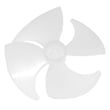
- Refrigerator evaporator fan blade WP2169142 (moves air across the evaporator)
Why it matters
The evaporator fan is what pushes cold air from the freezer through the refrigerator. When the fan circuit fails, temperatures rise, frost can build up, and food can spoil even if the compressor is still running.
Helpful reference
For model-specific diagnostics, wiring references, and error-code behavior, use the 10641123211 owner’s manual.
Last updated: January 2026
Why is my Kenmore side by side refrigerator not getting cold?
When a Kenmore side-by-side refrigerator like model 10641123211 is not getting cold, the most common causes are poor airflow (dirty condenser coils or a failed evaporator fan), a defrost problem causing ice buildup, or a sealed-system issue. Start with airflow checks because they are fastest and most likely.
Quick checks we recommend first
- Confirm the temperature settings were not bumped warmer.
- Make sure both doors close and seal fully; a gap can stop cooling.
- Listen for the evaporator fan in the freezer; it should run when the compressor is running.
- Check for heavy frost on the freezer back wall (a defrost failure clue).
- Clean dust from the condenser area and verify the condenser fan (if equipped) runs.
What the symptoms usually mean
| Symptom | Most likely cause | What to check next |
|---|---|---|
| Freezer cold, fresh food warm | Airflow blockage or evaporator fan issue | Frost buildup, fan noise, vents blocked |
| Both sections warm, compressor runs | Dirty condenser, condenser fan issue, sealed system | Coil cleanliness, fan operation |
| Frost blanket on freezer back wall | Defrost system failure | Defrost thermostat, heater circuit |
| Clicking, then stops cooling | Start device or compressor problem | Professional diagnosis recommended |
Parts that commonly relate to “not cooling” on this model
These parts are often involved when cooling is weak or stops, depending on your symptoms:
- Evaporator fan blade WP2169142 (if the fan is running but airflow is poor or the blade is damaged)
- Evaporator motor 4389144 (if the freezer fan is not running)
- Refrigerator defrost bi-metal thermostat WPW10225581 (if you see heavy frost and airflow is blocked)
- Refrigerator condenser coil 2324712 (if the coil is damaged or cannot be cleaned effectively)
- Refrigerator compressor W10309988 (if the compressor is not running or is failing)
Why it matters
A side-by-side depends on steady airflow from the freezer to cool the fresh-food section. When airflow is restricted (ice buildup, fan failure, blocked vents) or heat cannot be rejected (dirty condenser), temperatures rise quickly and food safety becomes a concern.
Helpful DIY guidance
- Use the 10641123211 owner’s manual to confirm temperature control locations, recommended settings, and airflow guidelines.
- For fan-related troubleshooting steps, follow how to fix your evaporator cooling fan.
Last updated: January 2026