Owner’s manual

What size blade is a craftsman 137284630 table saw?
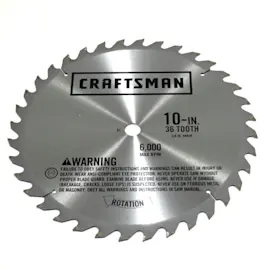
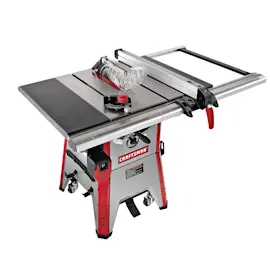
The Craftsman 137284630 is a 10-inch jobsite table saw, so it uses a 10-inch blade. For the exact blade type and installation details (arbor hardware order, washer orientation, and tightening direction), follow the steps and safety notes in the owner's manual.
What blade size to buy
Most 10-inch jobsite table saws like the Craftsman 137284630 are designed around a standard 10-inch diameter blade.
- Choose a 10-inch blade for this saw
- Match the blade to the cut: rip blade, crosscut blade, or combination blade
- Use a blade rated for at least the saw’s operating speed (check the blade label)
- Use a sharp, clean blade to reduce burning and motor strain
- Install the blade with the teeth facing the correct direction for the saw’s rotation
Quick compatibility checklist
Use this checklist before you order or install a new blade.
| Item to check | What to look for | Why it matters |
|---|---|---|
| Blade diameter | 10 in. | Fits the guard and height range correctly |
| Blade kerf | Thin-kerf or full-kerf | Affects feed pressure and cut quality |
| Tooth count | Lower for ripping, higher for crosscut | Controls speed vs. finish |
| Blade condition | No missing teeth, no wobble | Reduces kickback risk and vibration |
Why it matters
Using the correct 10-inch blade helps the Craftsman 137284630 maintain proper cutting depth, keeps the blade guard and riving knife alignment in range, and improves cut quality while reducing the chance of binding and kickback.
Related DIY help
- If you need step-by-step blade removal and installation, use how to replace a table saw blade.
Last updated: February 2026
What not to do with a table saw?
With the Craftsman 137284630 table saw, do not freehand cuts, do not rip warped or twisted boards, and do not remove or bypass the riving knife, anti-kickback pawls, or blade guard. These actions greatly increase kickback risk and serious injury; follow the owner's manual safety rules every time.
What to avoid (high-risk mistakes)
- Do not rip work that is twisted, warped, bowed, or lacks a straight edge against the rip fence.
- Do not attempt to reverse out of a cut with the blade running.
- Do not pull the workpiece backward during a cut.
- Do not use a miter gauge when ripping.
- Do not use more than one rip fence during a single cut.
- Do not leave the saw running unattended; wait for the blade to stop completely.
- Do not cut metal or masonry; this saw is designed for wood and wood-like products only.
What we recommend instead (safer habits)
- Keep the blade sharp and keep the rip fence parallel to the blade.
- Keep the riving knife, anti-kickback pawls, and guards installed, aligned, and working.
- Set blade height correctly for the cut (commonly about 1/8 inch above the workpiece for crosscuts).
- Mount the saw securely on a bench or stand before cutting.
- Clean sawdust frequently, including inside the cabinet and motor area.
Quick guide: ripping vs. crosscutting
| Operation | Use this guide device | Avoid this device | Key “don’t” |
|---|---|---|---|
| Ripping (with the grain) | Rip fence | Miter gauge | Don’t rip warped/twisted stock |
| Crosscutting (across the grain) | Miter gauge | Rip fence (remove it) | Don’t pull the workpiece backward |
Why it matters
Most table saw injuries happen during kickback or when hands drift into the blade path. The safety devices and correct setups (fence parallel, straight stock, no backward pull) are designed to keep the work controlled and reduce sudden throwback.
For more technique and setup tips, see how to use a table saw safely and how to make basic cuts with a table saw.
Last updated: February 2026
Are craftsman table saws any good?
Yes; Craftsman table saws are a solid value for many DIYers, and the Craftsman 137284630 10-inch jobsite table saw is built for common wood and wood-like cutting tasks when it’s assembled, adjusted, and used as described in the owner's manual.
What “good” means for a jobsite saw like model 137284630
A jobsite table saw is designed to be portable and practical, not a heavy cabinet saw. You’ll typically get good results when you focus on setup, blade choice, and alignment.
- Good for: ripping and crosscutting lumber, plywood, and sheet goods
- Not for: cutting metal or masonry (this saw is intended for wood and wood-like products)
- Best results come from: careful blade alignment, a straight fence, and a sharp 10-inch blade
- Safety and consistency improve when you: mount the saw to a bench or stand before cutting
How to judge cut quality (and improve it)
If you’re seeing burning, wandering cuts, or out-of-square results, the saw usually needs adjustment or a better blade, not more motor power.
| What you notice | Most common cause | What to do first |
|---|---|---|
| Cuts not square | Blade or fence out of alignment | Follow the alignment steps in the owner's manual |
| Rough edges/tear-out | Dull or wrong blade type | Install the right blade for the material |
| Angles inconsistent | Bevel mechanism or gauge setup | Re-check bevel stops and gauge settings |
For targeted troubleshooting, use our DIY guide: table saw bad cuts.
Why it matters
A “good” table saw is one that cuts accurately and safely. On a portable saw, accuracy depends heavily on assembly, mounting, and periodic adjustments; those steps also reduce kickback risk and improve repeatability.
Safety notes we consider non-negotiable
- Use a push stick for narrow rips (the manual includes a push stick pattern)
- Keep the work area ventilated and clear sawdust frequently
- Never leave the saw running unattended; wait for the blade to stop completely
- Use a blade compatible with the riving knife thickness guidance
Last updated: February 2026
Can you use an 8 inch blade on a 10 inch table saw?
Yes, you can use a smaller blade on the Craftsman 137284630 table saw as long as the blade is compatible with the saw’s arbor and you keep the safety setup (riving knife and guard) correctly matched to the blade’s kerf. For dado work, this saw is set up for a smaller dado diameter.
What matters most on this model
Our manual notes this saw is supplied with a 10-inch blade and specifies that the blade body thickness and kerf must be properly matched to the riving knife thickness. That means blade compatibility is not only about diameter; it is also about kerf and alignment. See the owner's manual for the riving knife and blade thickness guidance and alignment checks.
- Confirm the arbor size of the replacement blade matches the saw.
- Confirm the blade’s kerf works with the riving knife (riving knife must not be thicker than the cut, and not thinner than the blade body).
- Recheck blade to riving knife alignment after any blade change.
- Use the blade guard and anti-kickback for through-cuts; remove/lower components only when the cut type requires it.
- Expect reduced max cut depth with an 8-inch blade compared to a 10-inch blade.
Dado blades: what this saw allows
For dado cuts, the manual is specific about what to use.
| Cut type | What to use on this saw | Key limit to follow |
|---|---|---|
| Through cuts (rip/crosscut) | Standard saw blade (commonly 10-inch on this model) | Keep guard and riving knife set correctly |
| Non-through cuts (dados/rabbets) | Stackable dado set | Max dado width 1/2 inch; use a dado insert plate |
The manual also states only stackable dado blades should be used (no wobble/adjustable dado types), and it calls out installing a dado not exceeding 6 inches in diameter for dado cutting.
Why it matters
Using a blade that does not match the riving knife and guard setup increases the chance of binding and kickback. Keeping the kerf, riving knife position, and guarding correct helps the saw cut straighter and safer.
If you are changing blades as part of troubleshooting cut quality, we recommend reviewing how to replace a table saw blade and, for accuracy issues, table saw bad angle cuts.
Last updated: February 2026